Saudi-First System Design Part 4: Federation Capability Maturity Model (FCMM)© What Sweden’s Olympic Structure Reveals About Saudi Arabia’s Opportunity to Build the Middle Layer
Saudi‑First System Design
Part 4 - Federation Capability Maturity Model (FCMM)©
What Sweden’s Olympic Structure Reveals About Saudi Arabia’s Opportunity to Build the Middle Layer
Federation Capability Maturity Model
Federations within rapidly developing sport ecosystems do not evolve uniformly. Different sports progress at different speeds depending on participation growth, governance clarity, workforce depth, and system integration. The Federation Capability Maturity Model provides a shared language for understanding this progression. It supports system diagnosis, structural planning, and long‑term capability development under Vision 2030.
The model outlines five levels of maturity, defined by governance behaviour, operational capability, workforce development, data maturity, medical and rehabilitation structures, and consistency with national priorities.
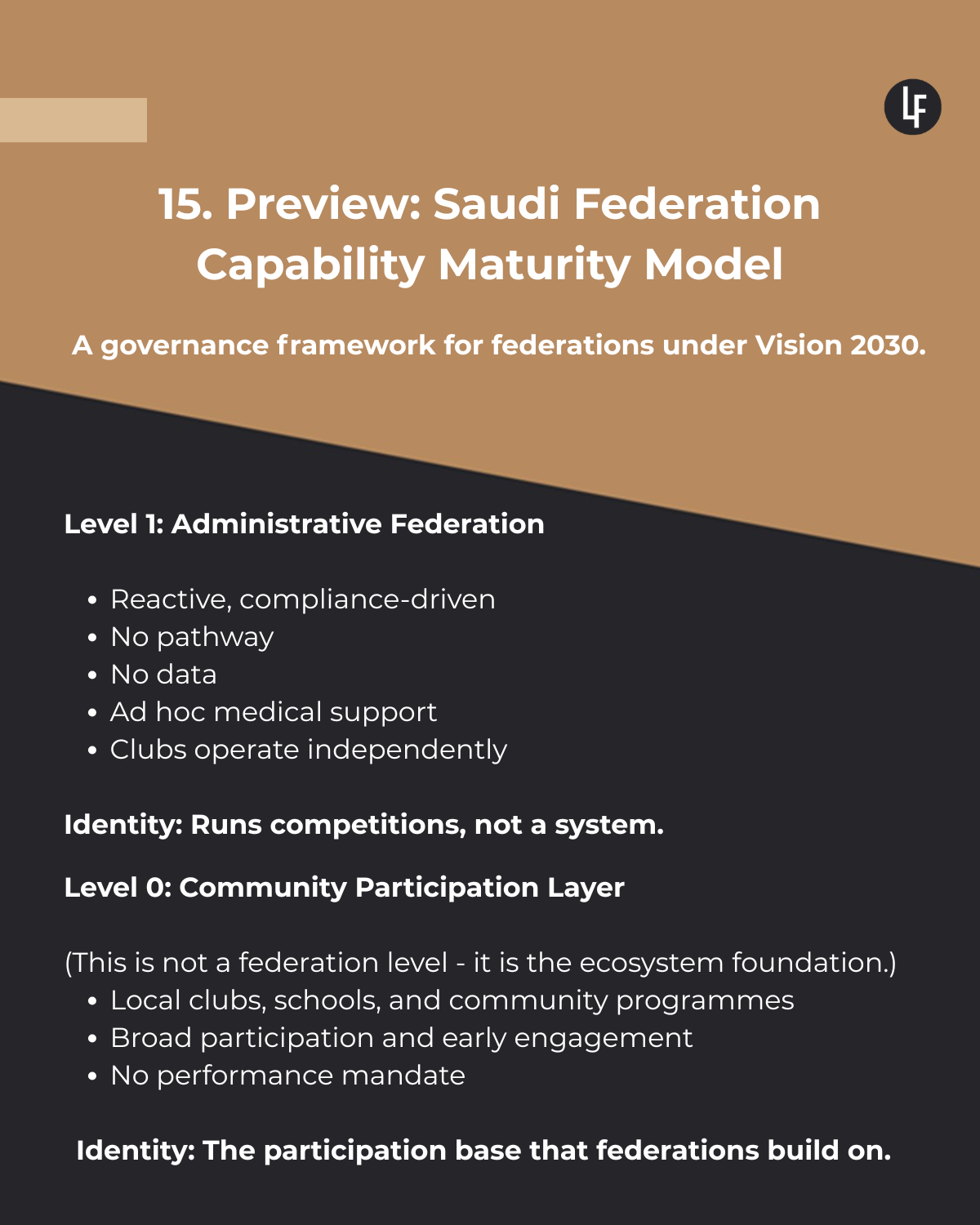
Level 1 – Administrative Federation
Federations at this level run competitions but do not yet operate a system. Governance is reactive and focused on basic compliance. Pathways are informal or absent. Workforce capability varies. Data is minimal and irregular. Medical and rehabilitation support is inconsistent and often dependent on private service providers. Clubs operate independently. The operational focus is event (Competition) delivery rather than athlete development.
Saudi Arabia’s capability landscape reflects a system developing in real time, with governance, regulation, integration, data pathways and institutional capability forming together.
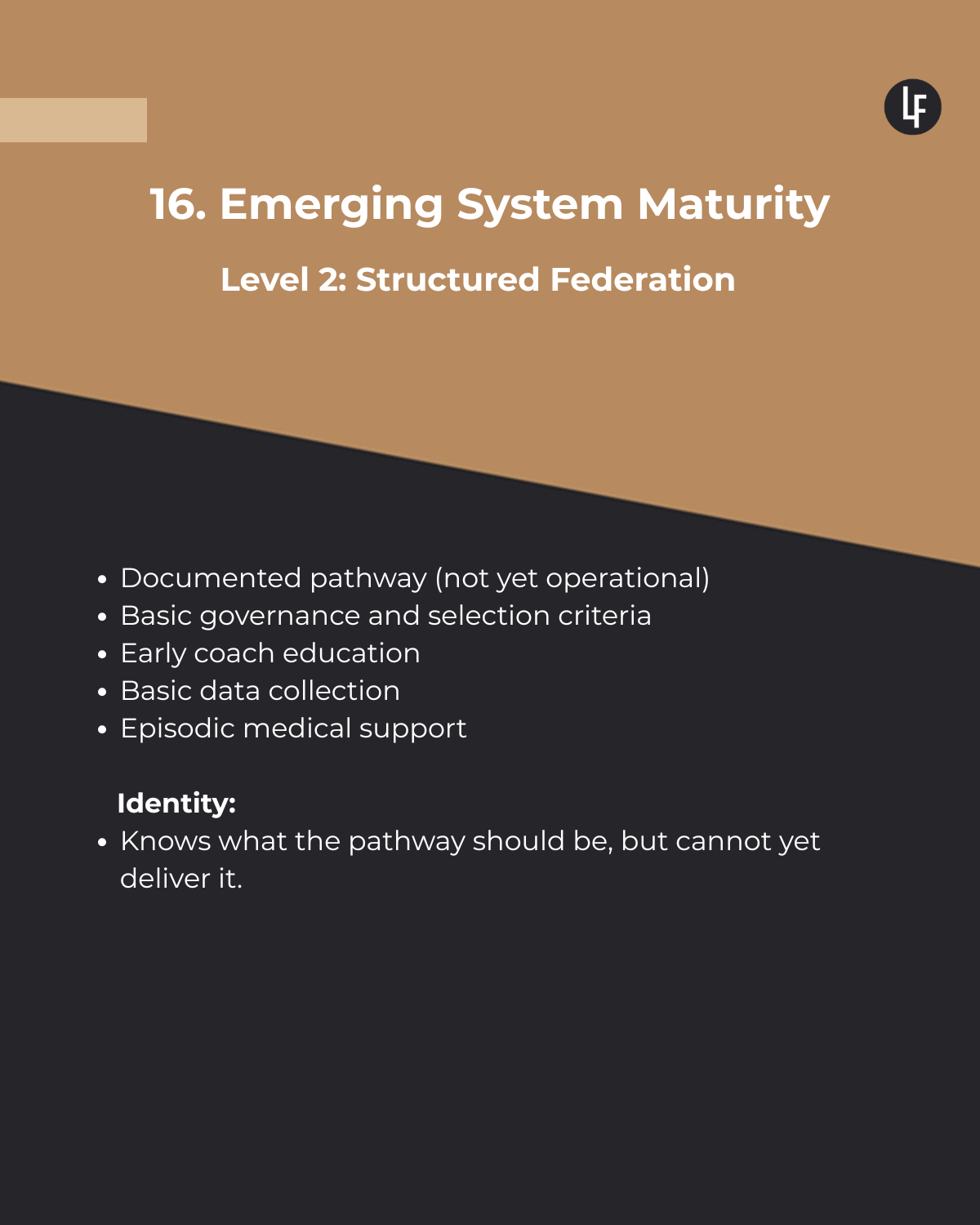
Level 2 – Structured Federation
Federations begin to formalise governance and define pathway intent. Pathways are documented but not yet operational. Workforce development begins through early coach education and basic technical roles. Data collection emerges but remains inconsistent. Medical support is episodic and relationship‑based. Rehabilitation is case‑by‑case. Governance structures exist but are not yet embedded. This level understands what the pathway should be but cannot yet deliver it.
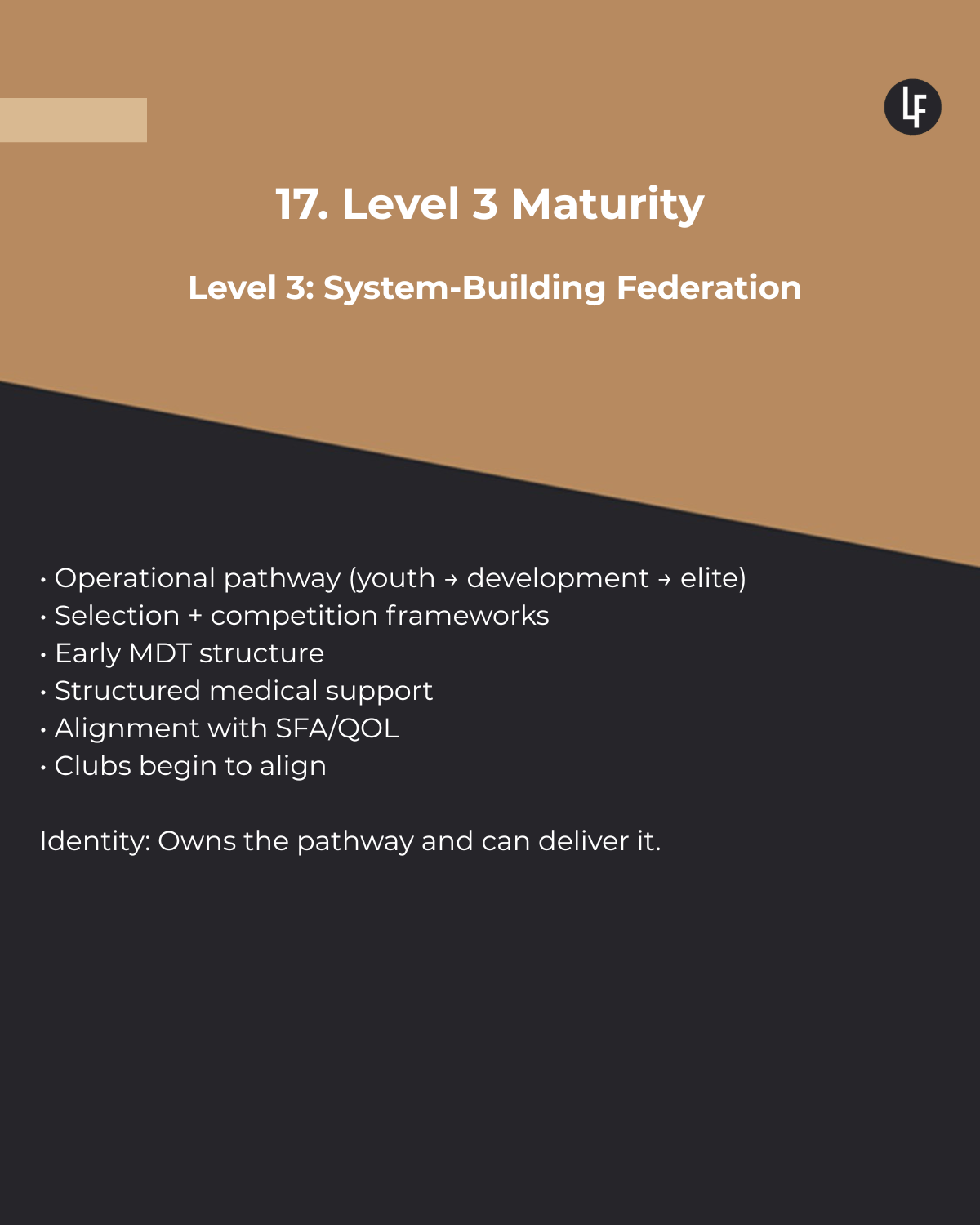
Level 3 – System‑Building Federation
Federations begin operating more like systems than standalone governing bodies. Pathways function across youth, development and early elite levels. Selection and competition frameworks become clearer. Multidisciplinary structures emerge, and medical and rehabilitation support becomes increasingly coordinated. Rehabilitation pathways begin to stabilise. Clubs start meeting federation standards. Data becomes operational, supporting selection, participation tracking and early performance planning. Regional coordination strengthens, and governance integration across environments becomes more consistent. Organisational identity shifts from competition administration toward long‑term pathway stewardship.
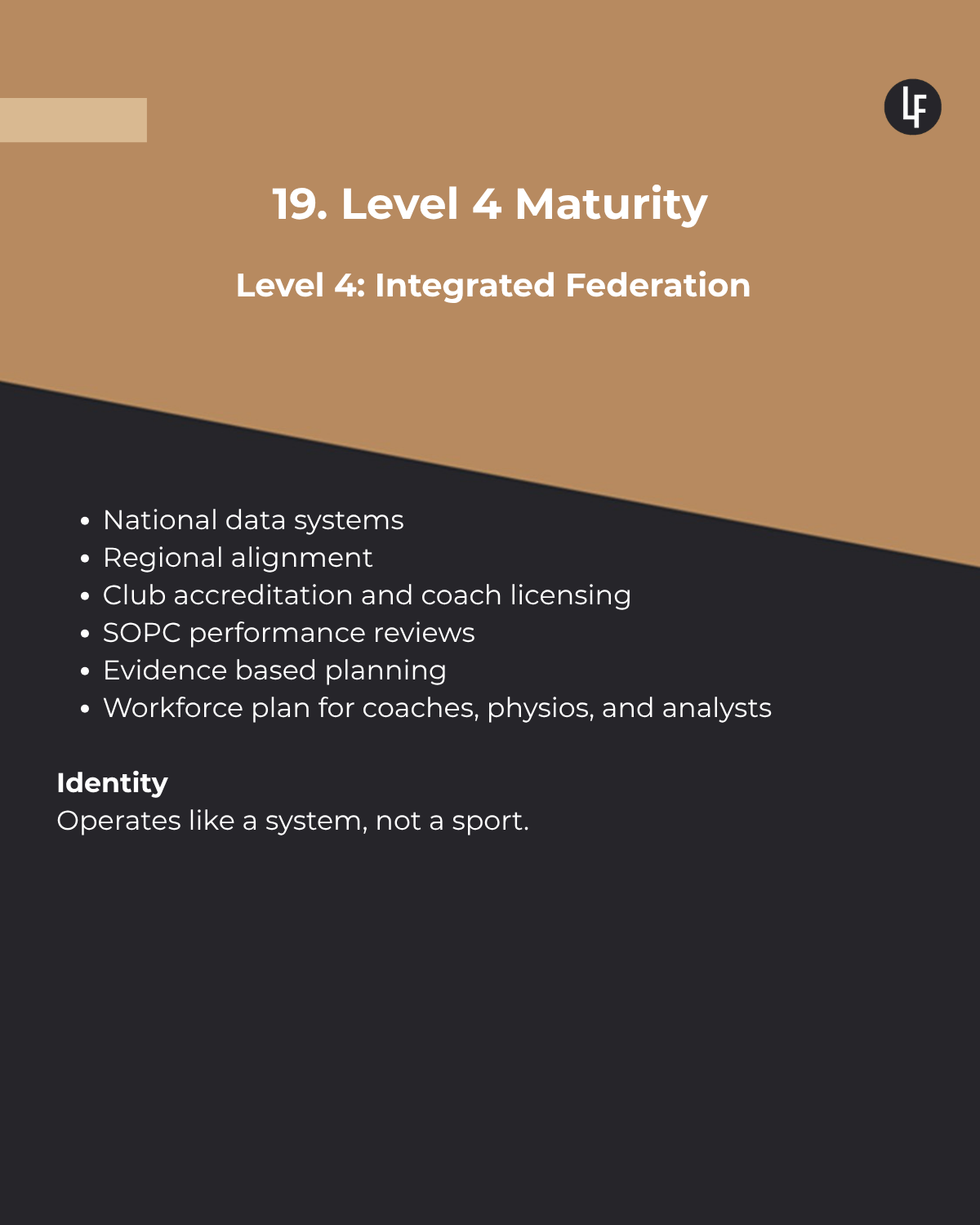
Level 4 – Integrated Federation
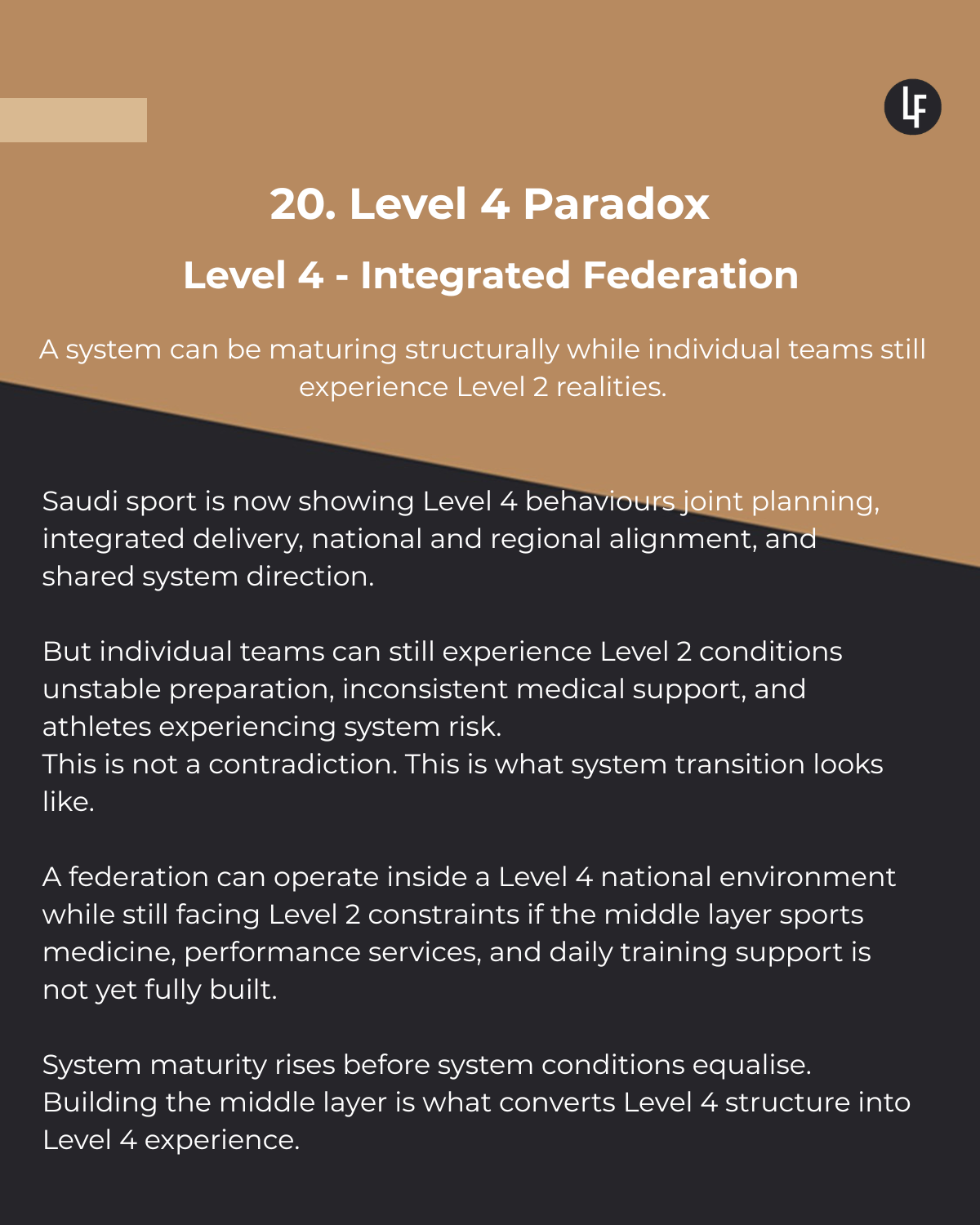
Federations operate with system‑level integration and capability. Longitudinal data systems support planning, injury reduction and talent tracking. Workforce capability expands across coaching, physiotherapy, analysis, psychology, pathway management and integrated performance support. Medical and rehabilitation services operate through coordinated regional and federation environments. Club accreditation and coach licensing frameworks are implemented. Performance reviews and evidence‑based planning become routine. Governance becomes increasingly stable and consistent. Federations operate as connected pathway environments rather than isolated functions.
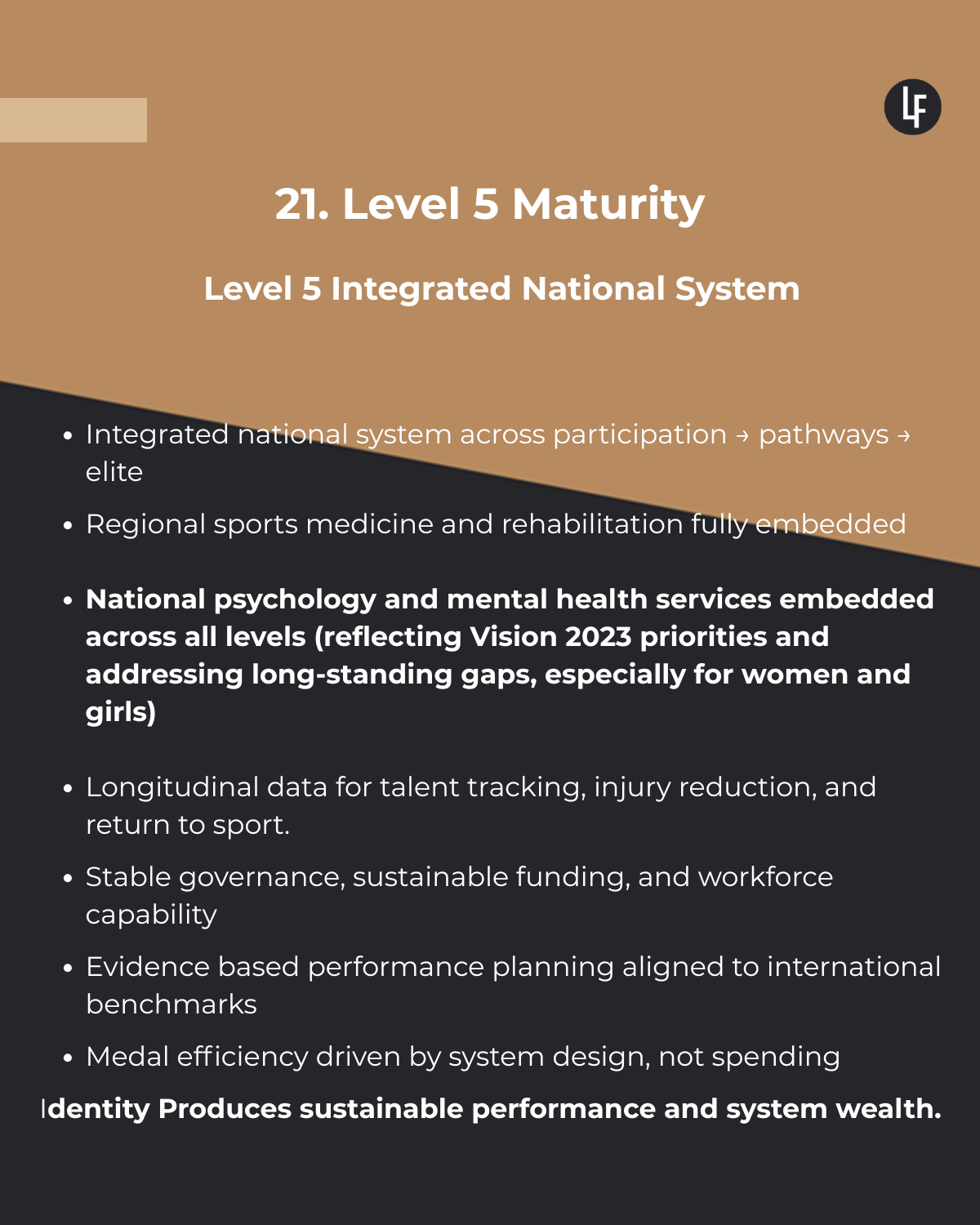
Level 5 – Integrated Pathway Ecosystem
Federations operate as integrated performance ecosystems rather than isolated sporting bodies. Coaching, sports medicine, rehabilitation, psychology, performance nutrition, analysis and pathway management function through coordinated, multidisciplinary operating structures centred on the athlete pathway.
Participation, rehabilitation, talent development and elite performance are connected through regionally distributed environments supported by strong governance frameworks, longitudinal data systems and coherent standards. Federations retain technical ownership while working within coordinated structures that support continuity, safety and long‑term capability development.
Workforce capability becomes sustainable and embedded within the system. Rehabilitation pathways operate seamlessly across training, healthcare and return to sport. Regional hubs develop strong local identity, operational trust and internationally credible delivery capability. Federations shift from direct operational oversight toward strategic coherence, innovation, capability exchange and long‑term system stewardship.
At this level, medal performance becomes a consequence of system maturity, not isolated investment.
Digitalisation, AI and Non‑Linear Capability Development
Federation capability development is not always linear. Digital systems, athlete management platforms, electronic medical records (EMR), athlete monitoring systems (AMS), electronic medical systems (EMS) and AI‑supported operational processes can appear at different stages of maturity when adapted to local conditions and workforce capability.
This is particularly relevant in Saudi Arabia, where federations may adopt advanced digital infrastructure while governance, pathway or operational systems are still developing.
Used effectively, digitalisation can accelerate coordination, improve communication, strengthen governance visibility, reduce administrative burden and support more precise decision‑making across athlete pathways. AI‑supported systems can help identify operational gaps, improve monitoring efficiency, reduce duplication and support both athlete and system needs.
However, technology alone does not create maturity. Digital systems depend on degrees of governance clarity, operational integration, workforce capability and consistent implementation. The strategic value of digitalisation lies not in adoption alone, but in its ability to support scalable coordination, integrated delivery and long‑term people and system learning across the ecosystem.