Part 3: The Middle Layer What Sweden’s Olympic Structure Reveals About Saudi Arabia’s Opportunity to Build the Middle Layer
Part 3 - The Middle Layer
What Sweden’s Olympic Structure Reveals
About Saudi Arabia’s Opportunity to Build the Middle Layer

5. The Middle Layer
Infrastructure, Capability Structure & System‑Level Value Creation
Every sport system has a participation base and an elite tier. What distinguishes mature systems from emerging ones is not the top or the bottom, but the middle layer, the infrastructure that connects daily training environments, medical and performance systems, local capability, and long term athlete development. In Sweden, this layer is decentralised. In the UK, it is centralised through institutes. In Saudi Arabia, it is only now beginning to take shape. Because it is being built now, the Kingdom has a unique opportunity: to connect health, participation, rehabilitation, regional infrastructure, and pathway governance into one coordinated system.
This middle layer is the infrastructure that stabilises the entire ecosystem. Without it, decentralised systems become uneven and overloaded, while athletes carry the cost, risk, and instability of system gaps. With it, federations can own pathways confidently, clubs can deliver consistently, and national bodies can coordinate without centralising.
5.1 Sports Medicine & Performance Infrastructure
The first component of the middle layer is a sports medicine and performance infrastructure. It is the system that ensures athletes experience continuity, and that federations can deliver pathways without relying on ad hoc service provider networks or private‑sector workarounds.
A distinction must also be made between athlete services and system infrastructure. Athlete services can exist without the presence of an integrated system. Infrastructure operates differently. It creates governance continuity through shared standards, clinical pathways, communication structures, regional coordination, and return-to-sport oversight. Without this layer, support remains episodic and dependent on individual practitioners or local environments rather than embedded within a scalable framework.
Sweden’s model illustrates the distinction between access and coordination. Athletes may move across SOK medical support, regional academies, private specialists, hospitals, and cross-border providers throughout the athlete journey. Multiple access points can increase flexibility and broaden expertise, particularly within decentralised environments.
However, where governance standards, rehabilitation ownership, communication pathways, and return-to-sport coordination vary between environments, continuity can become inconsistent across the system. In practice, athletes and families may still carry responsibility for coordinating information, navigating providers, and maintaining pathway continuity between environments. The question is therefore not how to eliminate multiple access points, but how to connect them through shared standards, integrated communication, and clearly defined accountability structures.
Saudi Arabia is now taking a different path. The recent job posting for a senior sports medicine role is one of the first visible signals of the middle layer emerging. The role is positioned to work across performance environments rather than within a single sport structure, supporting coordination, clinical governance, rehabilitation continuity and cross‑system integration.
Importantly, this does not imply the creation of a fully centralised institute model. Federations may struggle to develop capability consistently and simultaneously during periods of rapid national expansion.
Federations retain ownership of technical pathways and sporting direction. The purpose of the middle layer is different: to provide coordination, continuity, governance stability, rehabilitation, medical infrastructure, and regional capability that individual federations cannot consistently build alone during periods of rapid expansion.
A system of this kind requires three foundational elements:
- A single clinical governance framework that defines safety, standards and decision rights across clubs, federations and performance environments.
- Regionally delivered medical and performance hubs that provide diagnostics, rehabilitation, and return-to-sport coordination close to where athletes live.
- Integrated data and communication pathways that ensure continuity of care and reduce duplication, risk, and uncertainty.
Rehabilitation ecosystems sit at the heart of this infrastructure. Globally, rehabilitation is the most fragmented part of sport systems. Athletes move between club physios, private clinics, hospitals, specialists, and national team staff. Each carries a role in the pathway; but not the whole system. This creates inconsistent load progression, unclear return-to-sport criteria, psychological uncertainty, reinjury risk, and athlete drop-off.
A middle layer solves this by building rehabilitation ecosystems rather than isolated services. These create continuity from injury to rehabilitation to training to competition, supported by regionally appropriate hubs, appropriate clinical pathways, shared visibility of cases and clear return‑to‑sport decision structures.
Return to sport is not only a medical decision; it is also a governance decision. It requires medical clearance, performance readiness, psychological readiness, load progression, risk assessment, and communication across club, federation, and national team, with the athlete at the centre and family. In decentralised systems, this coordination is inconsistent.
In Saudi Arabia, alignment can be created without uniformity. One of the Kingdom’s structural advantages is the ability to build a clear, safe and connected return‑to‑sport pathway that reduces risk and burden for athletes, families and organisations while still allowing regional variation.
Regional capability is the final pillar of this infrastructure.
It cannot be Riyadh-centric. Regional capability determines participation continuity, injury outcomes, family trust, female access, and long-term athlete retention. When capability is concentrated in one city, the system becomes exclusionary by design. When capability is distributed, the system becomes accessible, scalable, and resilient.
Saudi Arabia’s middle layer must be regionally delivered and locally trusted over time. Its strength comes from creating safe, consistent and connected return‑to‑sport pathways that support athletes, families and organisations while allowing regional variation.
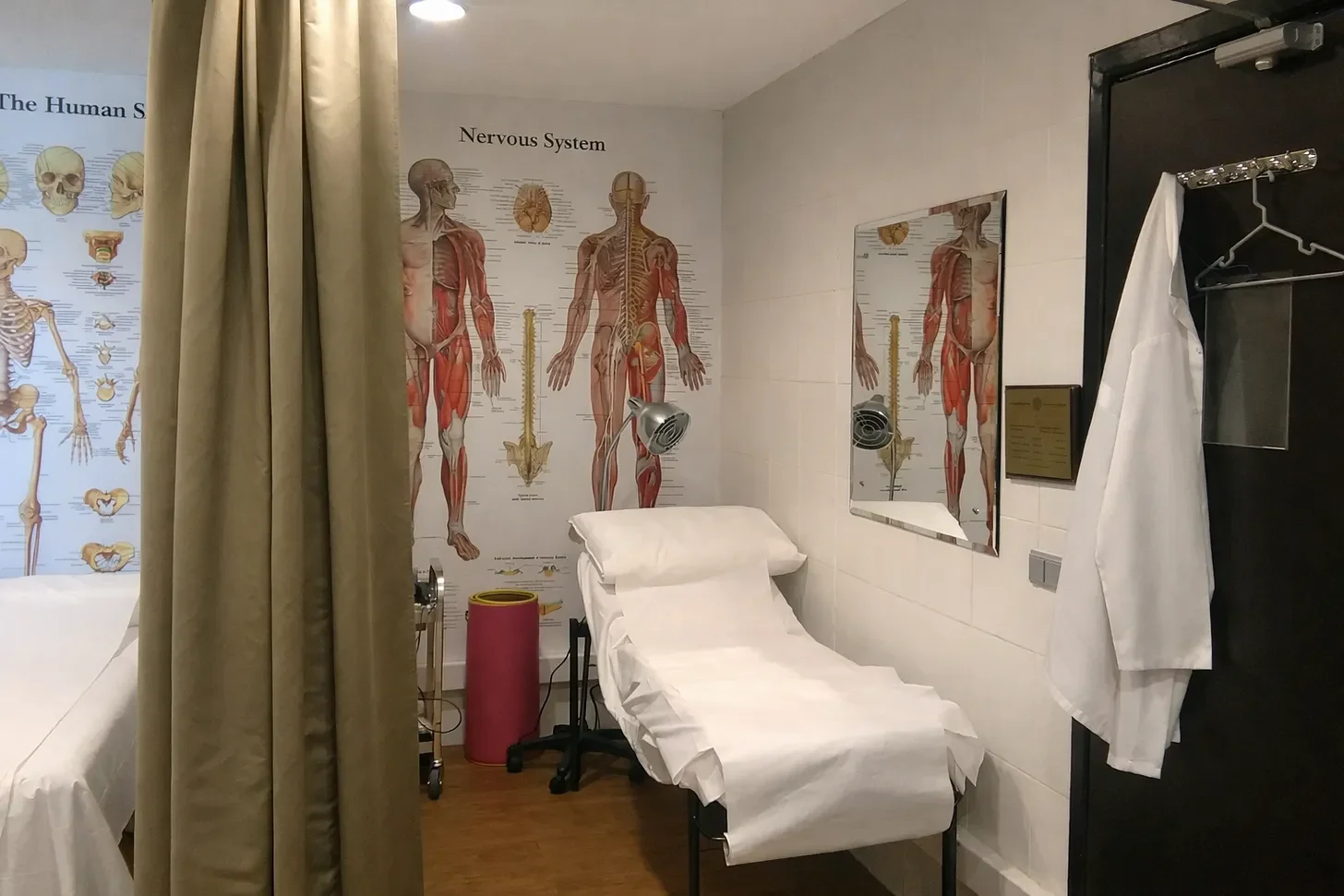
Early performance medicine infrastructure within a private athlete environment in Al‑Khobar (2016), during a period of significant transition in Saudi sport participation systems.
5.2 Capability Structure
The second component of the middle layer is the capability structure, the system that develops, builds capability, connects the people, practices and environments that support sport across the Kingdom.
This model shapes whether the system grows in a way that is inclusive, scalable and resilient, or becomes dependent on a small number of high‑capacity environments.
Saudi Arabia’s current capability landscape is developing at different speeds across regions. Riyadh has density: specialists, diagnostics, variable private sector capability, federation proximity, and emerging performance hubs. But Saudi Arabia has the opportunity to design a different trajectory by building a middle layer that distributes capability rather than centralising it.
Building capability requires three structural commitments
the foundations that allow systems, people and environments to develop in a sustainable way.
- Local access to essential services, ensuring that participation does not break when injury occurs and that families trust the environment enough to keep children, especially girls, engaged and keep attending.
- Federated support delivered through shared national infrastructure, allowing federations to maintain technical autonomy and build their own medical, rehabilitation, and performance systems, combined with regional hubs.
- Scalable delivery models, where regional hubs, unified standards, and digital integration allow the system to grow.
Local access is the foundation of participation continuity. When athletes must travel long distances for medical assessments, rehabilitation, or specialist care, participation becomes vulnerable. When access is local, accessible, and culturally aligned, participation becomes resilient. This is especially true for women and girls, where family trust, psychological safety, and local accessibility determine whether participation deepens or disappears.
Women’s and girls’ participation environments are therefore not a separate component; they are a structural part of federation and sports organisation capability. Female participation requires environments that are accessible, modesty‑aligned, psychologically safe, and locally trusted. When these conditions exist, participation deepens, retention increases, and long‑term medal potential expands. When these conditions are absent, participation pathways narrow before long‑term talent development can fully emerge.
Saudi Arabia’s capability must therefore continue to integrate women’s sport from the beginning, as a core design principle. This is one of the Kingdom’s most significant structural opportunities: to build participation systems where female engagement, retention, and long‑term pathway continuity are embedded from the start.
Concentrated expertise, skills, knowledge, experience and competency can accelerate short‑term performance. But it can also create long‑term dependency risk.
Sustainable capability requires workforce depth, regional and local learning environments, and distributed operational knowledge so that system continuity does not depend on a limited number of sports organisations, federations, practitioners, or regions.
Long‑term stability therefore depends not only on importing expertise, but on creating clear progression pathways for Saudi nationals to develop across clinical, technical, operational, and leadership environments throughout systems.
5.3 System‑Level Value Creation
The third component is system‑level value creation:
These are the outcomes that emerge when infrastructure, participation, healthcare, rehabilitation and capability operate as one coordinated environment. This is where the middle layer extends beyond sport and contributes to development, public health, workforce sustainability and long‑term societal value.
The first area of value creation is the reduction of athlete cost burden.
Sweden’s data is clear: athletes pay for private rehabilitation, travel, specialist care, and fragmented access. Costs accumulate because the system lacks integrated pathways. Families and athletes carry the burden because the state does not.
Saudi Arabia has the opportunity to significantly reduce this burden through coordinated sports medicine infrastructure, local rehabilitation hubs and integrated return‑to‑sport pathways. This reduces private‑sector dependency and travel costs. It also increases equity, allowing athletes from all backgrounds to remain in the system.
The second area of value is population health integration.
Sport systems are not separate from public health; they are part of the same structure. Saudi Arabia faces high obesity rates, high inactivity, rising NCD burden, and a young population. Sport participation is a preventative health intervention.
The middle layer enables early detection, early intervention, healthier, robust pathway entry, reduced injury burden, reduced dropout, and long‑term public health savings. This is measurable: reduced NCD burden, reduced musculoskeletal injuries, reduced healthcare utilisation, increased workforce productivity, increased female participation, and stronger community cohesion.
The third area is rehabilitation continuity.
Globally, post‑injury impact is one of the biggest drivers of dropout. Athletes lose continuity, confidence, identity and psychological safety. A rehabilitation ecosystem provides organised pathways, psychological support, return‑to‑participation frameworks, local delivery, MDT coordination and family‑aligned communication.
This is one of the most under‑discussed areas in global sport governance. Saudi Arabia can lead the field by designing it deliberately.
When these elements come together — reduced burden, healthier populations, participation continuity, women’s inclusion, family trust, workforce development and long‑term medal efficiency — the middle layer becomes more than a sport system. It becomes capability infrastructure.
This is particularly relevant for Saudi Arabia, where a young population, rapidly expanding participation base, increasing female engagement, and significant investment in public infrastructure are converging simultaneously. The strategic opportunity is therefore not just to increase participation numbers, but to create an integrated ecosystem where health, participation, rehabilitation, and performance reinforce one another rather than operate as separate sectors.
The middle layer is the infrastructure that stabilises the Saudi sport ecosystem. It enables federation autonomy, regional and local capability, athlete protection, participation continuity, public‑health value, and long‑term medal efficiency.
Many sporting nations built this layer gradually over time. Saudi Arabia now has the opportunity to build it deliberately from the beginning.
This is where the Kingdom’s opportunity becomes significant: creating integrated capability systems designed for modern sport, public health, participation growth, and long‑term societal development.