Edition 5: Saudi Sport: The Delivery Layer Building Performance on the Ground

The return of the Virgin Astraea signals a strong and stable monarchy against corruption and injustice to bring a new Golden Age. The Painted Hall, Old Royal Naval College, Greenwich, by Sir James Thornhill (painted 1707–1726)
Originally published as Edition 5 of the Saudi–MENA Sport Environments LinkedIn Newsletter.
Edition 5: Saudi Sport: The Delivery Layer Building Performance on the Ground
Saudi Arabia dominates global digital transformation, and the sports sector now faces its next decisive delivery layer.
Across the Kingdom, public-sector platforms demonstrate what mature digital governance looks like in practice. The Ministry of Human Resources and Social Development (MHRSD) is a primary example of this, structured workflows, operational transparency, user-centred design, and data democratisation built into the system core.
The opportunity is not just to digitise delivery. It is to build an integrated, secure, and behaviourally intelligent operating spine that unifies federations, clubs, athletes, and high-performance support teams.
In Edition 5 of Saudi-MENA Sport Environments, I explore what Saudi sport can learn from MHRSD’s platform, and how those infrastructure lessons translate into sport delivery systems fit for purpose at scale.
Key Themes Explored:
The Federation Capability Model FCMM©
Is a five‑level model that diagnoses federation capability and accelerates non‑linear development. This model can be applied to any sports organisation.
PDPL-Aligned Data Systems
Implementing data minimisation, role-based access controls (RBAC), and culturally intelligent consent to protect athlete records.
The Leadership Paradox
Combining psychologically safe, high-trust environments with independent oversight, proving that trust without governance can enable systemic manipulation.
The Sociology of Resistance
An objective case study in how poor governance and cultures of concealment undermine accountability, athlete safeguarding, and organisational integrity.
Streetwise Governance™
This is a concept that has emerged from my evolving experience and observations. Governance competency that integrates behavioural intelligence, situational awareness, rigorous compliance and system design.
Forensic Behavioural Governance™
This framework brings forensic criminal behavioural profiling into professional sport. It applies analytical methods used by leading criminal behaviour experts to understand risk, manipulation, coercive control, dark personality characteristics, and the likelihood of abuse or misconduct in sport environments.
Anti-doping Governance and Compliance
Including the operational risks created when records are fragmented, accountability is unclear, and responsibility across the athlete pathway is not consistently integrated into the delivery system.
Institutional Risk Under Catastrophic Pressure
A global case of public interest showing how ignored behavioural warning signs can escalate into severe institutional failure.
If we want sport environments that are safer, stronger, healthy and more professional, we must design for the realities of governance, behaviour, and operational delivery.
Edition 5: Saudi Sport: The Delivery Layer Building Performance on the Ground
Part I
Saudi Sport: The Delivery Layer
Saudi Arabia has built national systems that operate through structured workflows, national coordination, and digital identity integration, supported by compliance pathways, documented requirements, verification steps, service repeatability, and backend governance systems. Governance is embedded in everyday life through a unified national digital infrastructure, clearly documented pathways, defined responsibilities, accountability, and oversight.
The Ministry of Human Resources and Social Development (MHRSD) is one of the clearest examples of this maturity. Its digital services platform stands out for the clarity of its design and intent by regional and national standards. The MHRSD digital services portal is structured and user friendly. The Ministry of Health’s platforms, together with Absher and Sehaty, are among the Kingdom’s most mature integrated digital ecosystems. MHRSD ranked second overall among all government agencies in the national Digital Transformation Index, issued by the Digital Government Authority (DGA).
Saudi sport has not reached this stage yet.
Statutory Landscape and System Acceleration
Crucially, the statutory landscape has now shifted to accelerate this transition. Under Saudi Arabia’s Sports Law (Royal Decree No. M/121), enacted on 1 December 2025 and effective from 11 June 2026, affected sports entities and individuals must regularise their status and complete registration in the National Sports Registry within the applicable transition period, understood to run until 11 June 2027. In practice, if a club or federation is not correctly recorded in the registry, it may not be allowed to operate, access funding, or participate in official competitions. Backed by the Ministry's inspection frameworks and the Violations Adjudication Committee, governance or safeguarding failures are severe regulatory risks that carry financial penalties up to SAR 5 million, alongside immediate licence suspension or cancellation.
Digital Core and the Federation Capability Maturity Model (FCMM)©
A foundational intervention addressing this infrastructure gap is SOPC’s deployment of a unified SAP cloud ecosystem, including S/4HANA, SuccessFactors, Ariba, and Analytics Cloud. Mapped against the Federation Capability Maturity Model (FCMM)© this platform represents a sophisticated digital core designed to compress non-linear development and shift federations up the maturity matrix. However, despite its maturity, the system currently functions as a corporate and financial platform rather than a fully realised sporting delivery layer. While it successfully builds the governance clarity, financial transparency, and administrative core of a Level 3 and Level 4 ecosystem, it does not yet capture the highly specialised requirements of Level 5.
Integrating Athlete Management Systems and Medical Governance
Bridging this gap requires the central core to integrate with localised Athlete Management Systems (AMS) and Electronic Medical Records (EMR). This integration must strictly adhere to Saudi national data protection requirements, including the Personal Data Protection Law (PDPL) and health information regulations, while incorporating Data Minimisation and Role-Based Access Controls (RBAC) to protect sensitive data and secure consent for elite athletes and youth academy minors. This integration is needed to unify athlete services, medical governance, pathway progression, and real-time physical readiness workflows on the ground.
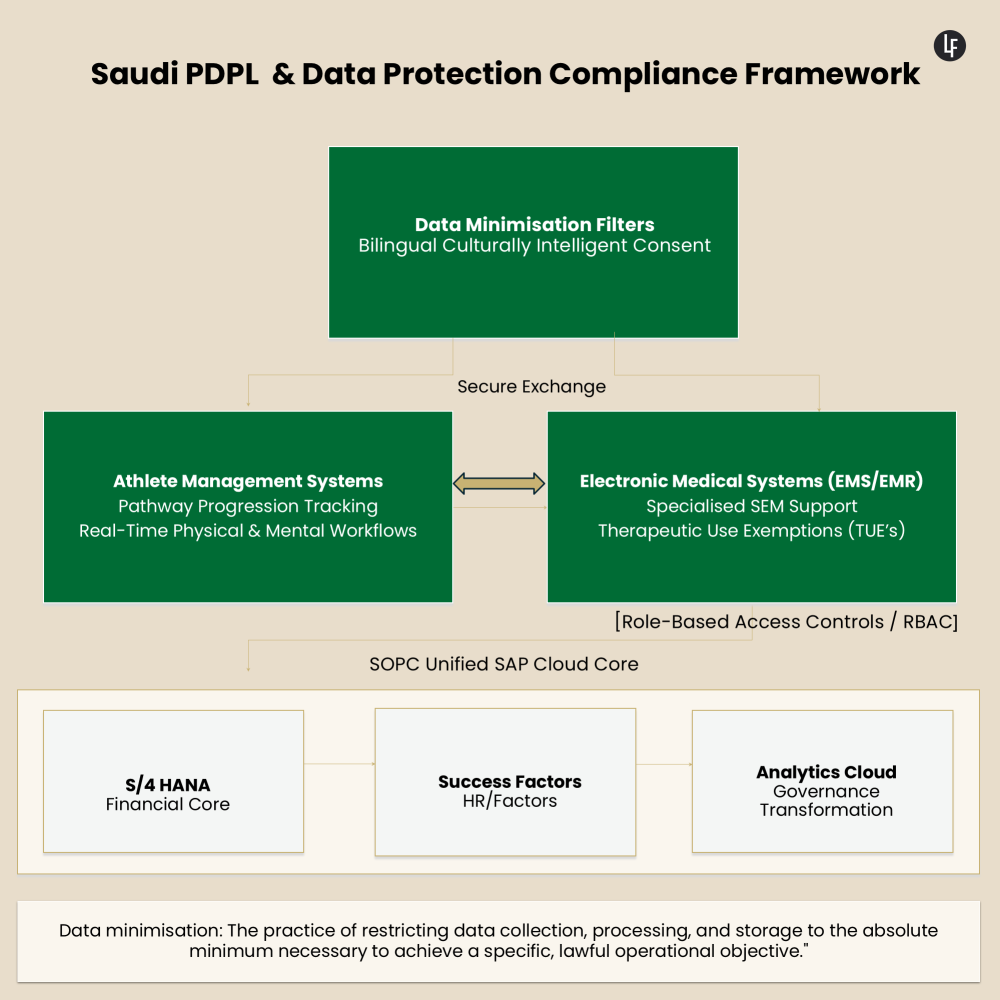
Figure 1: Sport Delivery "Spine" system integration and data protection controls.
Federation Capability Maturity Model (FCMM)©
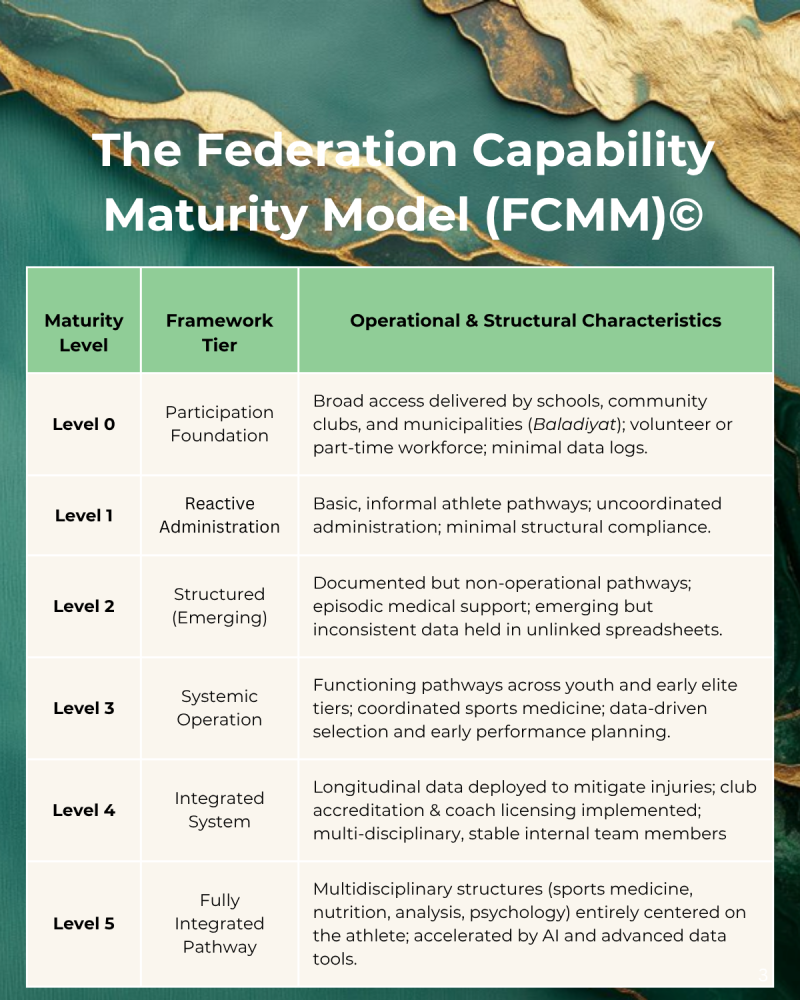
Federations within rapidly developing sport ecosystems do not evolve uniformly.
Different sports progress at different speeds depending on participation growth, governance, workforce depth, and system integration.
The Federation Capability Maturity Model (FCMM)©
Provides a shared language for understanding that progression. It supports system diagnosis, structural planning, and long‑term capability development under Vision 2030 and international sport standards.
The model outlines five levels of maturity defined by governance behaviour, operational capability, workforce development, data maturity, and medical and rehabilitation structures, aligned with national priorities and international benchmarking.
Level 0
Is the participation foundation: schools, clubs, municipalities (Baladiyat), and community programmes deliver broad access and early engagement without performance mandates or formal pathways. Infrastructure is local, the workforce is largely volunteer or part time, data is minimal, and medical support is community based or private.
Levels 1 and 2
Describe federations moving from reactive administration and basic informal pathways (Level 1) to documented but not yet operational pathways, early coach education, episodic medical support, and emerging but inconsistent data collection (Level 2).
Levels 3 to 5
Describe increasingly integrated systems. At Level 3, federations operate more like systems: pathways function across youth, development, and early elite levels. Medical and rehabilitation support becomes coordinated; data supports selection, participation tracking and early performance planning; and governance shifts from competition administration toward pathway stewardship.
Level 4
Features system‑level integration: longitudinal data informs planning and injury reduction; workforce capability expands across coaching, medical, analysis, psychology, and pathway management; club accreditation and coach licensing are implemented; and performance reviews become routine.
Level 5
Is an integrated pathway ecosystem in which coaching, sports medicine, rehabilitation, psychology, performance nutrition, analysis, and pathway management operate through coordinated, multidisciplinary structures centred on the athlete. Digitalisation and AI can accelerate progress at any stage, but only when underpinned by governance clarity, operational integration, workforce capability, and consistent implementation.
2. Data Governance, Athlete Privacy, and PDPL Architecture
Building on the regulatory foundations established in my previous analysis of MENA sports infrastructure, and specifically on compliance with the Saudi Personal Data Protection Law (PDPL).
The integration of an SAP digital core with localised Athlete Management Systems (AMS) and Electronic Medical Records (EMR) must go beyond simple data collection to robust data governance. To satisfy national statutory mandates, a mature delivery spine requires Level 4 and Level 5 data stewardship capabilities that operationalise privacy as a system feature:
• Data Minimisation and Purpose Limitation
Ensure that only the personal data necessary for a specific purpose is collected, used, and retained. For example, highly sensitive clinical data, haematological profiles, and Therapeutic Use Exemption (TUE) information should be handled only when necessary and processed strictly for explicit, specified, and legitimate medical, performance, regulatory, or anti-doping purposes.
• Role-Based Access Controls (RBAC) and Audit Trails
Implementing strict digital boundaries so that an athlete’s private medical history or psychological assessments are restricted behind audited, role-specific access tiers.
• Culturally Aware Consent
Developing unified, bilingual digital consent workflows aligned with the Saudi Personal Data Protection Law (PDPL) that clearly define data governance responsibilities across federations, clubs, athletes, and healthcare providers, while protecting minors within youth academy systems and supporting elite athletes operating in performance and commercially sensitive environments.
The Ministry of Sport, specifically the Leaders Development Institute (LDI), is a specialised sport delivery arm operating as the equivalent of the MHRSD. The LDI is responsible for developing the national sport workforce, setting competency frameworks for accreditation and licensing, improving governance capability, and auditing institutional performance.
The Ministry of Sport is the policy, governance and regulatory engine which anchors the entire sport ecosystem. It sets national sport strategy, governance frameworks, federation oversight, manages club licensing, and enforces compliance systems. In addition, it governs broader national sport workforce direction and multi-sport coordination via the Saudi Olympic and Paralympic Committee (SOPC). The LDI is the sport sector’s capability building institution responsible for leadership development, competency frameworks, accreditation, and institutional performance.
The Ministry of Sport, specifically the Leaders Development Institute (LDI), is a specialised sport delivery arm operating as the equivalent of the MHRSD. The LDI is responsible for developing the national sport workforce, setting competency frameworks for accreditation and licensing, improving governance capability, and auditing institutional performance.
The Ministry of Sport is the policy, governance and regulatory engine which anchors the entire sport ecosystem. It sets national sport strategy, governance frameworks, federation oversight, manages club licensing, and enforces compliance systems. In addition, it governs broader national sport workforce direction and multi-sport coordination via the Saudi Olympic and Paralympic Committee (SOPC). The LDI is the sport sector’s capability building institution responsible for leadership development, competency frameworks, accreditation, and institutional performance.
3. Mapping LDI Frameworks to the FCMM© Matrix
The Leaders Development Institute (LDI) plays a critical role in driving federations out of the Level 2 (Structured) tier and embedding them into the Level 4 (Integrated) tier. Without the LDI's standardised compliance and education pathways, technology platforms like SAP remain without power; the human workforce lacks the baseline skills to operationalise them.
Below is the strategic mapping of how LDI's licensing and competency frameworks drive this non-linear transition across Federation Capability Maturity (FCMM©) model’s core domains.
1. Workforce Capability & Professionalisation
At Level 2, workforce development is highly episodic.
Coaching education is informal, and technical roles are often relationship-based or transactional. Federations understand they need specialists (such as physiotherapists, sports medicine doctors (SEM’s), analysts, coaches and psychologists) but lack a national standard to evaluate their credentials or quality.
The LDI Intervention:
LDI enforces standardised, multi-tiered licensing systems for coaches, technical directors, and sports administrators. By partnering with elite international academic institutions, LDI codifies exactly what constitutes an accredited practitioner in Saudi Arabia.
The Level 4 Outcome
Workforce capability becomes stable, measurable, and highly specialised. Federations stop relying on outsourcing and instead deploy licensed, multi-disciplinary units (coaches, psychologists, and analysts) who speak a shared operational language.
Examples can include information gaps, duplicated communication, unclear responsibility, delayed prioritisation, uncertainty around approvals, and inconsistent medical flow.
This directly supports the need for:
- digital continuity
- rehabilitation coordination
- longitudinal systems
- integrated communication pathways
2. Operational Capability & Standardisation
• At Level 2
Pathways are documented on paper but remain entirely non-operational. Club structures operate as siloed, independent units with minimal accountability to the central federation, leading to highly variable training delivery.
• The LDI Intervention:
LDI implements formal club accreditation and governance capability frameworks. These systems mandate that to receive licenses and government funding, clubs must connect their internal coaching standards and administrative processes with national benchmarks.
• The Level 4 Outcome:
Club accreditation and coach licensing frameworks transition from compliance goals to routine daily operations. Performance reviews become evidence-based, ensuring that every regional club environment acts as an effective, interconnected extension of the central federation's pathway.
3. Data Maturity & Institutional Performance
• The Level 2:
Data collection is intermittent, irregular, and rarely used to guide strategy. Because the workforce lacks training in modern sports data workflows and data literacy, valuable athlete records remain spread across unlinked spreadsheets or paper records.
• The LDI Intervention:
LDI embeds institutional performance metrics, digital competency, and modern sports science analytics directly into its core leadership and administrative curricula. It trains sports executives and technical directors on how to govern via data-driven workflows.
Saudi Arabia’s digital transformation gives the Kingdom an advantage many sporting nations did not possess during their early phases of system development. National platforms such as Sehaty, Tawakkalna, Absher, Nafath, Mawid, and the national health portals already coordinate identity, health records, appointments, and communication between institutions and citizens. These systems demonstrate that digital coordination can operate reliably at national scale and across diverse regions.
• Equipped with LDI-certified analysts and data-literate managers, federations possess the institutional capability to utilise platforms like SAP Analytics Cloud to actively manage injury reduction, monitor talent pipelines, and plan long-term athlete development pathways.
Sehaty style communication for participation, health, injury prevention / reduction, and return to sport. Digital continuity so information follows the athlete across school, club, federation, and regional centre. Longitudinal data to support early intervention, pathway planning, and public health insight. Regional communication that links families to local opportunities and reduces travel burden. Pathway tracking that gives federations visibility of participation depth, regional variation, trends, and long-term athlete development.
My previous work in Jordan and wider MENA systems shows a different operational pattern. Data is often manually coordinated, institution specific, and held within vertical approval pathways.
Clinical information does not consistently move with the athlete, rehabilitation continuity varies between environments, and associations can struggle to maintain visibility across participation and pathway progression.
These are common structural characteristics of emerging systems operating across multiple governance and delivery environments.
The Saudi sport ecosystem has already strong elements of digital identity, digital communication, partial digital governance and compliance, and event-specific delivery. Team Saudi already has elements of digital governance, delivery discipline, dashboards, KPI governance, issue referral systems, risk logs, initiative tracking, executive reporting, scenario planning, and cross-functional coordination.
4. Why MHRSD’s Digital Structure Matters for Saudi Sport
The MHRSD has already built the kind of national-scale digital delivery structures that Saudi Sport needs. Its platform shows what mature public sector delivery looks like in practice. Every service is defined in plain language, navigation is intuitive, and requirements are transparent.
The Ministry has automated over 1,000 services, serving more than thirty-two million beneficiaries. This achievement is driven by a digital transformation strategy that prioritises beneficiary experience, proactive communication, and transparent workflows that drive the population and ministry forward. The platform presents information in a way that is easy to understand and accessible. This reflects a system built with the end-user in mind, Saudi citizens, visitors, organisations, and businesses alike, delivering services to a clear and consistently high standard. Transparency across the platform is visible in each service: users can see what it does, what is required, and how long it takes.
Each service has standardised workflows; the platform is built around beneficiary needs, not ministry structure. Clarity of service departments also projects confidence and competence. Services clearly set out eligibility requirements, the steps users need to follow, and the expected outcomes. By managing expectations through operational excellence, the platform communicates a standard of service quality that is visible and measurable. As a user, you feel it when engaging with the platform.
Data Democratisation: Transparency, Access, and Reciprocal Data Sharing
MHRSD’s open data portal appears more advanced than many Western and European equivalents. The Ministry drives data democratisation and states explicitly that it believes in transparency principles and provides open data to encourage collaboration, participation, innovation, and informed decision-making. This also gives the Ministry a significant advantage in gaining insights from cross-sector organisations, businesses, individuals, and Saudi citizens. Its values of excellence, innovation, responsibility, mastery, and transparency underpin the mission to empower individuals, society, and institutions, and create a labour market that fosters innovation, sustainability, and keeps pace with future transformations through flexible and effective policies and regulations.
The openness and usability of the data feel significantly more advanced; this creates a dynamic reciprocal flow of information. This enables real-time insights into what is happening on the ground at the point of delivery. Patterns, trends, successes, and challenges can be identified with far greater clarity, supporting more informed decision-making and continuous system improvement. It is rare to see this level of transparency and structured access in western public sector systems.
Why This Matters for Sport: The Health Sector Skills Dictionary as Structural Blueprint
The health sector dictionary reinforces the same point. Across 447 technical skills and 114 priority skills, the emphasis is on democratisation, information management, regulatory compliance, crisis response, data literacy, communication, and structured operating practice. These skills, along with the delivery end, are not unique to health.
These are the same skills required in sport environments, performance systems, participation ecosystems, and federation governance. These delivery skills are the infrastructure behind safe environments, transparent decision-making, and regulatory compliance. The skills dictionary shows delivery capability is built through shared operational competencies, not just through titles or specialist roles.
This is also visible in esports. The esports federation's current governance role language emphasises trackers, logs, referral routes, stakeholder management, and structured execution, clear evidence that modern competition environments depend on delivery capability.
The Cost of System Gaps
Every environment carries a degree of structural cost. When systems are disconnected, undocumented, or dependent on individuals rather than processes, people spend more of their time and energy managing the system itself rather than driving delivery performance. This increased cognitive load is one of the most under-recognised issues in emerging sport systems, and it directly affects team members, athletes, and support teams.
The Saudi Olympic sports ecosystem shows that the organisation deeply understands the need for structured delivery capability, but the current limitations of its systems are also apparent. The existing infrastructure handles corporate shared services and solutions; it does not yet stretch across a full athlete ecosystem. True maturity requires a unified digital spine that connects the entire athlete journey, linking medical governance, anti-doping readiness, performance monitoring, rehabilitation pathways, training camps, pathway progression, documented decision logs, risk assessments, and daily governance workflows.
When information does not move clearly through a system, people are forced to compensate, and risks emerge much faster than they can be mitigated. Valuable time is wasted reducing immediate risks or addressing baseline system gaps first, while reporting and communication vary across team members and timelines. This fragmentation breeds miscommunication, high dependency, reactive and emotional measures, operational errors, unsafe decisions, unclear protocols, and systemic breaches. Under these conditions, athletes can experience unsafe environments and become the conduit for unsafe decisions; they experience operational variability rather than consistency and stability.
To be steadfast, secure, and resilient, frameworks embedded across departments and organisations must enable consistent action, even when full clarity is not yet available in emerging environments. Governance and documentation must be integrated directly into daily workflows, supporting on-the-ground decision-making without relying constantly on top-down direction. Implementing shared processes and unified terminology allows teams and organisations to coordinate and plan effectively in evolving or uncertain contexts, ensuring consistent athlete standards regardless of operational or structural change.
5. Saudi Arabia’s sport ecosystem is entering a phase where delivery capability will determine the stability, safety, and credibility of every performance environment.
The System Conditions That Create Anti-Doping Risk
A sports ecosystem’s delivery capability is built on the core skills and competencies of its workforce. These attributes form the foundations of healthy sports systems and the infrastructure required to protect athletes and team members while reducing risk. True systemic resilience requires anchoring teams to a robust value system. However, in my experience, values can only truly exist if the system enables them to be delivered consistently. To establish this consistency on the ground requires institutional bravery. As Maya Angelou said, you cannot practice any virtue consistently without courage. You cannot practice it when the threat becomes too severe, the difficulty too high, or the challenge too great.
Part II

“This section reflects patterns observed and experienced across the UK, Western Europe, and other emerging sport systems where governance capacity has not always kept pace with commercial pressure, safeguarding expectations, and performance demands.”
In environments where mature delivery structures are absent or only partially built, basic administrative deficits can rapidly translate into severe operational and institutional liabilities.
When documentation, records, accuracy, quality, medical governance, technical and practitioner competence, leadership, regulation, systems, HR departments, and policies are missing, it introduces immediate danger. This structural void threatens organisations, athletes, National Governing Bodies (NGBs), external and internal stakeholders, service providers, and suppliers alike.
This risk is very real.
For example, when a medical department operates with no functioning record system, poor or no injury documentation, no clinical oversight, and poor operational standards, it cannot be described merely as a system under development; it is a serious structural absence.
These severe vulnerabilities can emerge directly from environments where governance is absent, accountability is actively resisted, and incompetence is protected.
Within these fragmented systems when a practitioner attempts to introduce compliance, improve athlete standards, welfare and structure, the response from the environment and leadership is widespread retaliation against governance attempts.
Accompanied by targeted organisational scapegoating. Closing governance gaps can trigger danger, threats, and intimidation from those threatened by reform and those committing misconduct. Organisations enable mob behaviour, further enabling offenders, and sacrifice those upholding governance. This can lead to targeting and isolation. In contrast, athletes themselves respond differently. They embrace strong governance, athlete care, and higher standards, shifting from a position of gratitude to one of expectation.
For example, driven to eliminate systemic biases, the practitioner transforms from an optimistic reformer into an advocate for institutional integrity who exposes deep-seated abuse, upholds standards, and reports failings despite facing immense professional backlash.
This reflects a well-documented pattern of institutional corruption seen across global sport integrity scandals. When organisations face extreme financial, commercial, or transactional pressure, such as a pending asset sale or critical licence renewal, athlete welfare and compliance functions are frequently deprioritised. The incentive is to suppress scrutiny that might jeopardise or invalidate the transaction.
Cultures of Concealment – Money and Power
The institutional risk arises when senior leaders actively conceal systemic governance breakdowns and severe safeguarding abuses to prevent the revocation of an operating licence, an outcome that would potentially nullify a sale.
7. Case Study of Failure - The First Breach: Systemic Regulatory Deficits and Data Siloing
The organisation’s operational chronology demonstrates this systemic framework of internal tracking gaps. The first major institutional failure provides the practical evidence of this risk profile.
The initial regulatory exposure followed management’s failure to act on an explicit warning from an external governing authority. The national regulatory body issued a formal notice to the organisation stating that existing documentation and clinical evidence were fundamentally deficient. The authority explicitly warned that an active testing protocol would trigger immediate enforcement actions against both the organisation and the affiliated athlete, stating:
"The required compliance paperwork and evidence is incorrect. If an unannounced regulatory inspection occurs, the organisation and the specific athlete in question will be subject to immediate enforcement action."
Instead of referring this warning to the board, initiating immediate corrective measures, or protecting athlete eligibility, the operational team took no action. The systemic failure was driven by a complete breakdown of medical data compliance, competency and internal transparency:
1. Siloed Regulatory Data and Operational Inaction:
Critical compliance files and official regulatory warnings were held exclusively in the individual’s assigned organisation account. Due to a failure in technical execution and operational oversight, the Head Practitioner left the documentation in the email inbox and took no action to resolve the warning, resulting in a lack of risk visibility for incoming senior leadership.
2. Task Devolvement from Safeguarding Protocols and Medical Governance:
Responsibility for executing complex, medical-legal exemption documentation was passed directly to the affected athlete.
3. This sequence of events represents a coordinated breakdown of medical reporting compliance and data management.
When regulatory officials subsequently conducted an unannounced on-site visit, the institutional deficits were exposed, and formal enforcement processes were triggered post visit.
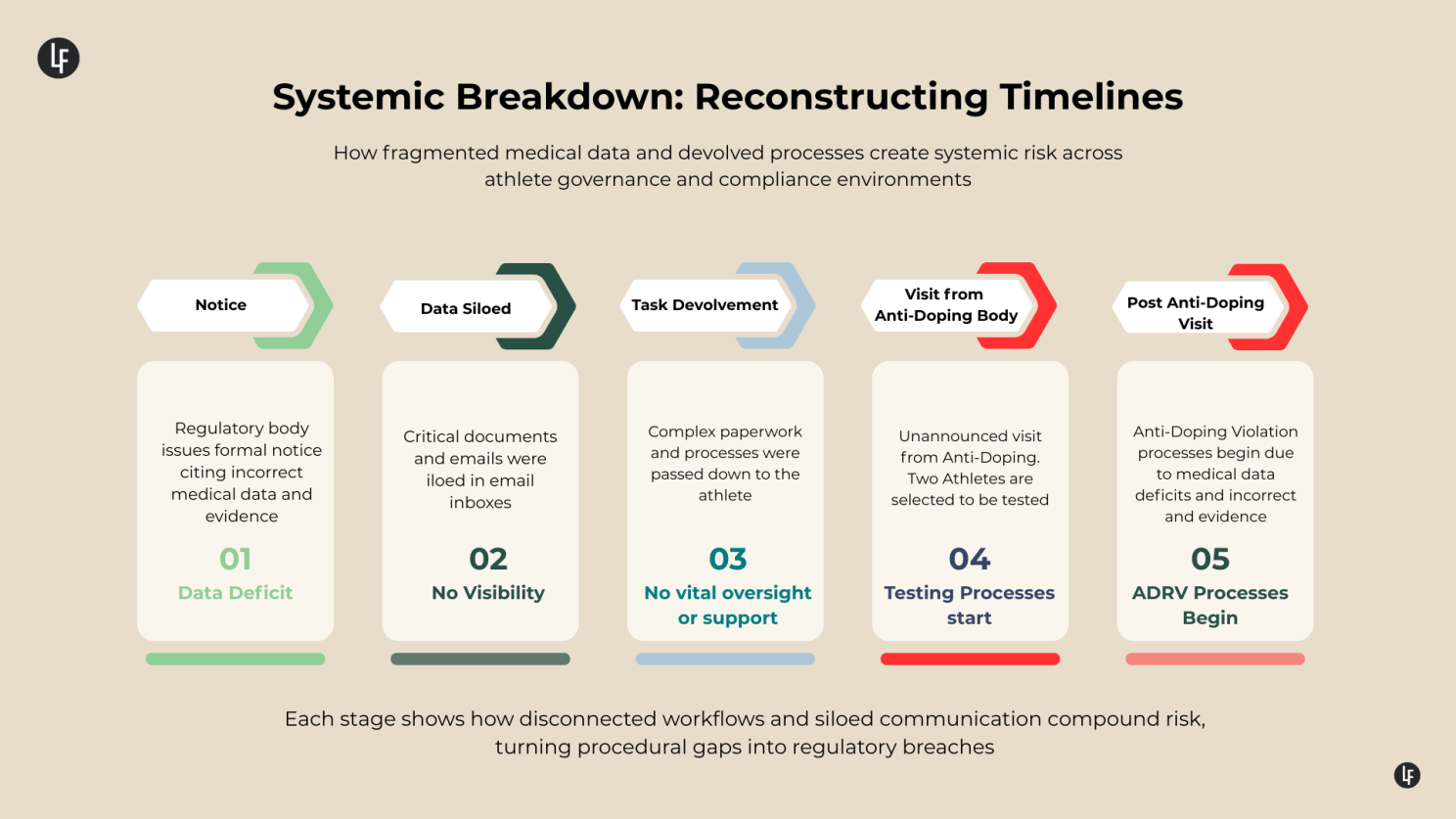
Section 7.1: Timeline of Corrective Action and Active Data Isolation
A. Context of the Discovery
Senior leadership initiated an immediate corrective action process following the post visit notification. Senior leadership formally tasked internal compliance personnel to consolidate all anti‑doping and medical governance data. Upon auditing the available files, it was discovered that previously complex medical‑legal exemption tasks were transferred to the affected athlete, while critical historical warnings remained unshared within individual organisations email accounts.
Contemporary Communication Logs (Anonymised Evidence)
The following example communication logs show the point senior leadership identified the systemic failure, the misallocation of administrative responsibility due to complexity, and the initial resistance from the specific department in question:
Log Entry 1 (23 April, 11:33):
Senior leadership formally coordinates with compliance personnel to establish direct contact with national governing bodies (NGBs), bypass the failed internal systems, and remove the administrative burden immediately from the affected athlete.
("In short, I am offloading [Athlete 1] with everything... I can contact the relevant bodies on Monday morning and introduce myself.").
Log Entry 2 (23 April, 14:29):
Compliance personnel formally report a severe breach of medical governance to the Sporting Director, confirming that the medical department had abandoned oversight.
("This should have been immediately picked up by the specific department. Both the Head practitioner 1 and head practitioner 2 have been cc'd into emails... [Athlete 1] has been doing all of the leg work.").
Log Entry 3 (Data Discrepancy Confirmation):
Compliance personnel confirm that despite requesting all historical correspondence from the Head Practitioner to resolve the regulatory issue, the practitioner provided only a single recent email, withholding the rest of the historical record.
("I have asked head practitioner to send me all emails sent, received and any comms. HP has sent me one... I have had zero information as to what [Athlete 1] has to provide.").
C. Chronological Discrepancy and Retroactive Record Completion
This sequence of events details the exact, audited mechanics of internal data tracking:
Initial Inaction:
• The national regulatory body sent explicit compliance warnings directly to the Head Practitioners, who left them unaddressed and un‑escalated in the organisation’s email accounts.
Investigation Trigger:
• Senior leadership subsequently initiated a formal data‑gathering review and internal audit to reconstruct compliance timelines and discover what communication had been sent to the athlete and the regulator.
Retroactive Record Alteration:
• While this compliance investigation was ongoing, the Head Practitioner accessed individual organisation emails and retroactively uploaded the missing correspondence and documentation onto the shared organisational drive. Senior leadership was not notified regarding this new information.
Evidential Distortion:
• These specific regulatory documents were completely absent from the shared organisation’s drive network prior to the audit. This late‑stage addition to the repository altered the evidential baseline mid‑investigation, creating an inaccurate reflection of historical network data. This required investigative analysis to piece together the correct timeline.
The Trigger Phase: From Compliance Success to Institutional Sabotage
The successful completion of processes and the enforcement of non-negotiable regulatory boundaries ultimately became the catalyst for widespread institutional retaliation. Full compliance requires absolute operational transparency, which directly threatened an entrenched legacy network relying on a culture of concealment.
An Organisational Paradox Emerged:
While the internal transformational leadership function continuously drove modernisation and governance improvements across the infrastructure, other co‑governing senior leaders, executive‑tier stakeholders, and operational personnel actively participated in, or permitted, the subsequent retaliation.
One tipping point occurred when public-facing recruitment media was created to highlight the department’s rising standards of competence, professionalisation, and governance improvement. This public showcase of modern standards, combined with formal efforts to address the toxic behaviours of existing networks before, during, and after all operations, triggered a retaliation.
Faced with deliberate inaction and complicity at the highest executive and operational levels, existing and legacy networks shifted to active resistance.
They systematically undermined performance and organisational infrastructure, systems, processes, fragmenting departments (de‑integrating) across the organisation. Creating space and room to commit safeguarding, systematic and regulatory breaches and crime. This included subverting reporting lines, accountability, and intentionally engineering operational failures through active blocking, subversion, manipulation, pathological falsehoods, and deep-seated prejudice to compromise the organisation’s overall success.
8. The Second Anti-Doping Collapse: Organisational Vacuum
A second phase of targeted retaliation accelerated into a total breakdown of governance during the subsequent competition period and beyond. Driven by extreme transactional and financial pressures, specifically a pending asset sale and critical licence renewals, executive leadership actively suppressed governance compliance and tolerated mob behaviour to conceal systemic breakdowns. Executive leadership deliberately dismantled the organisation’s infrastructure, creating an operational vacuum:
Absent Operational Infrastructure:
The entity functioned without any formal, specialised departments or structural frameworks.
The Erosion of Institutional Oversight:
Operational and administrative frameworks were entirely absent, resulting in a total vacuum of systemic accountability.
One of the paradoxes of leadership is that high‑trust cultures are essential for performance, yet trust without governance can create opportunities for manipulation, retaliation, and abuse. Effective leaders must balance support, development, and psychological safety with independent oversight, documented accountability, and robust governance.
9. Governance Versus Operational Communication
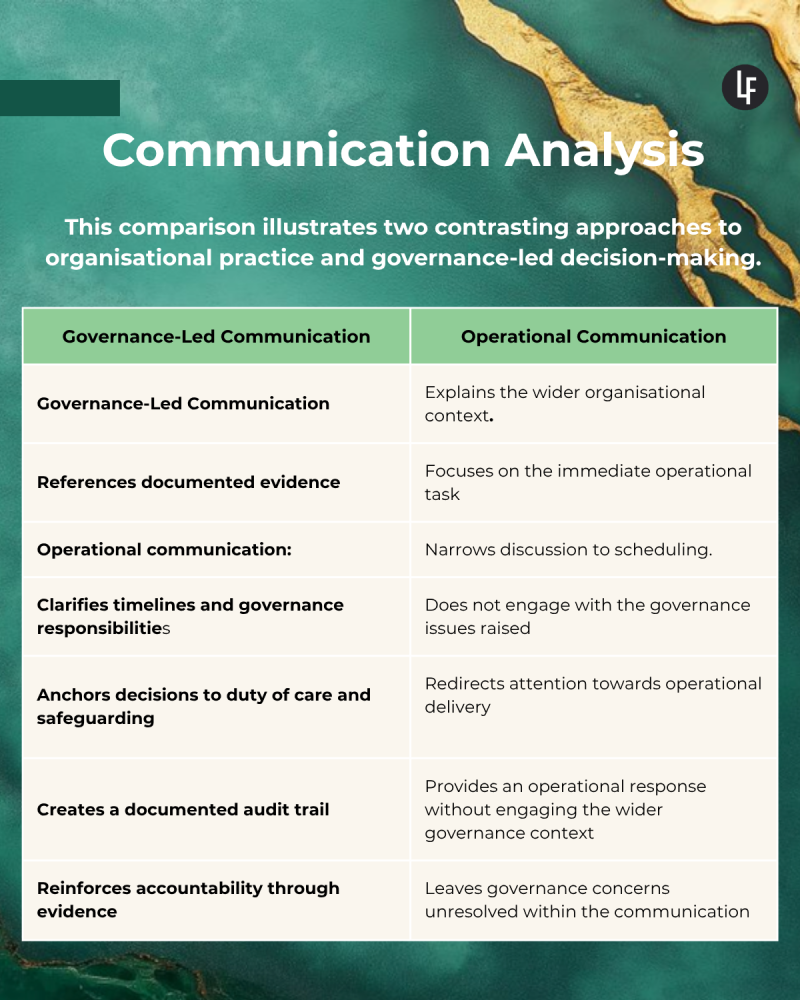
“The following exchange illustrates an important distinction between governance‑led communication and operational communication. This examines how governance concerns are either acknowledged or displaced within organisational decision‑making.”
9. The Leadership Paradox: Trust, Governance and Organisational Protection
The governance-focused communication documents the wider organisational context, referencing duty of care, safeguarding responsibilities, regulatory processes, evidence, and organisational risk. It explains why decisions are being made, establishes a documented chronology, and reinforces accountability through written records.
The operational response focuses exclusively on the immediate practical task, namely the athlete’s schedule. This distinction is significant because governance failures rarely occur through a single catastrophic event. More commonly, they develop incrementally and intensify as documented concerns become separated from day‑to‑day decision‑making, allowing delivery needs to take precedence over accountability, transparency, and organisational learning.
This comparison is not presented as evidence of wrongdoing in isolation. Rather, it demonstrates two contrasting approaches to organisational practice. One seeks to document, clarify, and manage governance risk through evidence and accountability. The other prioritises operational continuity without substantively engaging with the governance concerns that have been raised.
When viewed alongside the wider chronology presented throughout this case study, this pattern becomes increasingly important. Governance concerns were repeatedly documented and reported, yet organisational responses frequently returned to immediate operational matters without addressing the underlying issues. Over time, this disconnect contributed to the complete erosion of accountability, significantly reduced safeguarding, and increased organisational risk.
One of the most overlooked risks within performance sport is not the absence of governance frameworks, but the failure to operationalise them. Organisations may possess policies, procedures, and regulatory obligations, yet if governance concerns are repeatedly reframed as operational inconveniences rather than organisational risks, those frameworks stop functioning as protective mechanisms.
Effective governance must protect not only athletes, but also the practitioners responsible for implementing organisational change. Without organisational mechanisms that safeguard those leading reform, accountability itself becomes vulnerable to retaliation, undermining the very systems designed to protect sport environments.
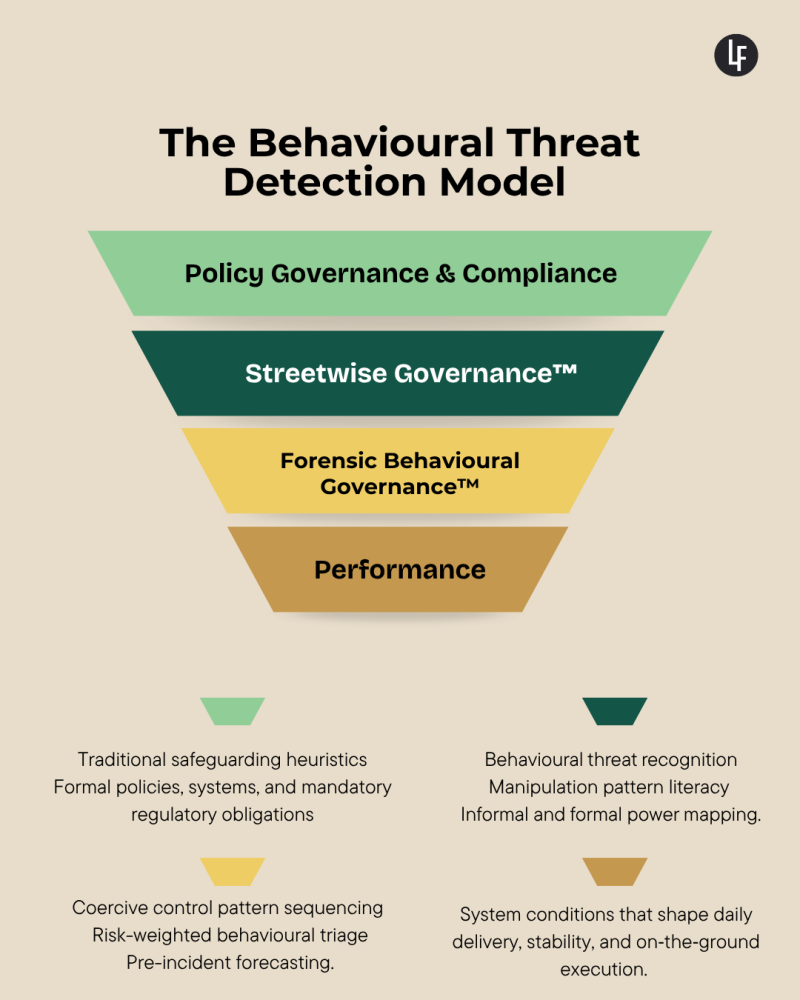
10. This is a concept that has emerged from my evolving experience and observations. Streetwise Governance integrates behavioural intelligence with formal governance structures. It is the ability to read behaviour, anticipate retaliation, recognise manipulation, and protect environments through situational awareness, rigorous compliance, and system design.
Spotting toxic or harmful patterns before they escalate into organisational crises.
Identifying covert influence, gaslighting, and deceptive tactics designed to bypass rules and regulations.
Retaliation anticipation: Forecasting and neutralising backlash against athletes, whistle-blowers, reformers, advocates, or leaders.
Dissecting the unwritten social hierarchies and hidden networks that shape decision-making.
Streetwise situational awareness: Maintaining alertness to cultural, environmental, and subtle atmospheric shifts.
Decoding the unique vulnerabilities, threat profiles, and predatory patterns present in gendered environments.
Creating concrete structures to safeguard the professionals tasked with enforcing compliance, including national governing bodies (NGBs).
The Behavioural Threat Detection Model
Safeguarding chaplains, ministers, and faith-based representatives who provide independent moral oversight, support athletes and team members, and identify behavioural risk may become targets when their presence, actions and accountability challenge abusers, extremists, or those breaching governance and regulatory duties.
This is especially critical in women and girls’ environments because:
Where governance is immature, accountability is poor, or oversight is inconsistent, environments may become more vulnerable to manipulation, retaliation, safeguarding failures and other governance risks.
• informal networks are stronger.
• safeguarding failures are more common and dangerous.
• practitioners implementing governance can be more likely to be targeted.
My second concept is Forensic Behavioural Governance, which brings forensic criminal behavioural profiling into professional sport. It applies analytical methods used by leading criminal behaviour experts to understand risk, manipulation, coercive control, dark personalities, and the likelihood of abuse or misconduct in sport environments.
• Laura Richards, BSc, MSc, MBPsS Criminal Behavioural Analyst, Founder of Paladin National Stalking Advocacy Service [1.4], and creator of the DASH risk model. Former Head of the Sexual Offences Section and Homicide Prevention Unit at New Scotland Yard.
• Professor Jane Monckton Smith OBE Professor of Criminology at the University of Gloucestershire and author of the Eight-Stage Homicide Timeline. Specialist in sequencing coercive control and tracking behavioural escalation.
• Dr. Karen Mitchell, PhD Australian Forensic Behavioural Researcher, CEO of the Kalmor Institute, and author of Human Predators. Creator of the Persistent Predatory Personality (PPP) Model, specialising in corporate grooming and dark personalities.
• Dr. Ann Olivarius OBE, KC (Hon) International Attorney and Founding Partner of McAllister Olivarius. Leading transnational authority on institutional abuse, sexual assault, and discrimination law.
• Informal Power Mapping
• Dark triad risk identification
• Abuse likelihood assessment
• Practitioner level vulnerability analysis
• Early warning detection of coercive or predatory behaviour
• Stalking markers (The FOUR Framework)
In these contexts, traditional compliance frameworks are not enough for athletes, leaving them trying to survive in environments where the real risks sit in behaviour and actions, not just in systems and processes.
In contrast, Streetwise Governance™ and Forensic Behavioural Governance™ deliver on-the-ground, real-world expertise. This shift fundamentally moves athletes from a baseline of gratitude to one of expectation.
By neutralising covert liabilities and allowing practitioners to focus entirely on what matters most, performance, athletes and organisations can truly thrive. This protection is what drives sustainable competitive success, economic dividends, and local and global geopolitical power.
14. Grooming is a patterned behavioural process that exploits vulnerability, dependency, and informal power. Within Streetwise Governance and Forensic Behavioural Governance, it is understood as a course of conduct rather than an isolated act, aligning with modern UK and global policing frameworks and the behavioural science foundations associated with Laura Richards.
In professional sport, grooming can occur in any gender configuration, but the underlying system is consistent: access, dependency, boundary testing, control, and exploitation.
Streetwise Governance identifies the early signals through behavioural threat recognition, manipulation pattern literacy, informal power mapping, and gender-specific risk intelligence.
Forensic Behavioural Governance then sequences those behaviours over time using structured forensic models, risk-weighted triage, and timeline reconstruction to expose escalation, fixation, and pre-harm indicators.
In modern UK policing and exploitation work, breadcrumbing is viewed as a grooming behaviour where an offender gives small, intermittent rewards, attention or contact to keep a victim engaged, compliant or hopeful. It is treated as a manipulation and control tactic within a wider course of conduct, creating dependency through inconsistent reinforcement rather than overt force.
Across all contexts, grooming is a governance risk as well as a safeguarding concern. It is a behavioural process that must be identified, disrupted, and prevented before it develops into harm.
- What people say and do
- How they behave
- Why they behave that way
It enables organisations to understand not just what people say and do, but how they behave, why they behave that way, and what risk their behaviour represents to athletes, colleagues, and the system.
I will show anonymised real-life profiles to demonstrate how these forensic methods reveal behavioural risk patterns and actions that traditional governance cannot detect.
Together with Streetwise Governance, this forms a unified framework: governance that is structurally rigorous, behaviourally intelligent and capable of anticipating harm before it materialises.
In these environments, the duty to report is not optional. It is a governance obligation, but ensure that you protect and safeguard yourself first, safeguard athletes, and team members where possible.
My reports contributed to governance action, and in a separate incident, reinforced the dismissal of an individual whose behaviour represented significant risk. This demonstrated that when organisations act, governance can correct course. But when organisations are complicit, under pressure to win, or driven by power, influence, Nepotism (Informal power), and economics, the price paid can be extremely heavy, including deep damage to the integrity of competition itself.
In organisations and national governing body systems, integrated data collection can help identify safeguarding and governance breaches.
In one real-life example, the transfer of electronic documentation between two individuals triggered an alert because the network configuration included unique features, inbuilt accountability measures and activity tracking logs. The institution then reviewed the profile of the original creator after the system flagged the file.
This signalled that something was seriously wrong in the environment, exposing critical early warning signs before further escalation occurred, while also triggering further investigation and exposing previous safeguarding reports.
For example, under severe compliance failures such as the unauthorised deployment of surveillance mechanisms in restricted changing environments, an institution may face serious statutory, safeguarding, civil, and data protection consequences, together with a significant failure of duty of care.
Such severe breaches would ordinarily require immediate internal refferal, safeguarding review, and, where appropriate, cooperation with relevant statutory agencies and criminal law enforcement. Civil claims and data protection liabilities may follow, alongside severe reputational damage that can undermine funding, strategic partnerships, and operational stability.
In addition, the organisation would be expected to inform affected individuals, and where appropriate parents or guardians, while also providing timely reassurance across the organisation that the matter has been dealt with swiftly, transparently, and with proper rigour, demonstrating the effectiveness and speed of its safeguarding and reporting processes. Because voyeurism may constitute a criminal offence under the UK Sexual Offences Act 2003, any affected organisation should cooperate fully with police and relevant statutory agencies during a criminal investigation.
Social media accounts can also provide evidence of safeguarding and governance breaches. In this case, the organisation’s accounts were deleted. The broader lesson is that competence and harmful behaviour can coexist, but competence alone does not make someone an abuser, even when the consequences for athletes are serious.
At the opposite end of the spectrum, organisations that do not know, or do not understand, the behavioural risk they are carrying can lose years of progress. In the case of an innocent Saudi entity, the impact is an estimated two‑year delay in ambition, development, and the opportunity to influence and shape global sport environments, workforce and athlete development, culture, economic benefits, and ecosystem growth.
One of the most significant lessons from this case study is that governance failures rarely remain confined to a single organisation. Individuals subject to governance concerns, safeguarding issues, or regulatory action may continue working elsewhere if recruitment, due diligence, and organisational oversight fail to recognise or act upon documented behavioural risk. Governance therefore extends beyond responding to misconduct within a single organisation; it also requires organisations to identify, assess, and prevent documented behavioural risks from being transferred into new environments through recruitment, informal and formal networks, or poor organisational oversight.


Whilst analysing publicly available disclosures from a whistle-blower connected to a high‑profile criminal murder case (serial killer), I identified significant behavioural and governance parallels with concerns and evidence I had independently documented within an organisation. My public analysis focused on those governance themes and the organisational lessons they presented.
Following that public engagement, and my continued response to the whistle-blower, we became the subject of sustained online trolling. Through documented digital and electronic evidence, the activity was traced to individuals connected with an organisation I knew.
The publicly visible content of several accounts participating in that activity also contained racist and extremist material, raising further questions regarding organisational culture, governance, safeguarding and organisational reputation.

Integrating transparent delivery pathways and reflective oversight within modern Saudi public and sporting environments
These lessons extend beyond a single organisation or jurisdiction. As Saudi Arabia continues to expand its investment in domestic and international elite sport portfolios and strengthen governance under Vision 2030, organisational integrity, accountability, and effective oversight are of paramount importance.
Institutions such as NAZAHA and PSS, together with Saudi Arabia’s wider governance and security structures, demonstrate the Kingdom’s commitment to protecting public interests, organisational integrity, and national reputation. NAZAHA encourages citizens to report crime and corruption through national digital pathways, with citizens and residents receiving monthly updates.
This reinforces why governance must extend beyond policies and regulatory compliance to include the behavioural intelligence needed to recognise emerging risks before they develop into safeguarding or organisational damage.
Edition 5 has explored how governance supports sustainable performance, athlete welfare and organisational resilience. It has also shown that governance is tested not only through systems and compliance, but through the behaviours that shape organisational culture, accountability and decision‑making.
These observations led to the development of Streetwise Governance™ and Forensic Behavioural Governance™, two complementary frameworks that integrate behavioural intelligence with governance, safeguarding and organisational leadership. Together, they provide a practical approach for recognising behavioural risk, anticipating retaliation, understanding informal power structures and fortifying governance before organisational harm occurs.
Builds upon this foundation through a forensic behavioural analysis of governance under pressure. Using anonymised behavioural profiles and documentary evidence, it examines how systemic abuse of power, manifesting as mobbing, bullying, coercion, deception, and professional sabotage, can emerge alongside governance reform. It deconstructs the precise operational mechanics such as record falsification, negligence, and targeted discriminatory conduct. Specifically, it deconstructs how a total collapse of executive boundaries enables predatory professional conditioning, severe abuses of authority, including unauthorised and compromising relationships between senior executive leaders and operational personnel.
Part Two asks a broader governance question: how should organisations recognise and respond to behavioural risk before it becomes organisational harm?
Through the introduction of Streetwise Governance™ and Forensic Behavioural Governance™, it argues that organisational environments must evolve beyond compliance alone to become behaviourally intelligent, capable of anticipating risk rather than simply responding to catastrophic and systemic failures.
Behaviour should be recognised as a governance signal, not simply a human resources issue. Organisations that understand behaviour are better equipped to prevent governance failure before harm occurs.
© 2026 Lizzie Fluke. All rights reserved.