Biomechanics of a Goalkeepers Diving Save
Biomechanics of a Goalkeepers Diving Save
In Sweden I started working with Goalkeepers due to a coach shortage, enjoyed the technical side of the position and continued to develop my knowledge. I found this of high value when programming for Goalkeepers and working alongside Målvakter coaches.
There is not a lot available in this space regarding physical preparation, as it is a highly specialised position, so I have developed my own approaches and resources. Throughout this section I will be sharing what I know, my work, and the programmes I have created for Goalkeepers on and off the field in collaboration with Goalkeepers and Målvakter coaches, particularly in Sweden.
This also includes young developing Goalkeepers.
Introduction
This is from the work of Assistant Professor of Biomechanics Dr Rony Ibrahim and colleagues from Qatar University. Dr Ibrahim and his team analysed the biomechanics of a Goalkeeper's diving save.
Key:
Contralateral Push Off = Leg opposite to the direction of movement or dive.
Ipsilateral Push Off = Same side as the dive.
Trolley Pushes can be used to assist with push-off mechanics during diving. Under-leg push-off (Contralateral) methods can support rehabilitation following knee injury, while also contributing to single-leg power development. Touching the feet helps the brain with sensory reconnection to the foot, builds confidence for diving, and can be integrated into Goalkeeper development programmes. I used this approach in the Swedish Damallsvenskan League.
Study 2 Subject: Nine Elite La Liga Goalkeepers Using a Ball Cannon
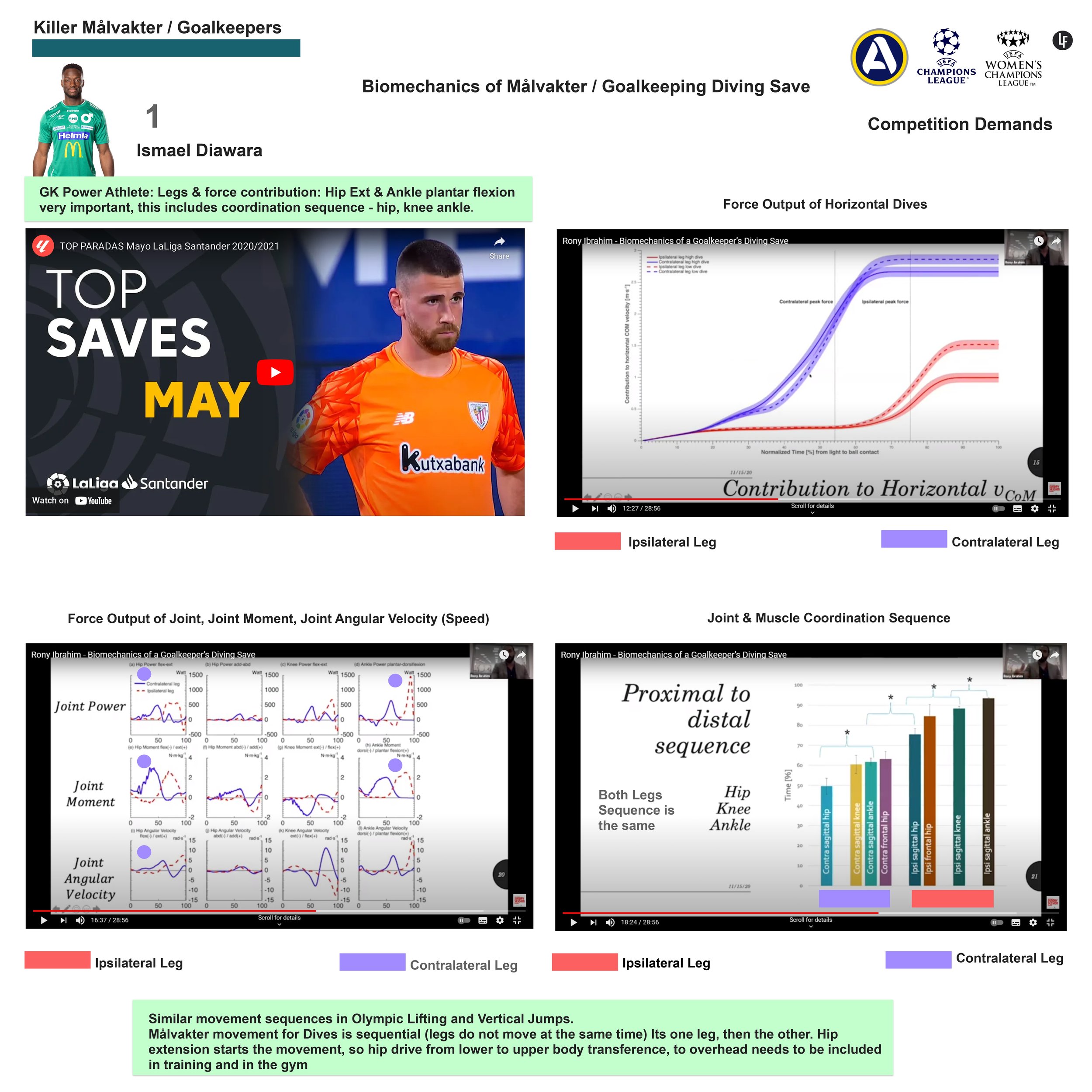
I will start with the force output of horizontal versus vertical dives and linear momentum. The solid lines in blue and red are high dives, the dashed lines are low dives. What he found is GKs produce much more horizontal momentum, which is in red, much more than vertical dives and this is for both high and low dives.
If we look at the force output of high versus low dives and angular momentum. Low dives are in blue, there is much more force in low dives. GK’s need to turn and fall as quickly as possible for low dives.
Biomechanics &
Force Output of GKs
Force output of vertical dives and contribution to vertical velocity of centre of mass towards the ball. Looked at the Ipsilateral leg and the contra-lateral leg using force plates to see how much power each leg is generating. Vertical contralateral leg is in blue. The Ipsilateral leg is the last leg that leaves the ground. The contra-lateral leg is contributing the peak force. Also, this lasts longer in the dive.

Goalkeeping Diving Save
There is a clear contribution from the contralateral leg (blue) and the ipsilateral leg (red). At the start of the dive, power production is clearly visible through a steeper force curve and movement of the centre of mass (COM).
The contralateral leg is much more important and contributes significantly to COM velocity (speed). Horizontal linear momentum and diving actions are much more significant than vertical jumping actions. Therefore, the focus of training should be horizontal (sideways/lateral) movement.
Study Two involved nine elite La Liga Goalkeepers using a Globus ball cannon. High balls were set at 190cm and low balls at 30cm, plus or minus 10cm. Ball speed was calibrated to approximately 1.2 seconds.
The study examined joint force output, joint moments and joint angular velocity (speed). The first column represents hip flexion and extension, the second hip abduction and adduction in the frontal plane, the third knee flexion and extension, and the fourth ankle plantar flexion and dorsiflexion towards and away from the shin.
Looking at joint moments, relatively small forces are generated across most joints. The largest moments occur around hip extension, with the contralateral leg shown in blue and the ipsilateral leg shown in red throughout. Joint power is highest during hip extension and ankle plantar flexion/dorsiflexion. The magnitude reflects the contribution of each joint to the diving action. The researchers also examined joint and muscle coordination sequencing.
- Hip
- Knee
- Ankle
The hips initiate the movement first in terms of peak power production. The Goalkeeper's diving movement is sequential, with the contralateral leg contributing first, followed by the ipsilateral leg. The movement is not simultaneous; one leg initiates the action and the other follows to complete the dive.
Goalkeeper Stance Width &
Knee Angles
The Third Study analysed stance width and imposed three different stance widths.
- 50%
- 75%
- 100%
This also included three different knee angles. PT1 and PT2 are preferred techniques before any changes.
Method: Goalkeepers completed two sets to normalise results before and after changes. Goalkeepers were faster with a stance width of 75% rather than the preferred technique and faster at 75% compared to the preferred 35% and 40%.
Velocity at 75% started to shift and this was sustained. The main difference was between the preferred technique and the 75% stance width.
Goalkeepers increase their stance width, performing a double tap or micro tap even when starting from a PT1 stance. This adjustment enhances the contralateral push-off force, allowing them to shift their centre of mass more efficiently.
In training, the focus should be on achieving an optimal stance width of approximately 75% of leg length, both on the pitch and in the gym.

Video 7.28 Mins Watch and Listen
Goalkeepers Saving Dive
A Retrospective. Here I explain the study by Rony Ibrahim et al. (2019), examining the biomechanical subsections of force and motion (movement) involved in a Goalkeeper's diving save.
Resource: Ibrahim, R., Kingma, I., de Boode, V. A., Faber, G. S., & van Dieën, J. H. (2018). Kinematic and kinetic analysis of the goalkeeper’s diving save in football. Journal of Sports Sciences, 37(3), 313–321. https://lnkd.in/eE5qHPpf