8 Stage Hamstring Strength Framework & Rehabilitation
8 Stage Hamstring Strength Framework &
Rehabilitation

Building Hamstring Resilience
Ground-Up Activation & Torque Efficiency: Emphasising the feet as the foundation for force transfer and stability, maximising engagement throughout the kinetic chain.
Rotational Mechanics & Pelvic Dissociation: Essential for change of direction, braking, movement, and dynamic scanning, which are critical skills in many sports.
Pre-Match Hamstring Readiness: Utilising activation strategies that prepare athletes for high-intensity competition, ensuring muscle readiness from the first whistle. This includes considerations such as injury history, competition intensity, weather and ground conditions (particularly on heavy or uneven surfaces), and the athlete's physical output profile. Very fast athletes often require a significant hamstring stimulus to feel ready.
Athleticism & Performance: Developing athletes' speed, strength, and power for both training and competition.
Reduced Injury Risk: Reducing the likelihood of hamstring injuries by building robust and durable athletes.
Why a Structured, Individualised Approach Matters
Hamstring injuries within certain sports can be common, certainly increasing within professional football (soccer), men's and women's.
Injuries are multifaceted; however, like any other injury, they can be recurring if not well managed.
Drawing on Derek Hansen's acceleration principles, short-to-long speed progressions, and Frans Bosch's dynamic rehabilitation philosophies, my framework is built around muscle coordination, with muscles and joints working together, not in isolation.
The focus is on the entire kinetic chain, from feet to hips to trunk, using progressive overload, multi-planar movement, and real-world applications to reduce injury and re-injury risk.
This approach is designed to ensure robust, training-ready and competition-ready hamstrings.
Individualisation is key for each athlete and training context. The goal is to ensure success and happier athletes, who remain at the centre of the process.
Introduction to the 8 Stage Hamstring Strength Framework
Key Concepts Applied to Hamstring Strength
1. Foundational Activation
Establishing basic neuromuscular engagement and foot‑to‑hip coordination.
2. Stability Development
Introducing controlled positions, bridges, and early isometric work.
3. Early Strength Loading
Building tolerance through low‑to‑moderate load patterns.
4. Eccentric Emphasis
Developing tension management and lengthened‑range strength.
5. Rotational & Torque Mechanics
Integrating rotational force, pelvic dissociation, and multi‑planar control.
6. High‑Force Isometrics
Progressing to advanced holds and force‑production positions.
7. Field‑Based Running Integration
Short‑to‑long progressions, acceleration mechanics, and controlled exposures.
8. Performance Readiness
Pre‑match activation, high‑intensity preparation, and return‑to‑competition profiling.
Key Concepts Applied to Hamstring Strength
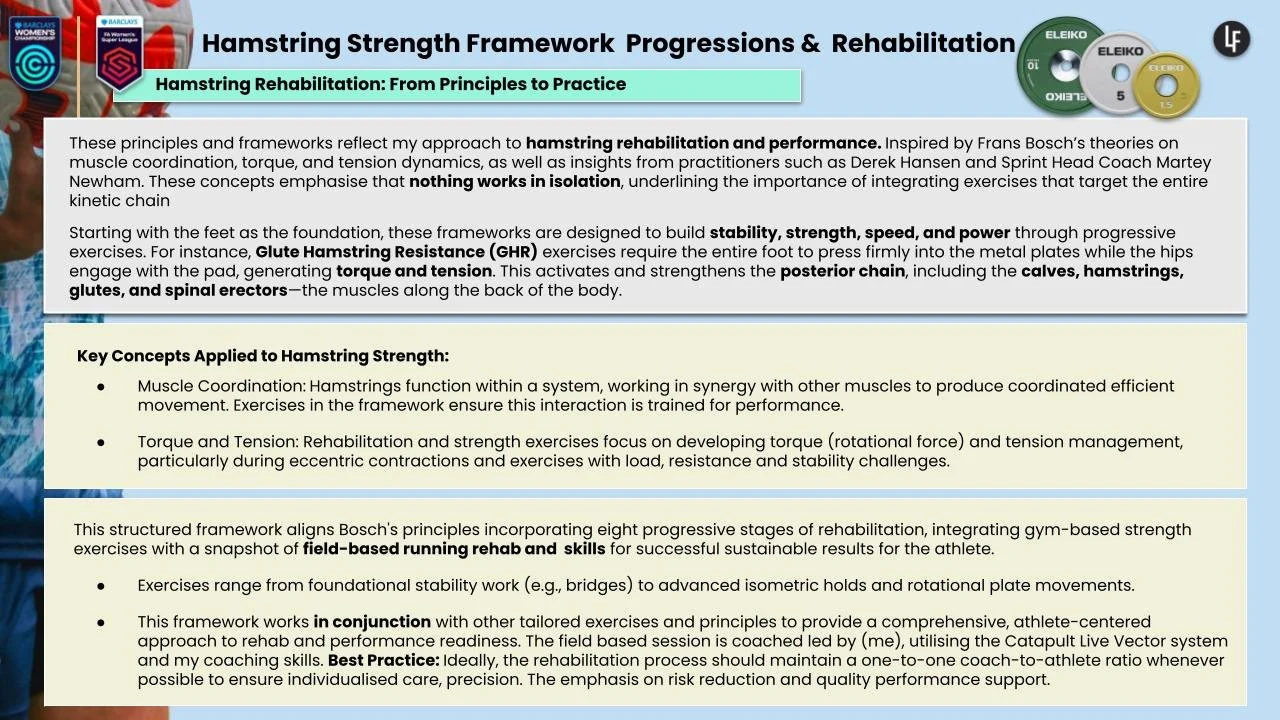
Key Concepts Applied to Hamstring Strength
Stage 1: Foundation & Stability - Building the Base
The primary goal is to establish a strong foundation of hamstring strength while promoting pelvic and core stability. This stage is about mastering fundamental movements and proper form, laying the groundwork for more advanced exercises. It's essential for athletes returning from injury, or starting a new phase of training.
Key Objectives:
- Neutral pelvic alignment
- Core activation and control
- Proper movement mechanics
Example Exercises:
- Double Leg Bridge (Two Feet): Focus on maintaining a straight line from shoulders to knees. Wiemann Holds (Low Box).
- Single Leg Bridge (Vary Knee Angle): Emphasis is on maintaining hip alignment and pelvic control. Progress by varying knee angle for full range, maintaining stability throughout.


Stage 2: Strength & Resistance – Introducing Load
Building upon Stage 1, this stage introduces resistance to strengthen the hamstrings through a full range of motion. Exercises progress from bodyweight to manual and elastic resistance, challenging the muscles to adapt and develop reactive stiffness. The exercises in this stage are designed to facilitate deceleration as well as re‑acceleration, making them excellent for training immediate power where muscles must respond rapidly.
Key Objectives:
- Increase hamstring strength and endurance
- Develop reactive stiffness
- Improve eccentric control
Example Exercises:
- Single Leg GHR (Bodyweight): Controlled movement through full range.
- Single Leg Manual GHR: Manual resistance adds perturbations (shoulders, mid‑section, hips).
- Single Leg GHR Elastic Bounce: A 1–2 second bounce (5–10 cm) trains rapid force production while maintaining pelvic stability.
Stage 3: Advanced Isometric Strength - Power & Torque
This stage targets isometric strength at specific joint angles, emphasising torque development, rotational control, and muscle coordination. Partner‑resisted hamstring curls are introduced to build tension and strength in lengthened positions.
Key Objectives:
- Enhance isometric strength at specific joint angles
- Improve rotational control
- Develop pelvic dissociation
Example Exercises:
- Single Leg GHR Maximal Isometric Hold (>50%): Maintain a maximal contraction for 5 seconds.
- Single Leg GHR Plate Rotations: Emphasises internal rotation and pelvic dissociation.
- Partner Hamstring Curls (Lying, 2 Feet): Builds tension in lengthened positions.
Stage 4: Building Strength & Endurance
Maintaining Stability Under Load
This stage increases stability, torque, and sustained endurance. Athletes must maintain tension, hip alignment, and pelvic stability under increased load for longer durations. The goal is to withstand stress while remaining stable, especially when fatigued.
Key Objectives:
- Increase hamstring strength and endurance
- Develop pelvic stability under increased load
- Improve rotational control
Example Exercises:
- Single Leg GHR Maximal Strength Isometric (>60%): Builds stability with maximal holds.
- Single Leg GHR Plate Rotations: Light plate load to build endurance under rotational tension.
Stage 5: Maximal Isometric Strength
Enhancing Maximal Load Capacity
At this stage, athletes hold and maintain maximal strength positions to improve muscular control, stability, and peak tension.
Key Objectives:
- Increase maximal isometric hamstring contraction
- Develop peak tension and stability
Example Exercises:
- Single Leg GHR Maximal Strength (Bent Knee ≈80%): High‑tension isometric loading.
Stage 6: Building Strength & Endurance
High‑Tension Loading
The focus shifts to high‑tension isometric loading, reinforcing hamstring stability, endurance, and rotational control. Athletes work to prevent hip drop and maintain pelvic control under increasing load.
Key Objectives:
- Enhance muscular capacity under high tension
- Improve rotational control
Example Exercises:
- Single Leg GHR Maximal Isometric (≥80%): Works calves, glutes, hamstrings, and back.
- Barbell Hip Thrusts (Single & Double Leg): Non‑GHR variation for strength and capacity.
Stage 7: Peak Strength & Control
Developing Precision Under Load
This stage focuses on reaching near‑maximal strength while maintaining precision and control. Heavier loads push athletes toward peak power.
Key Objectives:
- Improve maximal performance
- Increase tension under heavy loading
Example Exercises:
- Single Leg GHR Maximal Strength (Bent Knee >90%): High‑intensity isometric for game‑speed power.
- Single Leg GHR Plate Rotations: Maintain control while rotating toward the athlete’s shoulder.
How to Perform the Superset:
Partner Lying Hamstring Curl Hold (Isometric Phase): Athlete lies prone while partner anchors ankles. Athlete flexes knee and holds tension isometrically.
Transition Into Partner Lying Hamstring Curls (Dynamic Phase): Athlete slowly lowers (eccentric), then curls back up (concentric) with partner resistance.
Why Superset Holds Into Curls?
Isometric holds increase muscle fibre recruitment. Dynamic curls then challenge eccentric and concentric strength, building control, speed, and deceleration capacity. This combination maximises time under tension and is highly efficient for warm‑up, activation, and readiness.
Stage 8: Maximum Strength
& Load Resistance
This stage combines strength and endurance to prepare the hamstrings for heavier loads and greater challenges. Exercises focus on maintaining contraction under consistent resistance while improving overall muscle durability.
Key Objectives:
- Full strength
- Endurance
- Explosive speed and power
Example Exercises:
- Single Leg GHR Plate Rotations (10–15% BW): Maintain range and power for performance and injury reduction.
- Single Leg GHR with Barbell Catch (Medium–Heavy Load): Builds immediate, intermediate, and long‑term strength, speed, and power.

Hamstring Readiness for Immediate Impact
(On‑Field)
We all know the first few minutes of a game can set the tone for the entire match. Whatever the conditions or level of opponent, athletes need to be ready to apply immediate pressure from the kick‑off. This is where targeted, on‑field hamstring activation becomes crucial, especially for explosive athletes who rely on immediate power output.
Beyond the Gym: On‑Field Hamstring Priming
While the gym is where strength is built, the on‑field pre‑match routine is about priming those muscles for explosive action. We need to bridge the gap between controlled strength and dynamic performance. This section focuses on non‑GHR movements designed to ignite the hip for game play.
Key On‑Field Hamstring Activation Exercises:
Reverse Hypers (Bent Knee, Medium to High Box with Partner Resistance)
- Pump‑style movement while pushing the feet “out of the glutes.” Partner anchors the hips.
- Focus: Biceps Femoris, Hamstrings, Semimembranosus, Semitendinosus, Glute Max, Erector Spinae, Core.
- Why it works: Engages the entire posterior chain with isometric tension. Smooth reps activate key muscles and pump‑style force prepares the system for movement.
Partner Hamstring Curls
(Lying, 2 Feet Into Curls)
Programming Notes:
- Sets & Reps: 2–3 sets or a 6–8 rep pump.
- Maintain a straight line across glutes and hips.
- Adjust based on athlete experience, age, and strength levels.
Stage 2–8: Maximum Strength & Load Resistance
Rotational (Torque) Hamstring Training
Here, athletes cultivate the ability to withstand and manage significant forces through multiple planes.
Key Exercises & Progressions: Horizontal Foot Drive & Rotational Control
In this stage, Single Leg GHR Plate Rotations build rotational control and torque. The athlete rotates the plate fully around, breaking the shoulder line. Load typically ranges from 5–15% of bodyweight depending on the athlete.
- Emphasis on Feet Push: Athletes must maintain horizontal force into the footplate for maximum torque.
Single Leg GHR Plate Rotations Progression:
- Phase 1 (Unloaded): Master 6–8 controlled reps with bodyweight.
- Phase 2 (5% Bodyweight): Add light load once stable.
- Phase 3 (5–15% Bodyweight): Increase load while maintaining stability and rotational control.
- Beyond 15%: Builds new movement pathways under maximal force.
The intention is to maintain stability, improving strength and movement mechanics for rotational activities such as change of direction, braking, and general sport actions.
Why This Stage Matters
This 2–8 stage summary translates strength, stability, and rotational control into practical athletic performance. By focusing on managing high loads and maintaining precise control during twisting movements, athletes are prepared for the unpredictable demands of high‑performance sport.
Torque & Feet Activation: A Key Differentiator
Inspired by Frans Bosch’s work, this framework emphasises a ground‑up approach: creating rotational force through firm foot contact and hip pressure into stable surfaces during GHR exercises. This is essential for posterior activation and lower‑body stability.


Explanation of Muscular Coordination
Athlete sharpness is simply coordination. By increasing coordination, athletes move towards instinctive, precise movement.
Video: Frans Bosch
From Injury to Performance
From a Grade 2 left hamstring strain, we build the foundations and progress toward power and strength using a combination of eccentric and isometric exercises. This framework delivers results both on and off the field, supporting long‑term performance and resilience.
What Sets This Framework Apart?
- Versatile Application: Suitable for various sports and levels, adaptable to individual needs and goals.
- Progressive Overload: Each stage builds upon the previous one, using proven principles to safely and effectively challenge athletes.
If you feel this may be of help to you, download the 8‑Stage Hamstring Strength Framework below.
8‑Stage Hamstring Strength Framework
Now Available in My Performance Shop
8‑Stage Hamstring Strength Framework is now available to purchase through my Performance Shop.
This resource is designed to support coaches, rehabilitation practitioners, and performance professionals working across team and Olympic sports, regardless of athlete level or performance environment.
The framework provides practical guidance that can be adapted to suit different populations, training contexts, rehabilitation demands, and performance goals.
Adjust the principles and frameworks to meet the needs of your athletes and performance setting.
Performance Shop:
View the 8‑Stage Hamstring Strength Framework
Lizzie