Speed and Muscle Fibre Types
Speed and Muscle Fibre Types
All Things Speed: Part 1
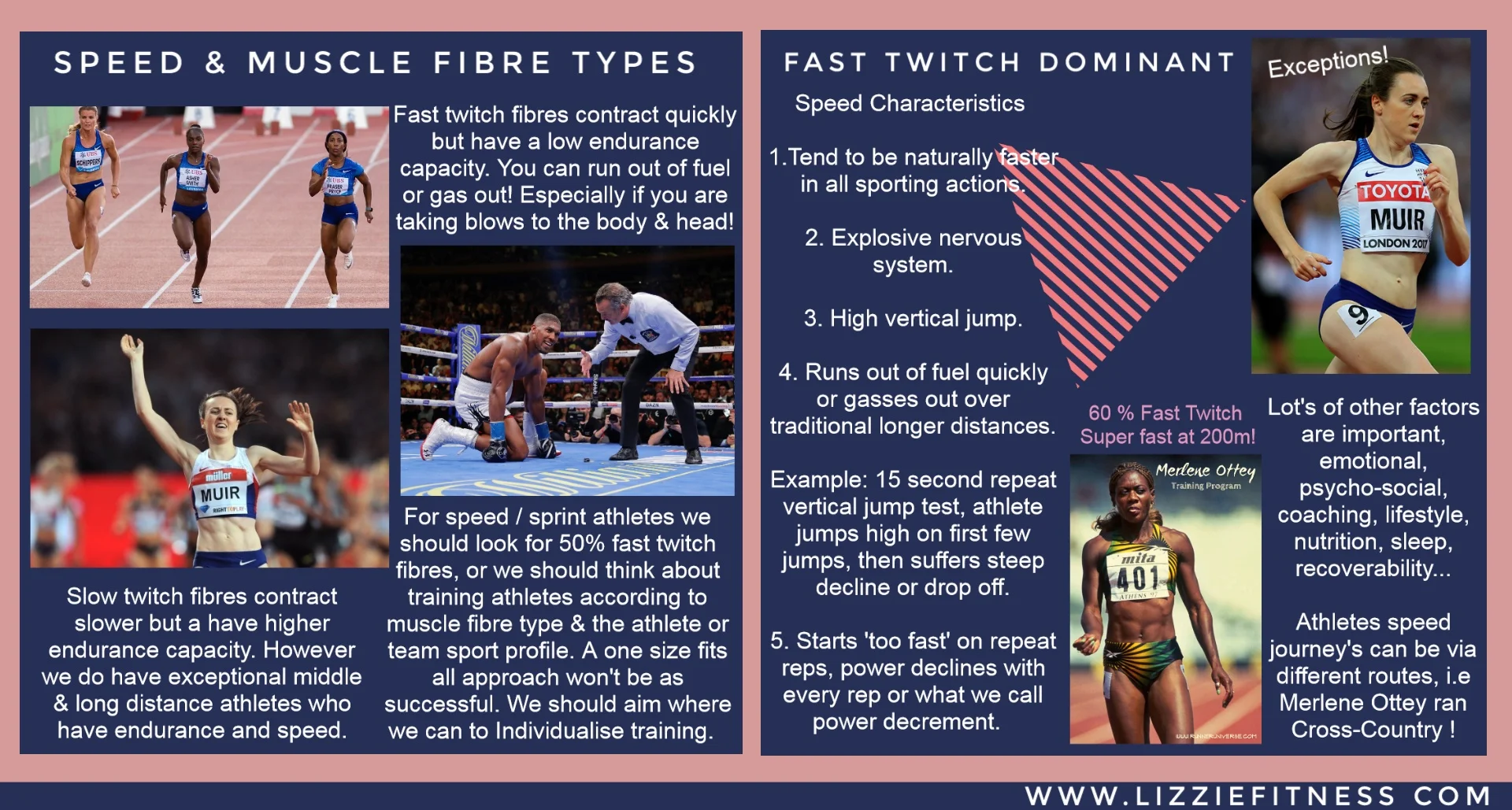
I will be adding more information on fast- versus slow-twitch dominant muscle fibre types and what you can do to maintain and improve these fibres. This includes what to do if you shift fast-twitch characteristics towards slower qualities through excessive hard training and accumulated fatigue.
I still believe Anthony Joshua (AJ) carried too much muscle and did not have a large enough engine or sufficient capacity to dissipate force efficiently. Due to a high proportion of fast-twitch muscle, he appeared to fatigue very quickly.
Even sprinters complete significant amounts of very low-level tempo training, which does not interfere with speed or power development. This helps them cope with the demands of progressing through multiple competition rounds on the same day or over consecutive days.
If you become stuck in the middle zone, where you are not training anything in particular, you will often generate large amounts of fatigue without meaningful adaptation.
When you go high, you really do. Training sits at 90%+ intensity, with maximum quality and long recovery periods. When you go low, the work stimulates recovery and regeneration, builds capacity, and helps move athletes up to the next level.
Do not end up in a middle zone of nothingness or spend sessions purely in survival mode. If the only way to complete the session is to turn the power down, then speed is inevitably compromised.
All Things Speed
Fast Twitch Dominant Characteristics - Part 2
These are just a few characteristics you may observe in athletes who are naturally fast.
Muscles That Are Important for Speed
Acceleration - First Phase
Glutes (buttocks), quadriceps (thighs), gastrocnemius-soleus complex (calves), shoulder complex, and latissimus dorsi complex.
If an athlete cannot hold their own bodyweight effectively out of the blocks, they will struggle to generate the force required for the first crucial three strides. Sprint coaches often describe the legs as being piston-like during this phase.
Lack of strength becomes a limiting factor because force production is reduced. What this often looks like is an athlete rising too early out of the blocks because they cannot maintain a low acceleration angle.
I worked with a female sprinter who significantly improved her overall strength. As a result, her acceleration from the blocks became much faster. This can often be observed by examining how long an athlete can remain within Acceleration Phase 1 and Phase 2 before transitioning into a more upright running position.
Acceleration - Second Phase
Glutes, quadriceps, erector spinae (to maintain posture), gastrocnemius-soleus complex, hamstrings, adductor longus, shoulder complex, and latissimus dorsi complex.
Transition Phase
Glutes, erector spinae, calf complex, hamstrings, adductors, trunk musculature, shoulder complex, and latissimus dorsi complex.
Max Velocity
Tendons, hip musculature, and the hamstrings become critically important. The hamstrings are biarticular muscles, meaning they cross two joints and play a significant role in high-speed running.
Speed endurance is the quality that prevents athletes from "hitting a fridge" halfway down the track. It is the component that helps get athletes over the finish line while maintaining performance.
If you are truly exceptional, you may simply continue accelerating throughout the race. Usain Bolt is a great example of this.
If you want to learn more about speed development, Sprint Coach Henk Kraaijenhof has influenced many coaches and remains one of the sport's great innovators. His book, What We Need Is Speed, is an excellent place to start.
Historically, muscle biopsy methods have been used to measure muscle fibre composition and provide insight into fast- and slow-twitch muscle characteristics.
