Saudi-First System Design Part 7 Mental Health, Cultural Intelligence and Athlete Environments
Saudi-First System Design
Part 7 - Mental Health, Cultural Intelligence and Athlete Environments
From Participation Readiness to Athlete Environments
The previous sections have shown that strategy becomes meaningful only when it is translated into the systems, routines, and environments experienced by athletes every day. Governance, medical coordination, participation pathways, monitoring, and clear communication do more than improve operational efficiency. Together, they shape whether athletes experience sport as organised, safe, supportive, and capable of sustaining progression.
The same principle applies to mental health. The source of psychological readiness is not limited to a standalone intervention or a service accessed only when a need becomes visible. It is also built through repeated participation, healthy relationships, consistent routines, trusted communication, supportive leadership, and environments that help athletes manage challenge and uncertainty.
As Saudi sport continues to professionalise, the next system-design question is how these environments can become culturally intelligent and psychologically supportive across participation, development, rehabilitation, and performance settings. It requires adapting useful principles to Saudi families, cultural identity, values, institutional relationships, and patterns of trust.
That is the focus of the next section: how mental health can be embedded within the athlete environment as part of Saudi Arabia’s wider delivery and development capability.
A nation’s minds and hearts are a priority for success, mastery, and sustainability.
Saudi Arabia’s Vision 2030 places health, prevention, wellbeing, access, digital transformation, and workforce development within a wider national transformation. These priorities create an important context for improving mental-health provision across society and sport. Within athlete development, mental health should therefore be understood as part of long-term system capability rather than as a separate welfare issue.
This builds directly on the previous section’s argument: delivery systems shape the environments in which athletes participate, train, recover, and progress. If those environments are healthy, trusted, and supportive, they can contribute to psychological readiness and longer-term participation continuity. If they are fragmented, unclear, or culturally misaligned, they may increase uncertainty, anxiety, and reduce the likelihood that athletes disclose concerns or seek support.
International Models and Adaptable Principles
Internationally, high-performance systems increasingly understand athlete mental health as an environmental and organisational responsibility, not only as an individual clinical issue. The Team Denmark Applied Model of Athlete Mental Health, for example, considers the athlete alongside the training environment, leadership, everyday life, and the wider cultural context. It also distinguishes between different levels of need and the types of support required.
The Team Denmark Sport Psychology Model provides a complementary framework for integrating identity, life as an elite athlete, mental skills, and the surrounding sport environment. Its 3R model – Register, Release and Refocus – offers a practical approach to helping athletes recognise unhelpful thoughts, emotions, and bodily responses, accept them without unnecessary struggle, and redirect attention towards the task or values.
These principles may be useful in Saudi Arabia, but they should not be transferred as a complete imported solution. Their value lies in providing design principles that can be adapted to Saudi cultural, relational, institutional, and governance realities.
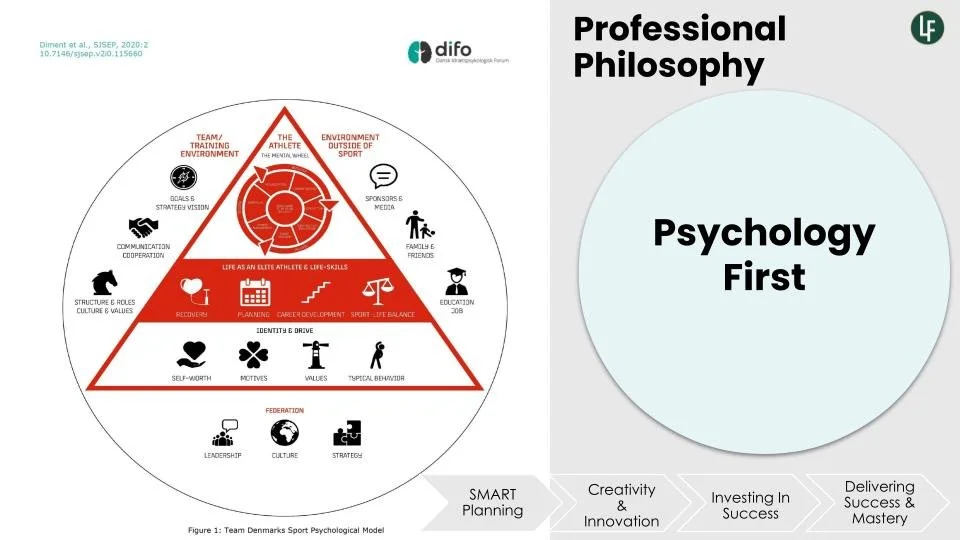
Team Denmark Sport Psychological Model. A system‑level framework showing how wellbeing, identity, communication, and environment sit inside daily performance, not outside it.
Cultural Alignment as a Precondition for Psychological Safety
Mental health systems work best when they are culturally aligned. Imported frameworks alone cannot create psychological safety. Athletes need to trust communication, leadership, team members, confidentiality, and the cultural understanding of the people around them.
In Saudi Arabia, this includes:
- family involvement
- tribal and regional identity
- religious and values based frameworks
- hierarchical communication
- relational expectations around authority and trust
These factors shape how athletes interpret support, disclose concerns, and engage with their environment.
Priority Environments for Culturally Aligned Support
This alignment is especially important in:
- women’s and girls’ sport
- youth pathways
- rehabilitation environments
- transition phases
- return to sport processes (Training and Competition)
These settings carry higher emotional load, more family involvement, and greater uncertainty around identity, belonging, and opportunity.
Athletes in these environments need support that recognises:
- identity formation
- cultural expectations
- family dynamics
- the psychological impact of injury, deselection, and uncertainty
A Saudi-First Approach to Mental Health in Sport
A Saudi first approach sees mental health as part of the athlete environment, not a separate clinical service.
Integrated multidisciplinary environments that combine medicine, rehabilitation, psychology, wellbeing, communication, and family support are still developing across the Kingdom. But this direction fits Vision 2030 and the professionalisation of federations.
Over time, these environments can give athletes continuity by helping practitioners:
- share context
- align communication
- coordinate rehabilitation
- support identity stability
- reduce uncertainty during injury or transition
Trust as the Foundation of Effective Mental Health Systems
Trust is central.
Athletes must trust the people around them and the confidentiality of conversations. Families must trust the cultural alignment and safety of environments. Federations must trust that psychological systems strengthen pathways.
When trust is present:
- athletes speak up earlier
- communication improves
- rehabilitation adherence strengthens
- psychological strain is identified sooner
- return to sport becomes more stable
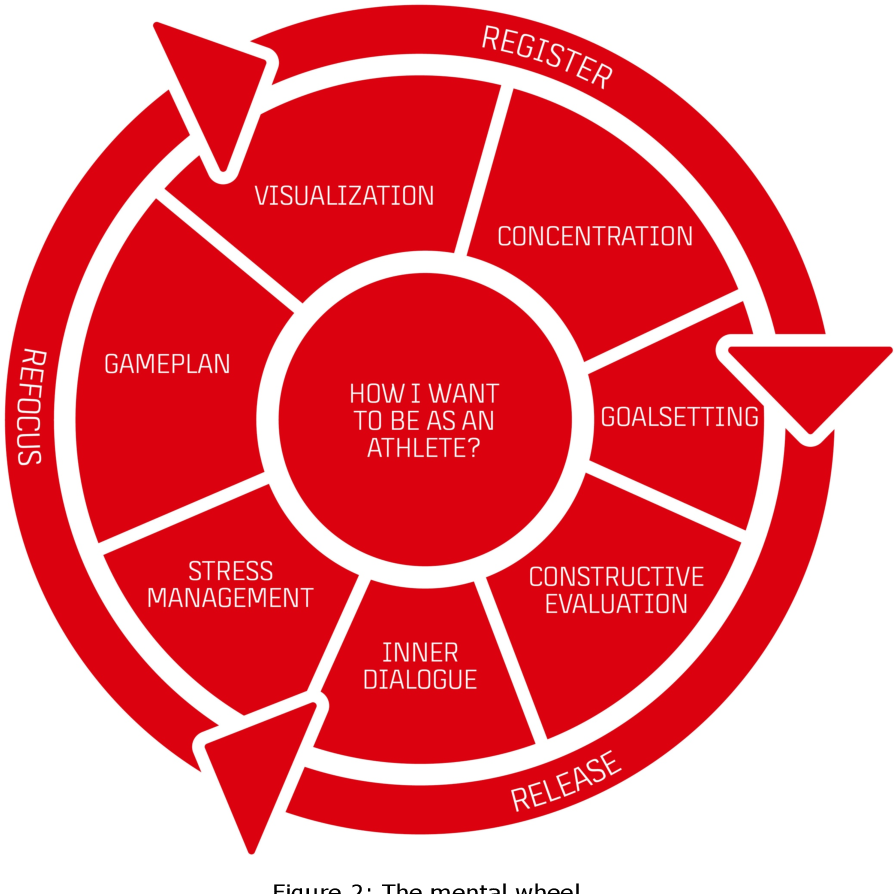
Team Denmark 2.0 Mental Wheel. Shows the individual athlete process of recognising emotions, releasing tension, and refocusing attention within daily environments.
Rehabilitation as a Psychologically Critical Phase
Rehabilitation needs particular attention. Injury disrupts identity, routine, progression, and belonging. In emerging systems, where pathways are still forming, injury can increase uncertainty about selection and future opportunity. A Saudi first rehabilitation environment should include:
- consistent communication
- family engagement
- identity support
- psychologically informed return to sport planning (competition and training)
- integrated multidisciplinary coordination

Adaptable International Frameworks for Saudi Contexts
Models like Team Denmark’s layered framework and the 3R approach – Register, Release and Refocus – can offer useful principles when adapted to Saudi cultural and institutional realities.
Mental Health as System Capability, Not Standalone Service
Mental health systems should be seen as part of healthy participation and performance environments. They support identity, family confidence, pathway stability, participation continuity, long term development and winning. (Winning Well)
Within Vision 2030, where sport contributes to public health, social cohesion, and national capability, culturally aligned and connected mental health systems become part of the Kingdom’s wider capability system, not a standalone service.