Edition 3: Saudi-First System Design. What Sweden’s Olympic Structure Reveals About Saudi Arabia’s Opportunity to Build the Middle Layer
Edition 3 Saudi‑First System Design. What Sweden’s Olympic Structure Reveals About Saudi Arabia’s Opportunity to Build the Middle Layer
Opening Positioning Statement
Saudi sport is entering a phase where long-term performance is increasingly shaped not only by investment, but by governance design, infrastructure coordination, workforce capability, and system integration.
The next phase is not simply expanding elite programmes or participation independently. It is connecting participation, health, education, digital infrastructure, regional delivery, rehabilitation, and federation pathways into one coordinated national environment.
Across Europe, smaller nations such as Sweden demonstrate that decentralised, federation-led systems can produce sustainable Olympic outcomes without relying on heavily centralised institute models. Sweden produced eleven medals at the Paris Olympic Games through a structure built around federations, municipalities, community clubs, and targeted Olympic coordination rather than a UKSI-style national network.
At the same time, Sweden reveals structural tensions and operational stress points highly relevant for Saudi Arabia:
- variable middle-layer support structures
- decentralised sports medicine provision with uneven regional accessibility
- siloed rehabilitation pathways across multiple providers
- athlete-initiated coordination of medical care
- inconsistent information flow between practitioners, federations, and healthcare environments
- reactive operational processes, including practitioners and athletes independently coordinating reports, scans, consultant notes, and electronic medical records
- unclear continuity of care and rehabilitation ownership
- increased risk surrounding return-to-sport decision making
- uneven regional service provision
- increasing athlete and family cost burden
- limited nationally coordinated daily training and rehabilitation infrastructure
Within health-system governance, this type of variable coordination is commonly associated with care operating outside integrated pathway structures, where rehabilitation, performance, and healthcare systems evolve separately over time. In practice, this can result in athletes and families assuming responsibility for coordinating medical communication, rehabilitation continuity, and return-to-sport processes independently, increasing both socioeconomic burden and operational risk across the athlete pathway.
These structural characteristics are not unique to Sweden.
They are frequently observed across transitional and developing sporting ecosystems MENA where participation structures, healthcare systems, rehabilitation pathways, and performance environments evolve at different speeds and under separate governance mechanisms.
The critical distinction is not simply the level of investment entering a system, but whether infrastructure, coordination, and operational capability mature alongside it.
Spending, Capability & Burden Transfer
Investment alone does not automatically create system capability. Sustainable capability emerges when funding is translated into coordinated infrastructure, operational continuity, workforce capacity, rehabilitation systems, regional accessibility, and integrated pathway support. Where allocation mechanisms and operational systems lack maturity, responsibility frequently transfers downward toward athletes, families, coaches, and local practitioners.
In practice, this may include:
• privately coordinated rehabilitation
• inconsistent medical communication
• variable access to specialist care
• self-managed return-to-sport processes
• increased family financial contribution
• uncertainty surrounding pathway continuity
Over time, this creates not only operational inefficiency, but also psychosocial strain across athlete environments.
Uncertainty surrounding injury management, rehabilitation timelines, selection continuity, financial pressure, and future progression can increase stress for both athletes and families, particularly within emerging systems where coordination structures are still evolving.
The long-term objective of integrated national infrastructure is therefore not simply performance optimisation. It is the reduction of delivery inconsistency, uncertainty, and unnecessary burden across the wider athlete pathway ecosystem.
Sustainable sporting ecosystems depend not only on investment, but on the health of the underlying structures supporting growth. As participation expands nationally, regionally, and locally, systems must be capable of evolving organically without transferring instability, coordination burden, or operational strain onto athletes and families. In this sense, the long-term objective is not simply expansion, but the creation of healthy conditions capable of sustaining participation, rehabilitation, performance, and pathway continuity as the ecosystem matures over time.
This is not a question of copying Nordic systems. It is a question of selectively understanding what works structurally, where operational gaps emerge, and how Saudi Arabia can design a culturally aligned system suited to its own institutional, regional, and social realities.
The next competitive advantage in global sport may not emerge from isolated high-performance departments alone, but from connected national infrastructures linking participation, healthcare, rehabilitation, education, digital systems, and athlete pathways into one coordinated environment.
In practice, organisations may transition through combinations of multidisciplinary and increasingly integrated environments, allowing operational processes, workforce capability, and communication structures to mature progressively over time.
As integration deepens, communication pathways become clearer, accountability structures strengthen, and continuity of care improves across the athlete journey. Athletes no longer need to coordinate between disconnected providers themselves; responsibility, communication, and decision-making become embedded within the system around them.
In this sense, integration is not simply an organisational model. It is a stabilising mechanism that reduces operational friction, strengthens rehabilitation continuity, and improves long-term athlete outcomes.
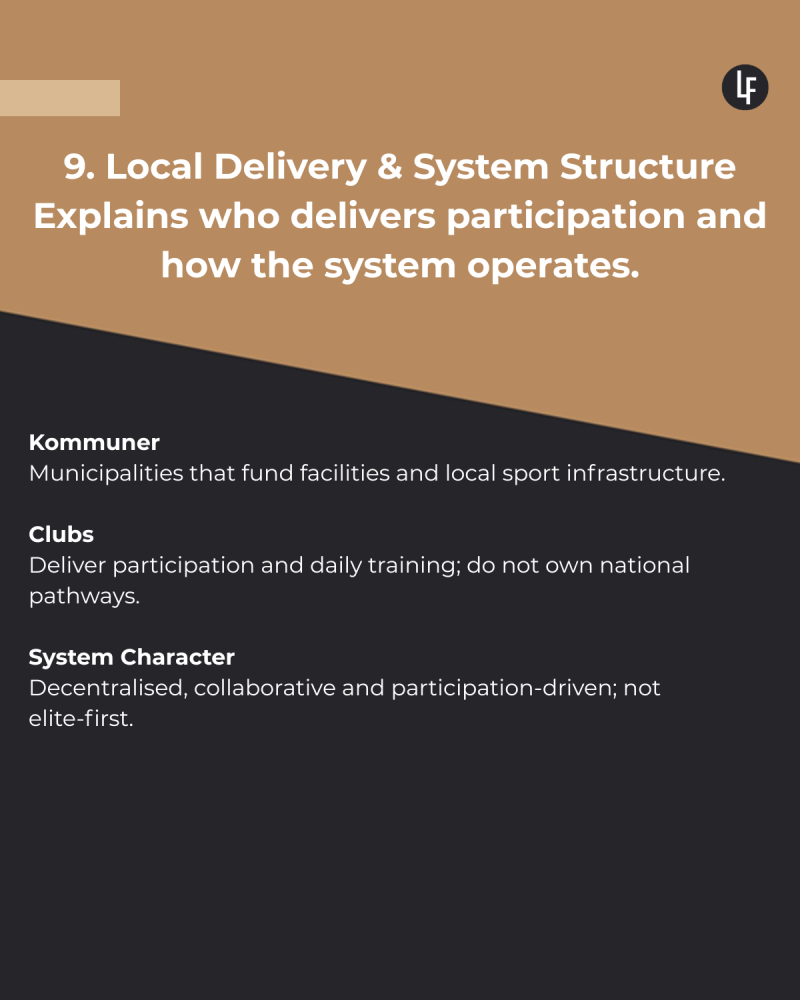
Local Delivery and System Structure
1. Why Sweden Matters to Saudi Arabia
Sweden offers one of the clearest examples of a federation-led Olympic structure operating without a fully centralised national institute system.
Pathways remain owned by federations. National bodies coordinate rather than control. Municipalities support participation infrastructure. Community clubs drive local engagement.
The Swedish Olympic Committee supports and coordinates performance development, while federations retain responsibility for athlete pathways and sporting direction.
This governance structure is highly relevant because Saudi Arabia already shares aspects of a federation-led system.
The comparison therefore becomes structurally useful: not because Saudi Arabia should replicate Sweden, but because it demonstrates that sustainable international performance can emerge through multiple governance models beyond highly centralised institute systems.
Sweden’s Paris Olympic performance (four gold, four silvers, three bronze) also demonstrates that decentralised systems can continue producing world-class athletes despite operating within identifiable structural constraints.
That lesson matters for Saudi federations currently navigating:
- pathway development
- operational maturity
- workforce capability
- infrastructure coordination
- regional expansion
- participation growth
Saudi Arabia begins from a fundamentally different baseline. For citizens, including women and girls, structured movement, organised play, and public exercise environments are new phenomena. For parts of the population, structured movement, organised play, and recreational sport participation were historically limited or absent from daily life. The rapid development of projects such as the Sports Boulevard reflects this historical absence of public movement environments.
This means Saudi Arabia is not “behind;” it is building from the ground up. And building from the start requires a different kind of system design: one that is sequenced, realistic, and grounded in long-term capability development.
1.2 Adopting the Logic, Not the Structure
Saudi Arabia should adopt the logic of Sweden’s system, not its institutional form. Sweden’s model evolved within civic cultures of trust, volunteerism, and generational club traditions. Saudi Arabia does not have these historical layers. Instead, it has:
• strong national strategic direction
• rapidly developing regional structures
• federations with growing operational responsibility
• a population entering sport for the first time
• women and girls with no inherited or established pathway models
• new public spaces, new terminology, and new expectations
This creates the opportunity for a Saudi-first hybrid model, but only if framed realistically:
Federation-owned pathways remain the central pillar.
Nationally coordinated infrastructure (sports medicine, rehabilitation, psychology, data) provides stability that federations cannot yet build alone.
Regional delivery capability grows gradually as workforce depth increases.
Participation expansion becomes the foundation of future competitive sustainability.
Saudi Arabia is not replicating Sweden. Saudi Arabia is constructing a system that has never existed before.
1.3 The National Middle Layer as a Long-Term Construction Project
In this hybrid model, the national middle layer becomes the critical structural asset, but it must be understood as a multi‑year capability-building project, not an immediate solution.
This middle layer includes:
• sports medicine
• rehabilitation
• performance services
• psychology and mental health
• data and monitoring systems
• regional coordination mechanisms
Its purpose extends far beyond elite sport. It exists to:
• reduce operational inconsistency across participation, rehabilitation, and performance environments
• improve continuity of care and decision-making accountability
• lower long-term health and financial burden on athletes and families
• strengthen pathway sustainability and regional delivery capability
• support long-term athlete development
• create stable operating conditions within a rapidly expanding sporting ecosystem
This is not a short-term performance intervention. It is long-term state capability construction. As participation ecosystems expand, governance systems must evolve alongside them through operational learning, coordination maturity, workforce development, and integrated delivery structures. Without this alignment, systems can become administratively functional on paper while operational inconsistency persists across daily environments, rehabilitation pathways, and regional service provision.
One of the long-term risks within rapidly expanding systems is the emergence of capability traps, where growth in infrastructure, policy, or investment outpaces the operational mechanisms required to sustain consistent delivery. Over time, this can produce variability between strategy and execution, limiting pathway continuity, slowing institutional learning, and transferring operational burden toward athletes, families, coaches, and local practitioners.
Saudi Arabia’s Advantage
Saudi Arabia’s advantage is that many of these systems are being designed in parallel with participation growth. This allows coordination, rehabilitation continuity, workforce capability, and integrated governance to be built into the system during expansion rather than retrospectively when pressures emerge.
1.4 Final Doctrine
The strategic question for Saudi Arabia is not whether to centralise or decentralise. It is how to build, over time, a national middle layer that strengthens federations recognising that the Kingdom begins from a limited experiential base and must sequence capability development carefully.
2. Nordic Participation Logic
2.1 Association Culture: Democratic Governance, Member Ownership & Slow Adoption
Nordic sporting systems are deeply shaped by association culture. Sweden’s association culture (föreningsliv) is the structural foundation of its sport system. Clubs are not commercial entities; they are democratically governed associations, shaped by a civic tradition that predates modern sport. The defining legal anchor is the 1999 “51‑percent rule,” which requires that at least 51% of every sports club must be owned by its members. This ensures that clubs remain community institutions rather than investor‑controlled assets.
In practice, members vote on leadership, budgets, long‑term strategy, and even facility decisions. A Swedish club is not a service provider delivering sport to passive consumers. It is a local civic organisation. This creates strong local identity, long‑term community continuity, and high levels of participation stability across generations.
This democratic structure produces stability, but it also produces conservatism. Clubs adopt change slowly because change must be negotiated through assemblies, committees, and member education. Federations cannot simply direct clubs; they must persuade, inform, and build consensus. Adoption speeds vary widely: one club may modernise rapidly; another may take years to shift a single governance practice. This is not inefficiency; it is the operational reality of democratic association governance. Swedish law formally embeds this structure through the 51% member‑ownership rule, reinforcing the position of clubs as civic institutions rather than investor‑controlled entities.
This has direct implications for:
• infrastructure modernisation
• integrated service adoption
• data governance
• rehabilitation coordination
• workforce standardisation
Saudi Arabia’s historical trajectory is structurally different.
The Kingdom developed within a centralised governance environment, where large‑scale civic associations and member‑owned sporting traditions did not evolve in the same way as in Nordic societies. Clubs emerged within a state‑led framework designed for national alignment, not local democracy. Institutional legitimacy therefore flows vertically through national governance structures rather than horizontally through member ownership.
At the same time, Saudi Arabia is now entering a new phase of professionalisation and commercial transformation through the privatisation of major clubs and the introduction of strategic investment structures involving entities such as the Public Investment Fund (PIF). This creates a fundamentally different governance trajectory from the Nordic association model.
Saudi clubs are increasingly developing as nationally strategic sporting assets operating within a state‑led modernisation framework. The objectives are therefore different.
Saudi Arabia’s current transition prioritises:
• rapid professionalisation
• commercial sustainability
• international competitiveness
• governance modernisation
• infrastructure development
• global sporting relevance
These approaches are not directly comparable because they emerge from different historical starting points and national priorities. Sweden’s system evolved over generations; Saudi Arabia is building a modern sport ecosystem within a single decade.
This creates a dual-track development reality: Saudi Arabia is simultaneously building elite commercial sport and participation infrastructure at the same time. Sweden built these sequentially; Saudi Arabia is building them in parallel.
The strategic challenge for the Kingdom is therefore not whether to become “more Nordic,” but how to ensure that rapid commercial growth at elite level is matched by equally deliberate investment in participation, community infrastructure, and long-term pathway development.
Without this balance, elite commercial expansion and population participation systems risk evolving separately rather than as one integrated national sporting ecosystem, a divergence risk seen globally in rapidly commercialising sport systems.
Saudi Arabia’s opportunity is to design a system where commercial ambition and community participation reinforce each other. The lesson from Sweden is not the model, but the principle: local identity, community engagement, and participation depth are structural assets, and they must be cultivated deliberately in a governance environment that is building them for the first time.
In highly decentralised systems, integration capacity often develops unevenly because local environments mature at different speeds. This is one reason why middle-layer coordination becomes increasingly important as systems scale.
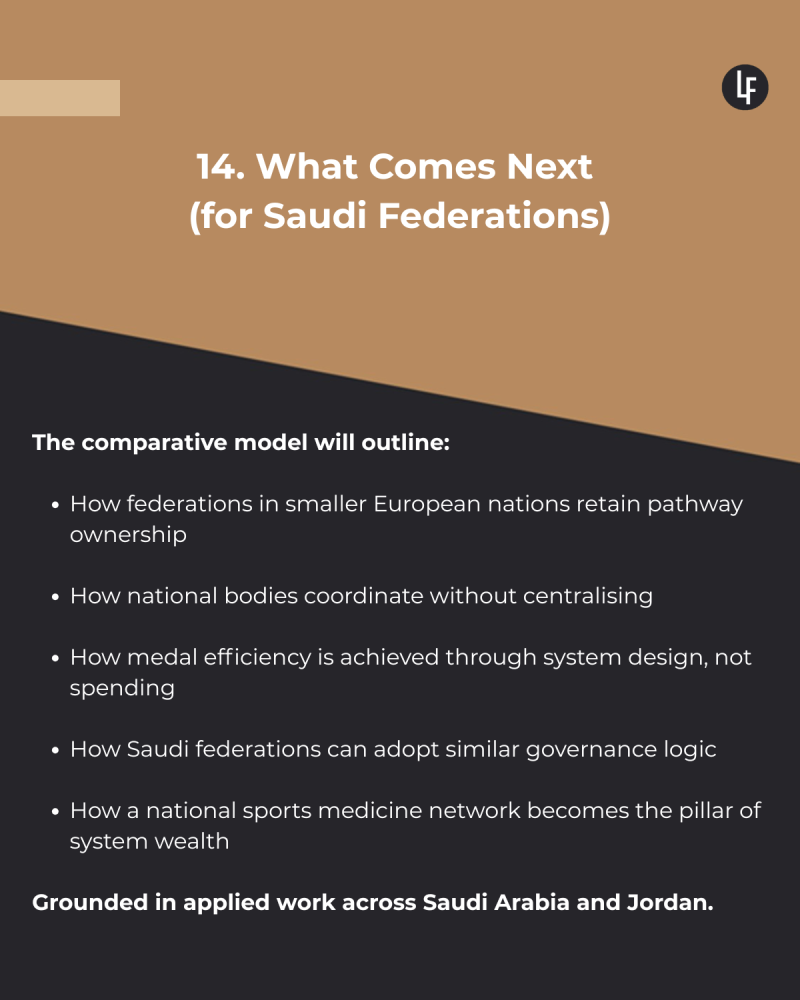
3. The National Middle Layer
National Infrastructure, Capability Structure & System-Level Value Creation
Every sport system has a participation base and an elite tier. What distinguishes mature systems from emerging ones is not the top or the bottom, but the middle layer, the national infrastructure that connects daily training environments, medical and performance systems, regional capability, and long‑term athlete development. In Sweden, this layer is decentralised. In the UK, it is centralised through institutes. In Saudi Arabia, it is only now beginning to take shape. And because it is being built at this moment, the Kingdom has a unique opportunity: to design a middle layer that integrates health, participation, rehabilitation, digitalisation, regional infrastructure, and pathway governance into one coherent national system.
This middle layer is the infrastructure that stabilises the entire ecosystem. Without it, decentralised systems become uneven, centralised systems become overloaded, and athletes carry the cost, risk, and instability of system gaps. With it, federations can own pathways confidently, clubs can deliver consistently, and national bodies can coordinate without centralising.
The middle layer is therefore the structural foundation of Saudi Arabia’s emerging hybrid model: a model that combines federation autonomy with national alignment, regional and local delivery with national governance, and sport‑specific identity with system‑wide safety, continuity, and quality.
3.1 National Sports Medicine & Performance Infrastructure
The first component of the middle layer is a national sports medicine and performance infrastructure. This is the system that ensures athletes experience continuity, and that federations can deliver pathways without relying on ad‑hoc networks or private‑sector workarounds.
A distinction must also be made between athlete services and national infrastructure. Individual services such as treatment, testing, rehabilitation, or performance support can exist without the presence of an integrated system. Infrastructure operates differently. It creates governance continuity through shared standards, clinical pathways, communication structures, regional coordination, and return‑to‑sport oversight. Without this layer, support remains episodic and dependent on individual practitioners or local environments rather than embedded within a scalable national framework.
Sweden’s model illustrates the distinction between access and coordination. Athletes may move across SOK medical support, regional academies, private specialists, hospitals, and cross‑border providers throughout the athlete journey. Multiple access points can increase flexibility and broaden expertise, particularly within decentralised environments.
However, where governance standards, rehabilitation ownership, communication pathways, and return‑to‑sport coordination vary between environments, continuity can become inconsistent across the system. In practice, athletes and families may still carry responsibility for coordinating information, navigating providers, and maintaining pathway continuity between environments. The strategic question is therefore not how to eliminate multiple access points, but how to align them through shared standards, integrated communication, and clearly defined accountability structures.
Saudi Arabia is now taking a different path. The recent national job posting for a senior sports medicine role, positioned explicitly as a multi‑sport, system‑building, governance‑aligned national function, is the first visible signal of the middle layer emerging. The role appears designed to operate across federations and performance environments rather than within a single sport structure, supporting national coordination, clinical governance, rehabilitation continuity, and cross‑system integration. Importantly, this does not imply the creation of a fully centralised institute model, that individual federations may struggle to develop consistently and simultaneously during periods of rapid national expansion. Federations retain ownership of technical pathways and sporting direction. The purpose of the middle layer is different: to provide coordination, continuity, governance stability, rehabilitation infrastructure, and regional capability that individual federations cannot consistently build alone during periods of rapid expansion.
A system of this kind requires three foundational elements:
• A single clinical governance framework that defines safety, standards, and decision rights across clubs, federations, and national teams.
• Regionally delivered medical and performance hubs that provide diagnostics, rehabilitation, and return‑to‑sport coordination close to where athletes live.
• Integrated data and communication pathways that ensure continuity of care and reduce duplication, risk, and uncertainty.
Rehabilitation ecosystems sit at the heart of this infrastructure. Globally, rehabilitation is the most fragmented part of sport systems. Athletes move between club physios, private clinics, hospitals, specialists, and national team staff. Each holds a piece of the puzzle; no one holds the whole pathway. This creates inconsistent load progression, unclear return‑to‑sport criteria, psychological uncertainty, re‑injury risk, and athlete drop‑off. A national middle layer solves this by creating rehabilitation ecosystems rather than isolated services. These ecosystems provide continuity from injury to rehabilitation to training to competition, supported by strong regional hubs, shared protocols, MDT case conferences, and return‑to‑sport governance.
Return‑to‑sport itself is not a medical decision; it is a governance decision. It requires medical clearance, performance readiness, psychological readiness, load progression, risk assessment, and communication across club, federation, and national team, with the athlete at the centre and family. In decentralised systems, this coordination is inconsistent.
In Saudi Arabia, it can be nationally aligned and regionally delivered. This is one of the Kingdom’s most significant structural advantages: the ability to create a predictable, safe, and nationally aligned return‑to‑sport pathway that reduces risk for athletes and institutions alike.
Regional capability is the final pillar of this infrastructure.
A national system cannot be Riyadh-centric. Regional capability determines participation continuity, injury outcomes, family trust, female access, and long-term athlete retention. When capability is concentrated in one city, the system becomes exclusionary by design. When capability is distributed, the system becomes accessible, scalable, and resilient.
Saudi Arabia’s middle layer must therefore be regionally delivered, nationally aligned, and locally trusted over time.
3.2 National Capability Structure - Second Middle Layer
The second component of the middle layer is the national capability structure: the way capability is distributed across regions, federations, and the wider population. This distribution model determines whether the system becomes inclusive or exclusionary, scalable or fragile, resilient or dependent on a small number of high-capacity environments.
Saudi Arabia’s current capability landscape is developing at different speeds across regions. Riyadh has density: specialists, diagnostics, private‑sector capability, federation proximity, and emerging performance hubs. Regional areas have emerging capability, variable access, uneven infrastructure, and lower specialist density. But Saudi Arabia has the opportunity to design a different trajectory by building a middle layer that distributes capability rather than centralising it.
A national capability structure requires three structural commitments:
• Local access to essential services, ensuring that participation does not break when injury occurs and that families trust the system enough to keep children, especially girls, engaged.
• Federated support delivered through shared national infrastructure, allowing federations to maintain technical autonomy while relying on consistent medical, rehabilitation, and performance systems.
• Scalable delivery models, where regional hubs, unified standards, and digital integration allow the system to grow without losing coherence.
Local access is the foundation of participation continuity. When athletes must travel long distances for diagnostics, rehabilitation, or specialist care, participation becomes fragile. When access is local, accessible, and culturally aligned, participation becomes resilient. This is especially true for women and girls, where family trust, psychological safety, and local accessibility determine whether participation deepens or disappears.
Women’s and girls’ participation environments
are therefore not a separate topic; they are a structural component of the national capability architecture. Female participation requires environments that are accessible, modesty‑aligned, psychologically safe, and locally trusted. When these conditions exist, participation deepens, retention increases, and long‑term medal potential expands. When these conditions are absent, participation pathways narrow before long‑term talent development can fully emerge.
Saudi Arabia’s capability structures must therefore integrate women’s sport from the beginning, not as an add‑on but as a core design principle. This is one of the Kingdom’s most significant structural opportunities: to build participation systems where female engagement, retention, and long‑term pathway continuity are embedded from the beginning. Concentrated expertise can accelerate short‑term performance, but it can also create long‑term dependency risk. Sustainable national capability requires workforce depth, regional learning environments, and distributed operational knowledge so that system continuity does not depend on a limited number of institutions, practitioners, or cities. Long‑term stability therefore depends not only on importing expertise, but on creating clear progression pathways for Saudi nationals to develop across clinical, technical, operational, and leadership environments throughout the system.
3.3 System‑Level Value Creation - Third Middle Layer
The third component of the middle layer is system‑level value creation: the national outcomes that emerge when infrastructure, participation, healthcare, rehabilitation, and capability structures operate as one coordinated environment. This is where the middle layer moves beyond sport and becomes part of national development, public health, workforce sustainability, and long‑term societal value.
The first area of value creation is the reduction of athlete cost burden. Sweden’s data is clear: athletes pay for private rehabilitation, travel, specialist care, and fragmented access. Costs accumulate because the system lacks integrated pathways. Families carry the burden because the state does not.
Saudi Arabia has the opportunity to significantly reduce this burden through nationally coordinated sports medicine infrastructure, regional rehabilitation hubs, and integrated return‑to‑sport pathways. This reduces private‑sector dependency, travel costs, and fragmentation. It also increases equity, allowing athletes from all backgrounds to remain in the system.
The second area of value creation
is population health integration. Sport systems are not separate from public health; they are part of the same national architecture. Saudi Arabia faces high obesity rates, high inactivity, rising NCD burden, and a young population. Sport participation is a preventative health intervention. The middle layer enables early detection, early intervention, healthier pathway entry, reduced injury burden, reduced dropout, and long‑term public‑health savings. This is measurable: reduced NCD burden, reduced musculoskeletal injuries, reduced healthcare utilisation, increased workforce productivity, increased female participation, and stronger community cohesion.
The third area of value creation is rehabilitation continuity.
Globally, post‑injury impact is one of the biggest drivers of dropout. Athletes lose continuity, confidence, identity, and psychological safety. A national rehabilitation ecosystem provides predictable pathways, psychological support, return‑to‑participation frameworks, local delivery, MDT coordination, and family‑aligned communication. This is one of the most under‑discussed areas in global sport governance. Saudi Arabia can lead the field by designing it deliberately.
The national middle layer is the infrastructure that stabilises the entire Saudi sport ecosystem.
It enables federation autonomy, national alignment, regional capability, athlete protection, participation continuity, public‑health value, and long‑term medal efficiency. It is the system that many sporting nations built gradually over time. Saudi Arabia now has the opportunity to build it deliberately, coherently, and aligned with Vision 2030 from the beginning.
This is where the Kingdom’s greatest opportunity lies: to build a nationally integrated capability system designed deliberately for the realities of modern sport, public health, participation growth, and long‑term societal development.
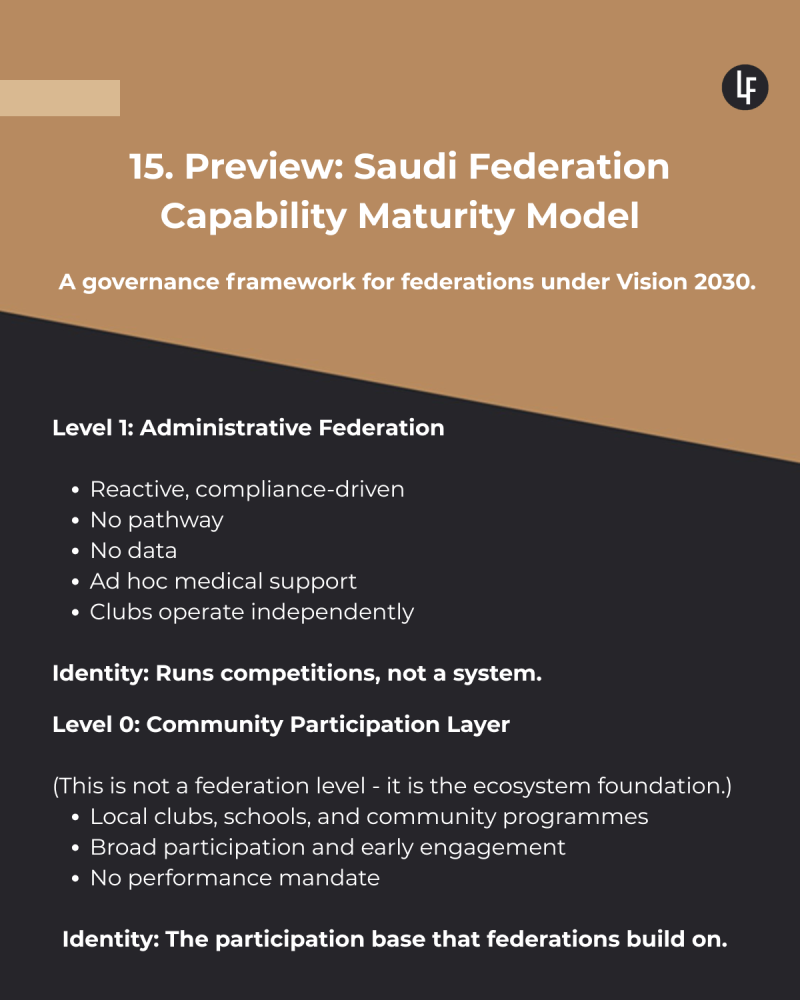
Federation Capability Maturity Model (FCMM)©
4. Federation Capability Maturity Model
Emerging sport systems rarely develop uniformly. Federations often operate at different levels of maturity at the same time, with some functioning primarily as administrative bodies and others beginning to resemble integrated pathway systems. The Federation Capability Maturity Model provides a shared language for understanding this progression. It is a framework for diagnosing system conditions, identifying structural gaps, and guiding long‑term capability development under Vision 2030.
The model outlines five levels of maturity, each defined by governance behaviour, operational capability, workforce development, data maturity, medical and rehabilitation structures, and alignment with national priorities.
Level 0 – Participation Foundation
This is not a federation level. It is the ecosystem base. Schools, clubs, municipalities, and community programmes deliver participation, early engagement, and broad access. There is no performance mandate and no formal pathway. Infrastructure is local. Workforce is volunteer or part time. Data is minimal. Medical support is community based or private. This layer forms the population base that federations build on.
Level 1 – Administrative Federation
Federations at this level run competitions but do not operate a system. Governance is reactive and compliance‑driven. Pathways are informal or absent. Workforce capability is limited and variable. Data is minimal and episodic. Medical and rehabilitation support remains variable across environments, with uneven integration between sport, health, and performance systems. Rehabilitation is unstructured, dependent on private providers.
The capability gap in Saudi is not a talent gap. It is an exposure and system maturity issue. Governance, regulation, system integration, data pathways, and institutional capability are still forming, so capability is developing in real time.
Clubs operate independently with limited alignment. Operational focus is event delivery rather than athlete development.
Level 2 – Structured Federation
Federations begin to formalise governance and define pathway intent. Pathways are documented but not yet operational. Workforce development begins through early coach education and basic technical roles. Data collection is emerging but inconsistent. Medical support is episodic and dependent on individual relationships. Rehabilitation is case by case. Governance structures exist but are not yet embedded. This level knows what the pathway should be but cannot yet deliver it.
Level 3 – System Building Federation
Federations begin to operate like systems. Pathways function across youth, development, and early elite levels. Selection and competition frameworks are defined. Early MDT structures emerge, and medical support becomes increasingly coordinated rather than episodic. Rehabilitation pathways begin to stabilise. Clubs start aligning with federation standards, while data becomes operational in supporting selection, participation tracking, and early performance planning. Regional coordination begins to emerge, alongside clearer governance integration across pathway environments. Organisational identity shifts from competition administration toward long‑term pathway stewardship.
Level 4 – Integrated Federation
Federations operate with national alignment and system‑level capability. Longitudinal data systems support planning, injury reduction, and talent tracking. Workforce capability expands across coaching, physiotherapy, analysis, psychology, pathway management, and integrated performance support. Medical and rehabilitation services operate through increasingly aligned regional and federation environments. Club accreditation and coach licensing frameworks are implemented. SOPC performance reviews and evidence‑based planning become routine. Governance becomes increasingly stable, integrated, and aligned with Vision 2030 priorities. The federations operate as connected pathway environments rather than a collection of isolated functions.
Level 5 – Integrated Federation Ecosystem
Federations operate as integrated performance ecosystems rather than isolated sporting bodies. Technical coaching, sports medicine, rehabilitation, psychology, performance nutrition, analysis, and pathway management function through coordinated multidisciplinary and increasingly integrated operating structures aligned around the athlete pathway.
Participation, rehabilitation, talent development, and elite performance are connected through regionally distributed environments supported by strong governance frameworks, longitudinal data systems, and nationally aligned standards. Federations retain technical ownership while operating within coordinated national structures that support continuity, safety, and long‑term capability development.
Workforce capability becomes sustainable rather than personality‑dependent. Rehabilitation pathways are integrated across training, healthcare, and return‑to‑sport environments. Regional hubs develop strong local identity, operational trust, and internationally credible delivery capability. National bodies increasingly shift from direct operational oversight toward strategic alignment, innovation, capability exchange, and long‑term system stewardship.
At this level, medal performance becomes a consequence of system maturity rather than isolated investment.
Digitalisation, AI & Non-Linear Capability Development
Importantly, federation capability development is not always linear. Digital systems, athlete management platforms, electronic medical records, athlete monitoring technologies, and AI-supported operational processes can emerge at multiple stages of maturity when adapted realistically to local conditions and workforce capability.
This is particularly relevant within rapidly developing ecosystems such as Saudi Arabia, where federations may adopt advanced digital infrastructure while broader governance, pathway, or operational systems are still evolving simultaneously.
Used effectively, digitalisation can accelerate coordination, improve communication continuity, strengthen governance visibility, reduce administrative burden on coaches and practitioners, and support more precise decision making across athlete pathways. AI-supported systems may also assist federations in identifying operational gaps, improving monitoring efficiency, reducing duplication, and connecting support provision more closely with actual athlete and system needs.
However, technology alone does not create maturity. Digital systems remain dependent on governance clarity, operational integration, workforce capability, and consistent implementation across environments. The strategic value of digitalisation therefore lies not in technological adoption, but in its ability to support scalable coordination, integrated delivery, and long-term system learning across the ecosystem.
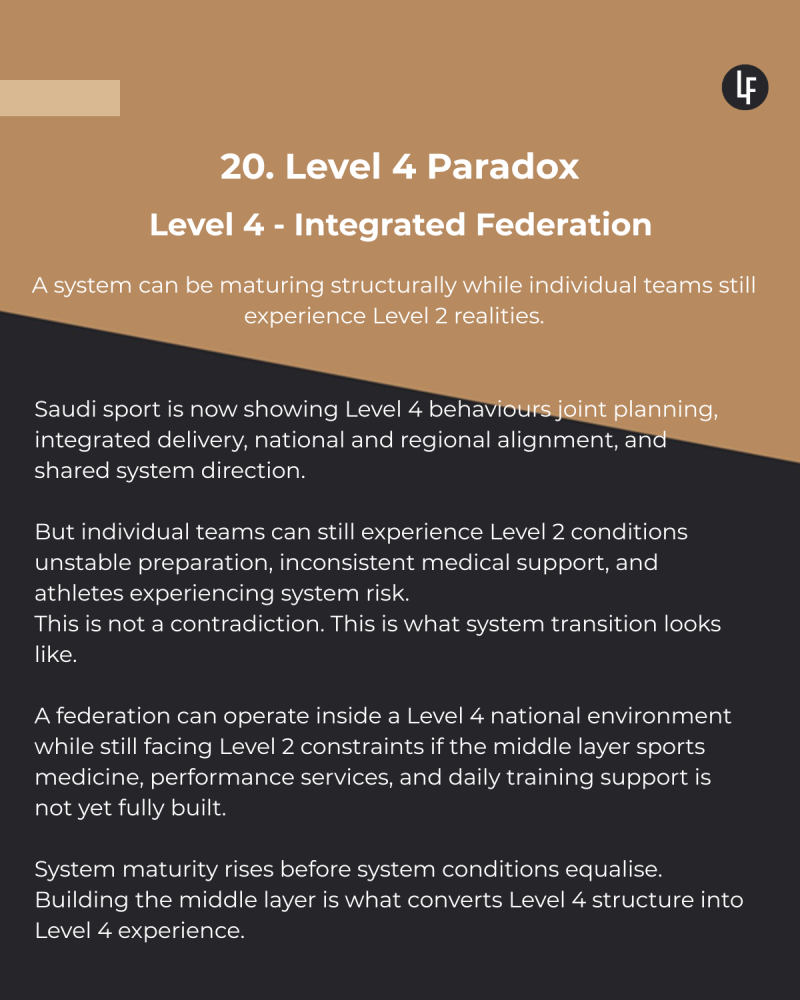
5. The Level 4 Paradox
One of the most consistent patterns in system development is that structural maturity often advances faster than operational conditions equalise across regions, clubs, and athlete environments. This transitional condition is described as the Level 4 paradox.
A system may demonstrate integrated governance, strategic alignment, infrastructure investment, participation growth, regional coordination, and emerging digital capability, while athletes may still experience uneven medical access, inconsistent rehabilitation, preparation, and variable daily training conditions. It is often characteristic of systems undergoing rapid structural transition.
In emerging and rapidly evolving environments, governance frameworks, national strategies, and investment can develop faster than operational capability.
Operational consistency, however, depends on workforce depth, regional capability, facility access, medical integration, rehabilitation systems, and the maturity of local delivery environments. These conditions typically take longer to stabilise. The result is a temporary gap between structural maturity and lived operational experience.
This pattern is visible within Sweden’s decentralised model and is highly relevant for Saudi Arabia. Sweden demonstrates high structural maturity through coherent federation ownership, strong participation infrastructure, and nationally coordinated governance. At the same time, publicly available reporting from the Swedish Olympic Committee and associated system analysis highlights uneven medical access, decentralised rehabilitation pathways, and athletes carrying significant personal cost and coordination burden. The system is structurally coherent, yet operational conditions remain uneven because the middle layer, integrated sports medicine, rehabilitation, psychology, and performance infrastructure, is not fully embedded nationally.
Saudi Arabia is entering a similar transitional phase, but under different historical and governance conditions. Vision 2030 has accelerated national alignment, participation expansion, digital transformation, regional investment, and federation development. Evidence of these trends is visible through workforce planning, regional coordination, participation initiatives, and integrated governance structures emerging across Saudi sport.
At the same time, individual teams or athlete environments may still experience unstable preparation, inconsistent medical provision, fragmented rehabilitation, or variable daily support conditions.
Within this framework, the central paradox is that a system can demonstrate advanced structural characteristics while operational consistency remains uneven during capability‑building phases.
The middle layer is what converts structural maturity into operational continuity. Integrated sports medicine, rehabilitation, psychology, data systems, and regional performance infrastructure reduce variability between environments and help ensure athletes experience more consistent standards of care regardless of geography, federation maturity, or local capability.
System maturity therefore tends to rise before system conditions equalise. The Level 4 paradox is therefore not a warning sign, but a characteristic of systems undergoing capability expansion across multiple environments simultaneously. Structural maturity often develops before operational conditions
6. Closing – Saudi-First System Design
Sustainable sporting success is not produced by elite programmes alone. It emerges from the interaction between mass participation culture, governance structures, healthcare systems, rehabilitation environments, education, digital infrastructure, workforce capability, regional delivery, and long-term institutional coordination.
Sweden demonstrates that federation-led systems can produce international success without relying on heavily centralised institute models. At the same time, it also reveals the structural pressures that emerge when rehabilitation, sports medicine, participation systems, and performance environments evolve unevenly across decentralised structures.
Saudi Arabia now has the opportunity to build differently.
The Kingdom is developing mass participation infrastructure, federation capability, regional delivery systems, public health integration, women’s sport, digital transformation, and elite pathway structures simultaneously under Vision 2030. This creates a rare opportunity to design integration deliberately from the beginning.
A Saudi-first model therefore does not require copying Nordic or UK systems. It requires understanding the structural logic behind them while designing for Saudi Arabia’s own institutional realities, regional diversity, governance environment, and long-term national priorities.
Within this model, federations remain the owners of technical pathways and sporting identity. National bodies provide alignment, governance continuity, and strategic coordination. Regional hubs stabilise operational delivery. Integrated sports medicine, rehabilitation, psychology, and performance systems strengthen continuity across pathways and athlete environments. Digital infrastructure supports coordination, communication, and long-term system learning across the ecosystem.
The objective is not simply medal production.
The objective is long-term national capability: a system that drives participation and enjoyment, public health, rehabilitation continuity, workforce development, athlete protection, and performance sustainability through one coordinated national environment.
This is the strategic significance of the middle layer.
It is the infrastructure that stabilises the ecosystem enough around the athlete.
And because Saudi Arabia is still building many of these structures in parallel, the Kingdom possesses a unique strategic advantage: the opportunity to design a nationally integrated capability system deliberately, coherently, and aligned with the realities of modern sport, public health, participation growth, and long-term societal development from the beginning.