Building Strength & Power for Killer Goal Keepers - Målvakter (Allsvenskan)
Building Strength & Power for Killer
Goal Keepers - Målvakter
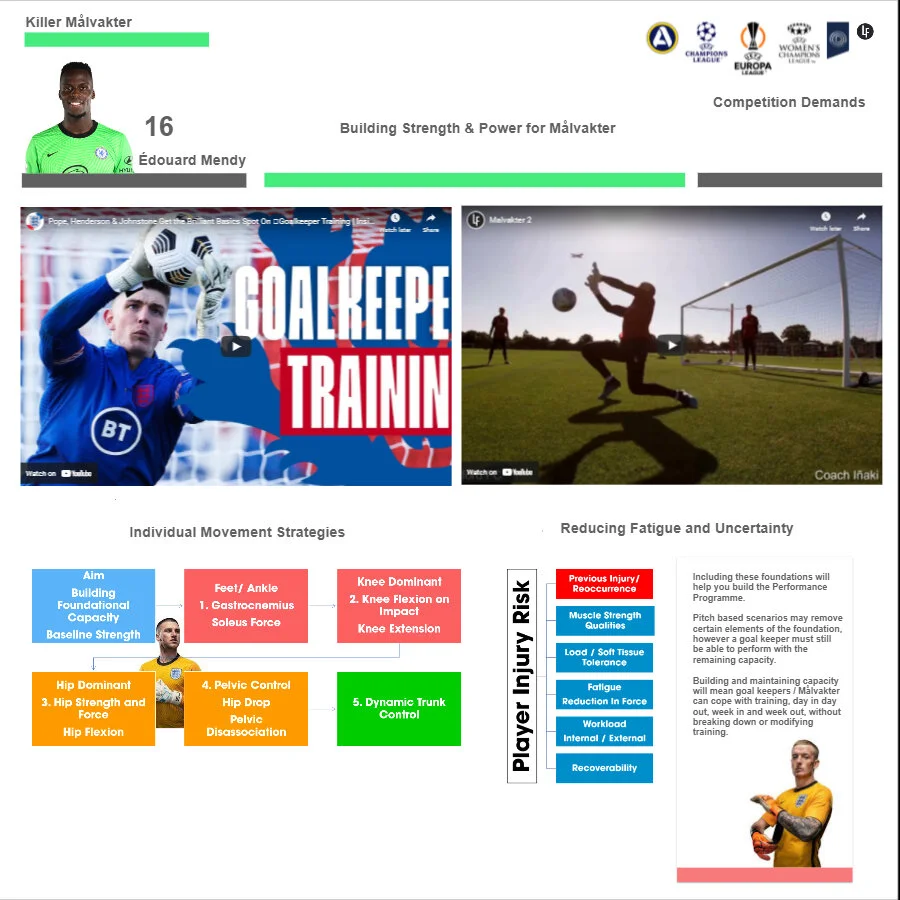
Welcome to Building Strength and Power for Killer Målvakter - Goal Keepers. I include training guidance and content gathered from my time coaching Målvakter in the field of performance. You can hop to the sections you are interested in, or work your way through the video resources at your own pace.
The focus is on physical preparation, both pitch and gym based. I am not a Goalkeeping Coach; however, I flex and support team needs across seasons. This includes working closely with Goalkeeper / Målvakter coaches.
Introduction Video 1
18 Mins Listen and Watch
The first video covers a little about my coaching background and why I use the term Killer Målvakter - Goalkeepers.
(Disclaimer: No fouls or taking players out).
I cover how to build from the ground upwards. This includes sample exercise menus, muscle forces for kicking, training videos, tension arc training, swing limb loading, upper body development and flexibility.
Key
Målvakter = Goalkeepers
Målvakt = Goalkeeper
Styrka = Strength
Killer Målvakter (Goalkeeper) Introduction
and Muscle Forces for Kicking

Biomechanics of Målvakter Diving Save and Force Output
Introduction Video 2 | 7.27 Mins Listen and Watch
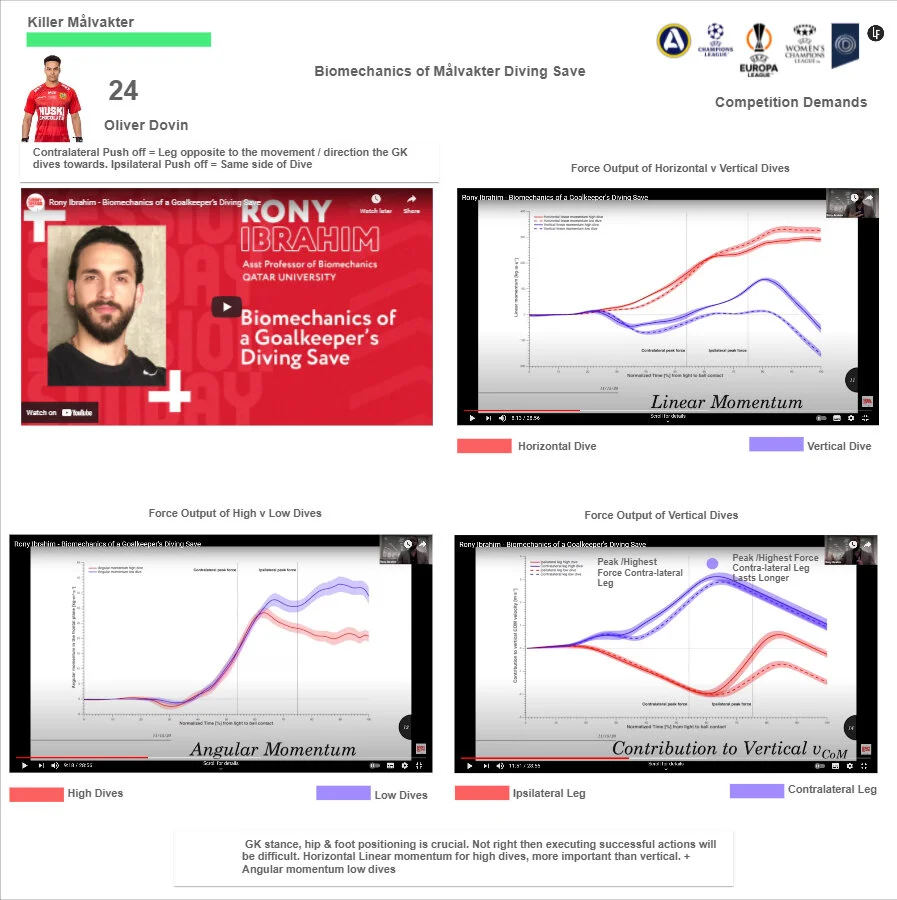
This video highlights the key insights from Dr Rony Ibrahim, Assistant Professor of Biomechanics at Qatar University. If you want to understand how goalkeepers dive, this is an excellent resource.
The presentation explores force production in horizontal and vertical dives, differences between high and low dives, momentum generation, force output, joint sequencing, muscle power and movement coordination. It concludes with practical considerations around stance width, knee angles and training implications for goalkeeper development.
A number of La Liga video clips originally embedded within the presentation could not be included due to YouTube restrictions. Whilst the video segments have been removed, the supporting slides and key information have been retained below.
Contribution of Horizontal Vertical Force to the Centre of Mass
The contralateral leg plays a particularly important role in generating centre of mass velocity and overall movement speed during a dive.
Horizontal linear momentum contributes significantly more to diving performance than vertical jumping actions. As a result, horizontal force production and movement capabilities should be a primary focus within goalkeeper training programmes.
Understanding how force is transferred through the body and into the centre of mass helps practitioners design more effective training interventions that improve diving efficiency, movement speed and overall goalkeeping performance.

Reference
Rony Ibrahim, Idsart Kingma, Vosse A de Boode, Gert S. Faber & Jaap H. van Dieën (2019) Kinematic and kinetic analysis of the goalkeeper’s diving save in football, Journal of Sports Sciences, 37:3, 313-321. DOI: 10.1080/02640414.2018.1499413
Force Velocity Profiling for Målvakter
Introduction Video 3 | 24 Mins Listen and Watch
This force-velocity profiling resource is designed for coaches who want practical guidance on interpreting force-velocity results and understanding the associated training and performance implications.
The video begins by exploring the qualities that may need to be developed based on an individual athlete's profile, providing practical direction for optimising speed, strength or balanced force-velocity characteristics. It also examines how to identify and address both major and minor deficits while supporting long-term athlete development.
Whilst the examples focus on goalkeepers, the principles and methods discussed can be applied across all positions on the field and adapted to a wide range of sporting environments.
The video covers training approaches, programme design, sequencing strategies and practical applications. Topics include speed, strength and power deficit exercise menus, tools for measuring and monitoring explosive power, plyometric progressions, overspeed methods, fast eccentric training, ballistic exercises and resistance training.
My advice is to take the elements you can apply most easily and begin there. Be open-minded, experiment with new approaches and focus on practical implementation. Breaking ideas into smaller, manageable pieces often makes the process easier and more effective.
For coaches already familiar with force-velocity profiling, this resource may reinforce current practice, provide alternative perspectives or offer new session ideas. Ultimately, ongoing exploration and practical application should complement the science. If you achieve positive outcomes, continue. If not, adjust, review and explore alternative approaches.
Strength, speed and power should be developed throughout the year, although the proportion and emphasis placed on each quality will vary according to training cycles, competition demands and environmental factors. Speed development, however, should remain a consistent feature year-round. My hope is that this information helps coaches build stronger, faster and more powerful Målvakter and goalkeepers.
Here is the tutorial from JB Morin on how to carry out force velocity profiling.

Reference
Hervéou T, et al. Force-velocity muscular profiles and jumping performances of soccer goalkeeper. Sci Sports (2018). https://doi.org/10.1016/j.scispo.2017.10.008
Reference
Buchanan, Janice (2019). The Validity, Reliability and Sensitivity of Utilising a Wearable GPS Based IMU to Determine Goalkeeper Specific Training Demands. MSc(R) Thesis.
Exercise Videos and Programming for Building Målvakter
Introduction Video 4 | 49 Mins Listen and Watch
My video and programming resources provide straightforward exercise examples and training programmes for coaches, medical teams and wider performance staff interested in gym- and pitch-based physical preparation for Målvakter / Goalkeepers (Styrka).
The resource covers a range of topics designed to support performance on the pitch, including injury surveillance and training implications, exercise videos, sample exercise menus, strength development, speed development and power development strategies for Målvakter.
The presentation includes practical examples using plyometrics, medicine ball training, ballistic exercises and strength training approaches aimed at developing stronger legs, hips and ankles, alongside improved force production and athletic performance.
Målvakter Programme Examples
Programme Descriptives and Sequencing
1. Training Durability – Priority Session
2. Power Session – Match Replacement
3. Power Development – Young Målvakter / Goalkeepers
4. Intimidation Programme – Upper Body Development (including core training)
Conditioning for Målvakter is often integrated within technical sessions. Tempo running, high-speed running (HSR), sprinting and repeated sprint work are typically modified to reflect the specific demands of the position, although goalkeepers may also participate in selected outfield conditioning activities when appropriate.
Overspeed methods can also play a valuable role within rehabilitation environments. These approaches may help reduce protective neural inhibition around an injured area, improve signal quality between the brain and muscle-tendon complex, and restore confidence in movement execution. The aim is to improve force expression, movement efficiency and the successful return of technical skills such as diving.
References
Muracki, J.; Klich, S.; Kawczyński, A.; Boudreau, S.A. Injuries and Pain Associated with Goalkeeping in Football—Review of the Literature. Applied Sciences. 2021, 11, 4669. DOI: https://doi.org/10.3390/app11104669
Ejnisman, B.; Andreoli, C.; Pochini, A.; Cohen, M.; Bizzini, M.; Dvorak, J.; Zogaib, R.; Lobo, T.; Barbosa, G. (2016). Shoulder Injuries in Soccer Goalkeepers: Review and Development of a FIFA 11+ Shoulder Injury Prevention Program. Open Access Journal of Sports Medicine, Volume 7, 75–80. DOI: 10.2147/OAJSM.S97917

Speed Reserve, Creating Time for Målvakter
Introduction Video 5 | 18.30 Mins Listen and Watch | Additional Content
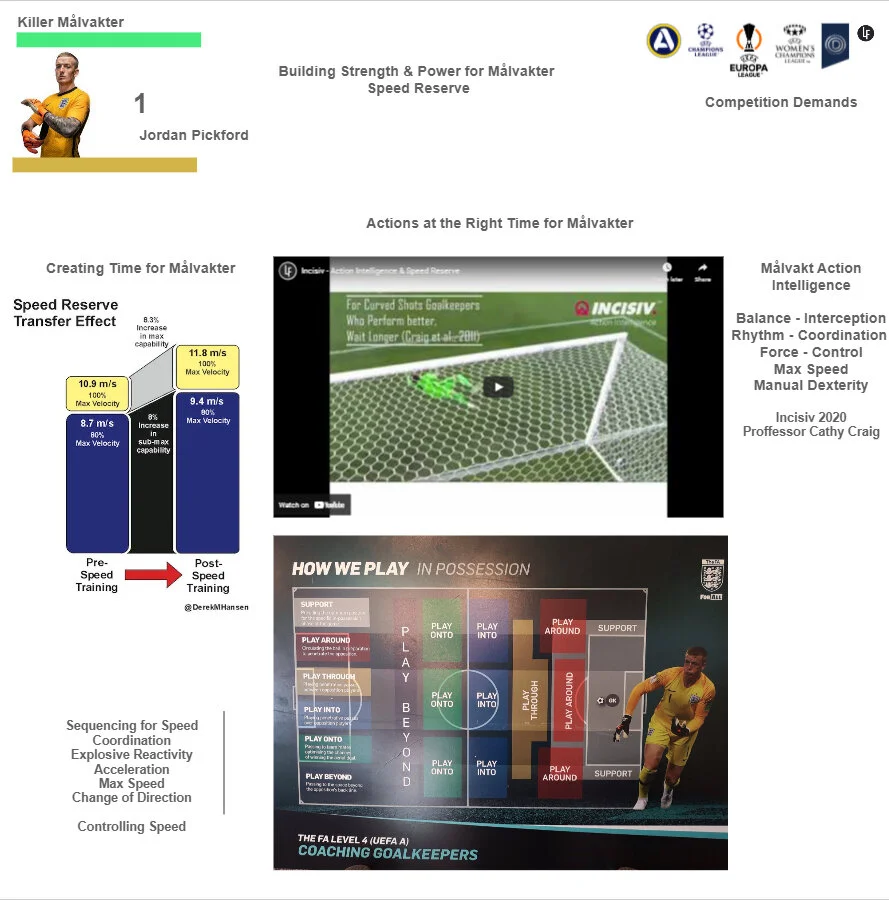
This video explains the implications of what happens when you get Målvakter Goal keepers faster and more powerful, and how that supports performance on the pitch. I cover speed reserve and the performance transfer, the 5 Pillars of Action Intelligence and how this creates more time for decisiveness.
A Paper of Interest
Valkanidis TC., Craig CM, Cummins A, Dessing JC (2020) A goalkeeper’s performance in stopping free kicks reduces when the defensive wall blocks their initial view of the ball. PLoS ONE 15(12): e0243287. https://doi.org/10.1371/journal.pone.0243287
Monitoring Målvakter and Training Loads using Google Data Studio
Introduction Video 6 | 18.32 Mins Listen and Watch
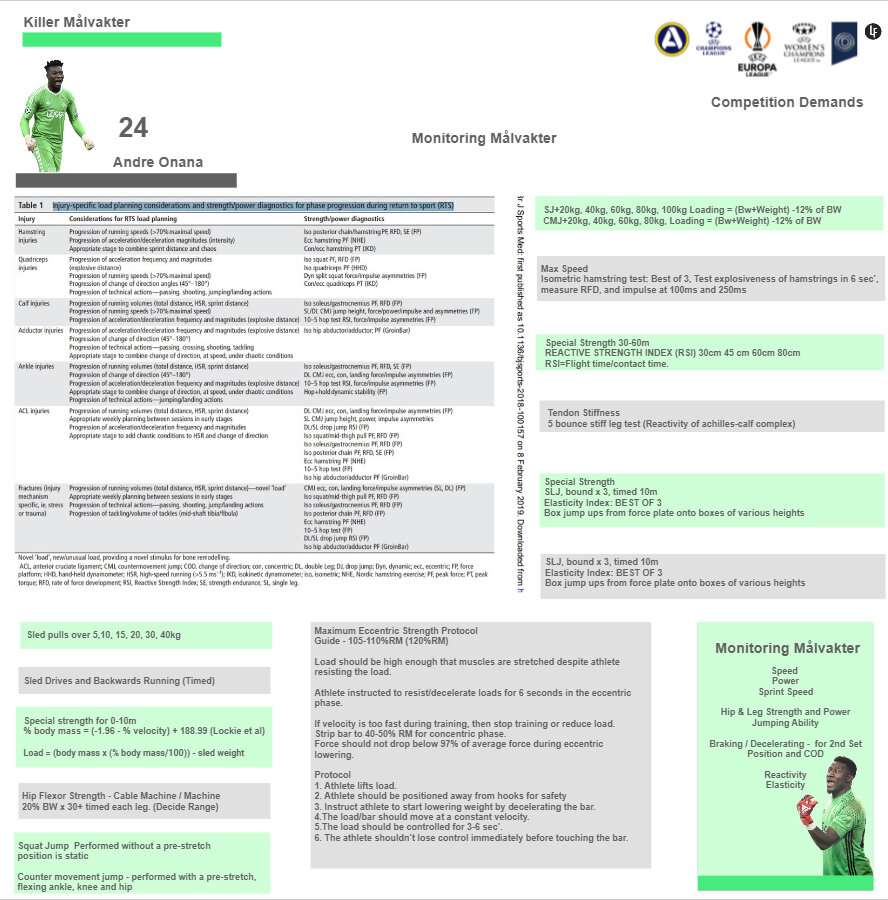
This video shows Monitoring Målvakter - Strength, Speed and Power Diagnostic Snapshots.
These Google Data Studio Dashboards are examples of basic level reporting. This is the front end of reports, google sheets provide the back end data, which is then uploaded. This is an alternative to Power Bi.
• Målvakter Daily Training Loads
• Målvakt Individual Player Dashboard
• Målvakter Individual Player Dashboard By Shape
• Målvakt Individual Weekly Training Dashboard
• Målvakt Individual Monthly Dashboard
This report is interactive, you can explore and click through the reports, drill down the graphs, tables. Scroll through the 10 pages, hover at the bottom of the report for page controls. This can also be enlarged to full screen for viewing for interactive use.
I will be posting GPS dashboards, drill sizes and games, percentage match minutes, Speed monitoring and other dashboards using Google Data Studio. These are a level up, reports will depend on what the manager, coaches and Målvakters want to see and what they regard as useful. I will be sharing more of my work and experiences within fotboll.
Målvakt Interactive Dashboard
Click - hover at bottom of page to click through pages. Click on Goal Keeper - Målvakter name, session dates, week and any other buttons. Use the graph controls to filter.