Edition 2: UK Sports Institute (UKSI) Performance Systems Saudi–MENA Governance Adaptation
Originally published as Edition 2 of the Saudi–MENA Sport Environments LinkedIn Newsletter.
UK Sports Institute (UKSI) Performance Systems
Saudi–MENA Governance Adaptation
This intelligence map outlines the governance, influence and pathway structures across Saudi, GCC and global performance ecosystems. It supports strategic decision‑making, relationship mapping and system‑level understanding for leaders operating at SOPC, federation and national‑pathway level.
1. Governance Reality - How Saudi and Jordan (MENA) Sport Actually Works
UKSI models were built inside a mature, decentralised, athlete‑centred ecosystem with stable governance, integrated data, and clear clinical decision rights. Saudi and wider MENA sport operate at a different governance altitude. Authority flows vertically through ministries, the Saudi Olympic and Paralympic Committee, federations, and clubs. Approvals move through hierarchy and relationships, and medical decisions often require executive or CEO‑level confirmation.
Where UKSI models are built around autonomy, horizontal integration and athlete‑centred clinical governance, Saudi systems are shaped by leadership, institutional priorities and developing structures. Pathways differ between clubs, federations, and ministries. Data democratisation is hierarchical and often held at executive level. Data is frequently fragmented or manual, systems sit across multiple platforms, team and athlete data literacy is uneven, and the pipelines that UK and European models rely on do not yet exist or are emerging at different speeds.
Athlete injury assessment, protocols, communication, and decisions reflect organisational considerations as much as clinical ones. Medical governance in Saudi and MENA operates inside relationship‑based and hierarchical structures rather than independent clinical pathways. Effective performance and medical systems must therefore be designed for the governance environment that exists today in Saudi and MENA sport, not for UK or European contexts.
2. The Hierarchical Governance Framework
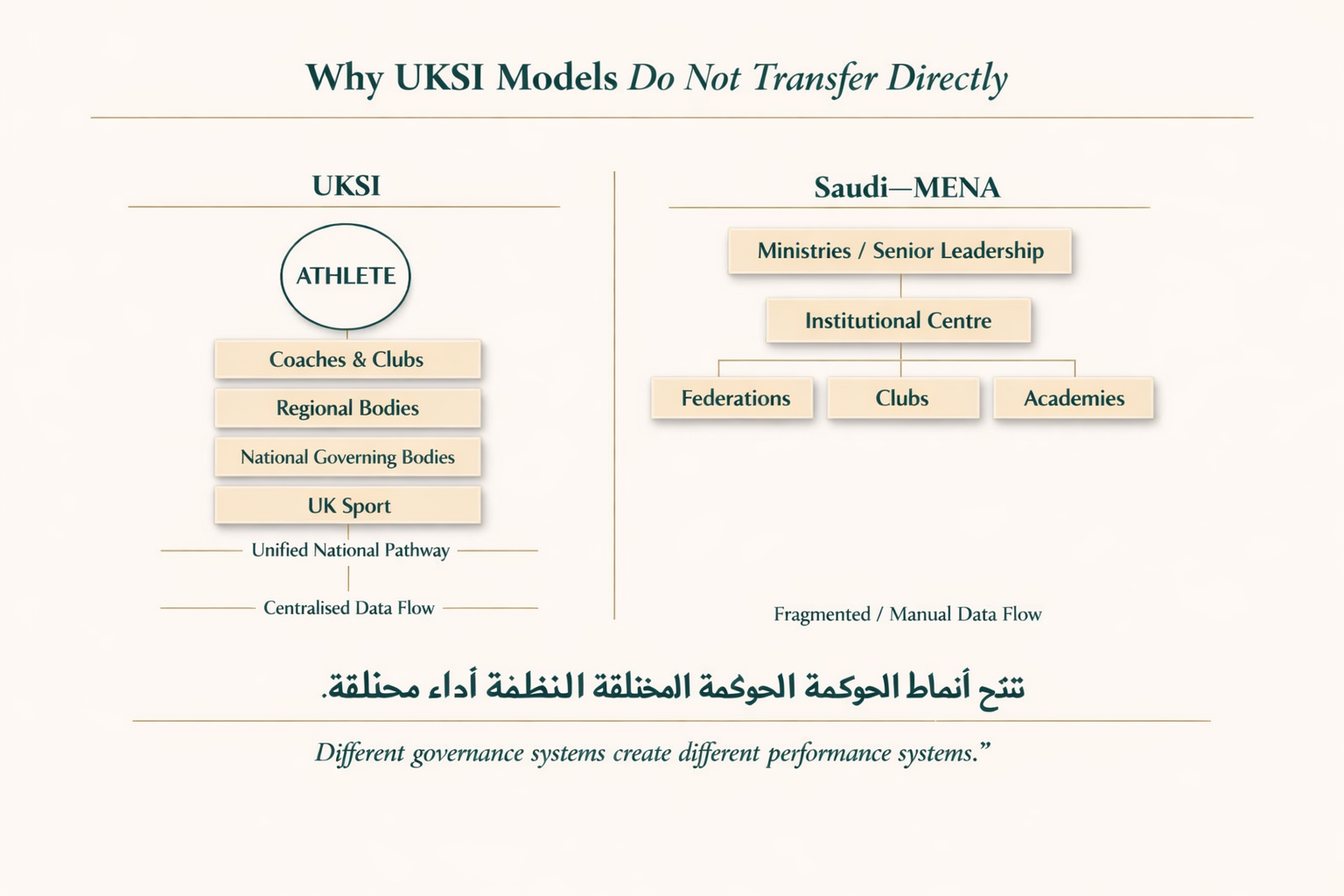
Governance Pathways: UKSI v MENA
2. Governance Mechanisms in Emerging Systems
The overview below sets the context for how governance operates across the region.
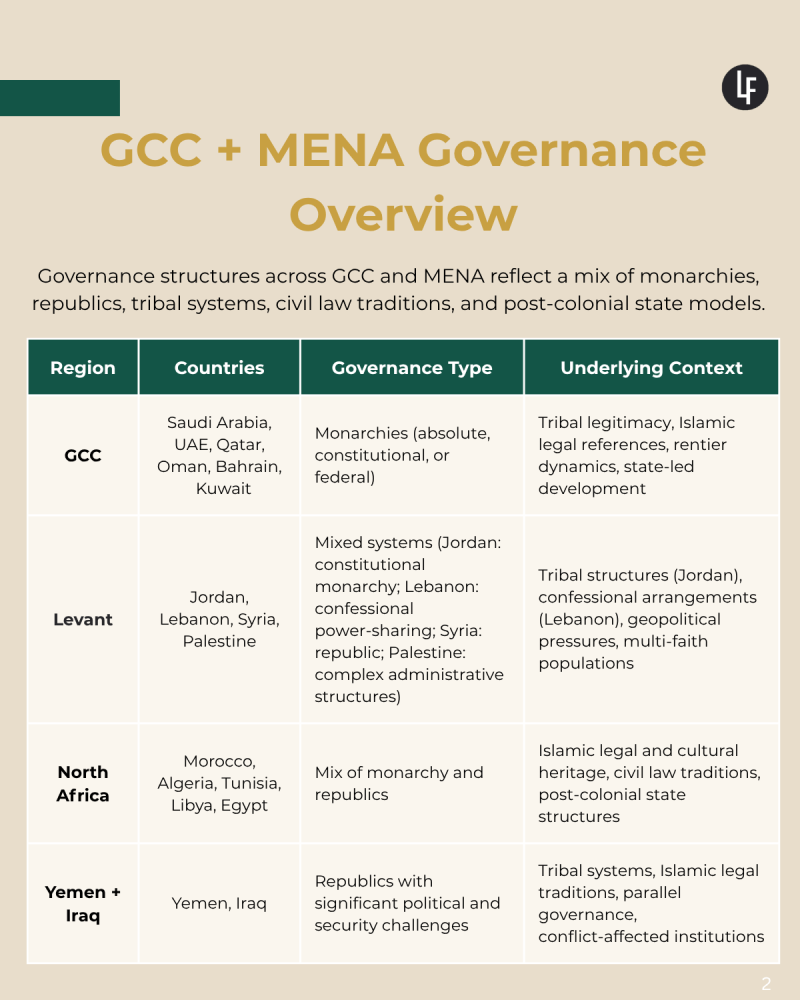
GCC + MENA Governance Overview
Governance is still emerging, with reporting lines and protocols forming as clubs and organisations professionalise. Director‑level performance and medical roles are developing, and authority remains concentrated at senior levels. By demonstrating competence in medical and performance matters, and by working collaboratively with Team Managers who act as connectors to executive leadership, external medical providers and national teams, it became possible to create a more integrated method of working while respecting authority and approval lines. Consistent delivery and clear communication helped build trust and model the behaviours required for more stable governance.
Back Channels as Strategic Enablers
In organisations where decision making is concentrated at board level, back channels become the mechanism through which leadership and team members add the nuance required for precise decisions. This mirrors the role of federation advisors, who act as a structured bridge between federations and the Olympic Committee on strategy and implementation.
Bilateral Flow and Decision Support
Team Managers also provided back channels to executive leadership. Information moved vertically, but also returned down to Director level, supporting nuance, cultural intelligence, context, diplomacy, strategy and precise decision making. This bilateral flow strengthened delivery and reinforced trust in the performance and medical functions. In systems where decision making is concentrated at board level, these relational conduits are essential for ensuring that technical and medical information reaches leadership with the nuance required for informed and timely decisions.
The Role of Cultural Intelligence (CQ)
Cultural Intelligence is the ability to navigate and adapt to unfamiliar cultural environments. It extends beyond technical expertise by integrating four dimensions:
Metacognitive: Reflecting on and adjusting cultural assumptions.
Cognitive: Understanding social, legal and institutional norms.
Motivational: Having the drive to engage with and value cultural differences.
Behavioural: Adapting communication and actions to local expectations.
CQ acts as the connective tissue that enables leaders and practitioners to translate technical medical and performance information into a language that aligns with the hierarchical and relational values of Saudi and Jordanian (MENA) leadership.
3. The Practitioner’s Governance Toolkit
Success in hierarchical environments is rarely achieved through technical expertise alone. It depends on the ability to listen to subtle cues communicated by Team Managers and intermediaries. Often, the “20%” of unspoken or indirect communication yields an “80%” return in operational effectiveness and executive buy‑in.
Diplomatic skills, emotional literacy and cultural awareness are not soft skills; they are the infrastructure that allows technical and medical professionals to navigate complex approval chains. These relational competencies enable practitioners to translate performance and medical functions into precise, contextually appropriate language that influences decision‑making at the highest levels.
Medical Administrative Teams – Access Points and Connectors
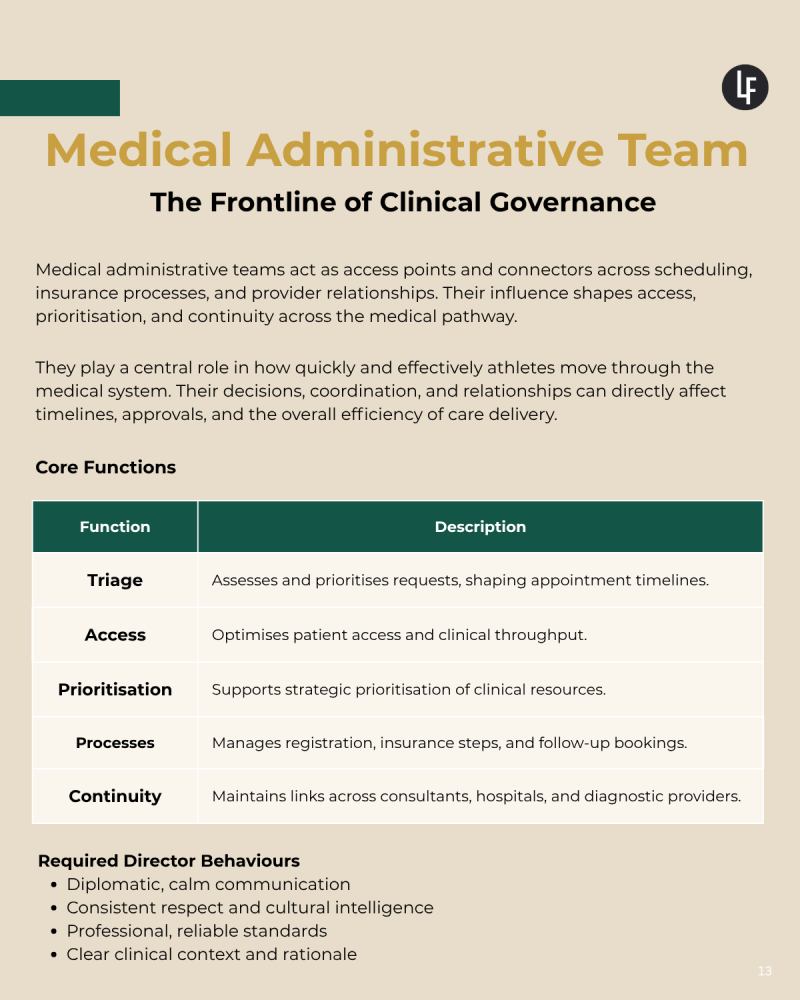
Medical Administrative Team - The Frontline of Clinical Governance
In Saudi and MENA systems, medical administrative teams shape access, prioritisation and continuity across the clinical pathway. They are often the first point of contact and the primary relationship access point between clubs, hospitals, consultants and insurers. Their influence determines the speed, clarity and stability of medical delivery, and they are the first contact point in the governance environment that practitioners must navigate.
4. Saudi Delivery Behaviour (Medical and Performance)
Olympic and Federation Approval Chain
In Saudi Arabia, the Olympic Committee often initiates or validates performance and medical decisions. Federations act as the operational bridge, coordinating delivery and ensuring alignment with national priorities. Approvals move vertically, with reimbursement and authorisation often fast tracked through federation advisors who act as trusted intermediaries. This creates a system where relational authority is as important as technical evidence.
Vertical Approvals for Medical and Injury Decisions
Medical decisions frequently require CEO or executive sign off, even when the issue is clinical. Non medical leaders can influence injury timelines, return to competition expectations, and treatment pathways. Approvals move through relationships rather than departments, and the speed of decision making depends on trust, clarity, and the perceived institutional impact of the decision.
Data Delivery Realities
Data systems remain fragmented. Manual capture is common, and executive leaders often hold data ownership. Data literacy varies across clubs and federations, which affects how performance and medical information is interpreted. This creates a system where the narrative around data is as important as the data itself.
Centralised medical and performance systems, such as Athlete Management Systems and Electronic Medical Records, aim to unify clinical, performance, and operational information. EMR platforms focus on clinical documentation, while AMS platforms integrate wider performance, wellness, and training data. Athletes typically interact through simple apps that allow them to log wellness, view schedules, and access training programmes. These systems support decision making, but their effectiveness depends on adoption, data literacy, and alignment with governance structures.
Data literacy across staff and athletes directly shapes daily operations, compliance, and the effectiveness of medical and performance protocols. In Jordan, for example at Etihad Club, no centralised athlete data, performance systems, or medical platforms existed, which meant that information moved through people rather than systems. Western European assumptions about capability can also slow or prevent the integration of centralised data systems. Capability is often equated with exposure, not competence, and if systems are not introduced clearly, contextually, and with cultural intelligence, errors, repetition, and low compliance follow. These challenges are not Saudi or MENA issues; they are the predictable outcomes of introducing new systems into environments where governance, literacy, and operational norms differ from Western models.
Cultural Delivery Constraints
Tribal approvals, HRH‑level influence, gendered access, and institutional priorities shape how medical and performance decisions are made. These are structural and cultural realities that must be understood and respected. Effective delivery requires cultural intelligence and diplomatic communication.
Separate Example (Non‑Medical)
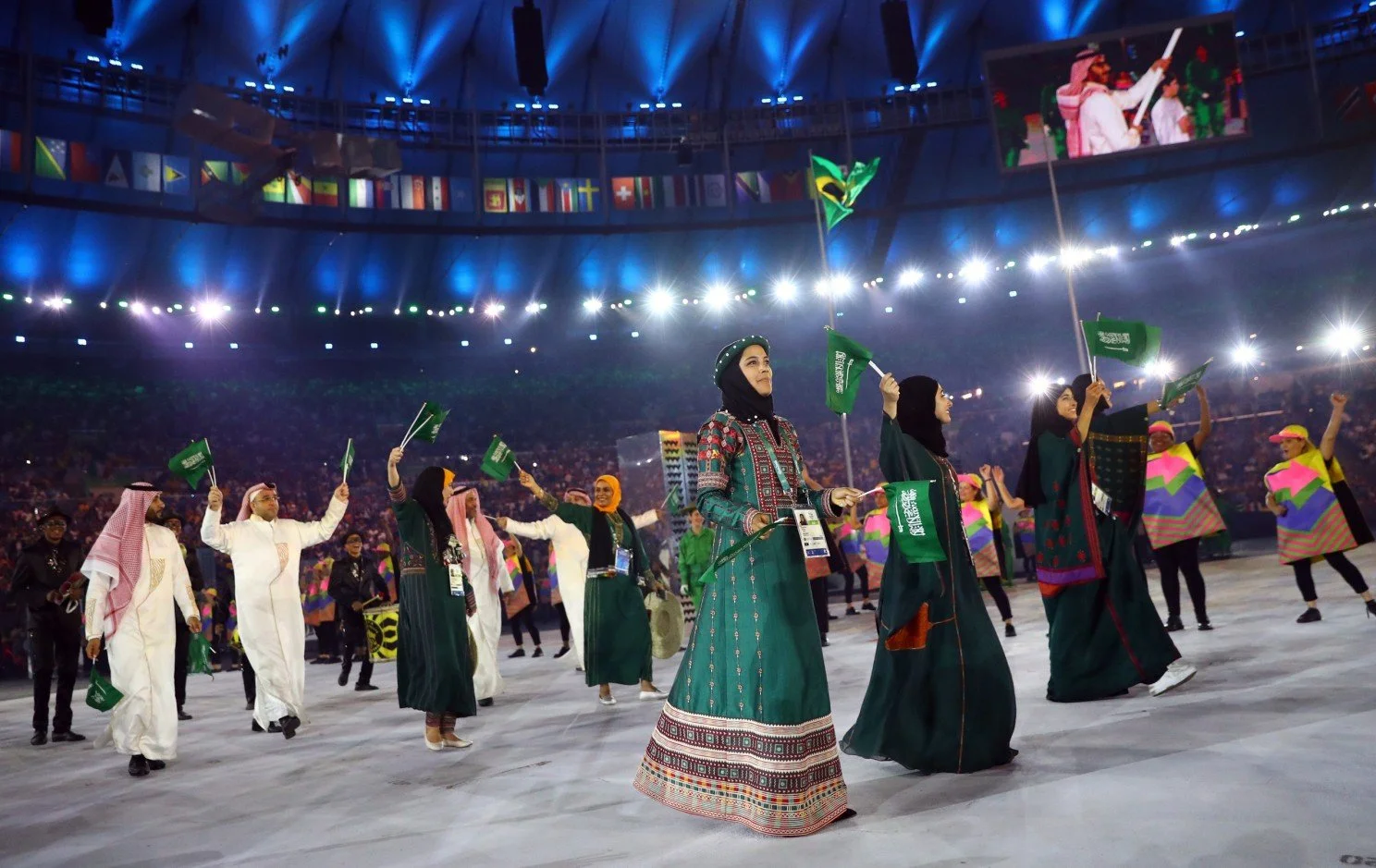
Ahead of the 2016 Olympic Games, approval for female athlete participation was sought through tribal and HRH leadership pathways, and the national dress worn at the opening and closing ceremonies was deliberately designed to represent all regions of the Kingdom. These processes were not symbolic; they reflected the formal pathways and national considerations required for representation on the world stage.
5. Medical Governance in Jordan - Real System Examples
Case Study 1 — Emergency Spinal Injury (Athlete 1)
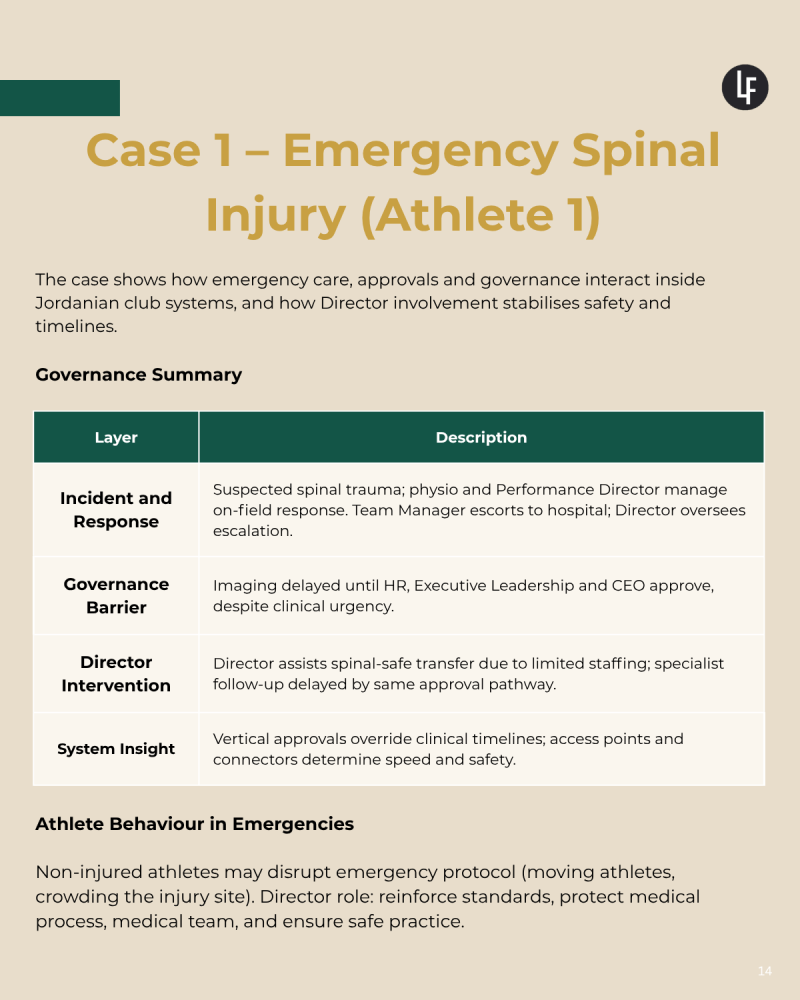
This case illustrates how emergency care interacts with institutional approvals inside Jordanian club systems. The clinical pathway was clear, but the speed of delivery was shaped by governance structures rather than clinical urgency. The Director’s presence ensured continuity, protected clinical standards and stabilised the pathway during a high‑risk event.
Governance Barrier
Imaging and specialist access were dependent on HR, executive leadership and CEO approval. This is a structural feature of the system and applies even when red‑flag injuries are present or when there is a history of previous hospitalisation. The approval chain is vertical, and it can introduce delay at critical points in the pathway.
Director Level Intervention
The Director’s involvement ensured spinal‑safe transfer, supported hospital staff during a period of limited capacity and maintained alignment between clinical need and institutional process. Without Director oversight, the pathway would have been slower, less coordinated and more exposed to risk.
System Insight
This case demonstrates that medical decisions operate within institutional processes, not autonomously. Access points and connectors, particularly the sequence that moves from the Team Manager to HR and then to the CEO, determine the speed at which care can progress. Director involvement remains essential to protect safety, continuity and governance coherence.
Athlete Behaviour in Emergencies
Non‑injured athletes can unintentionally disrupt emergency protocol by moving injured athletes, crowding the injury site or removing athletes before assessment. This reflects an emerging ecosystem where professional standards are still developing. The Director’s role is to reinforce protocol, set expectations and protect the integrity of the medical process.
This case shows how emergency care interacts with institutional approvals in Jordan. The next case demonstrates how the same governance decisions shape specialist access, imaging and decision‑making in non‑emergency scenarios.
Case Study 2: Nasal Fracture
Incident and Response
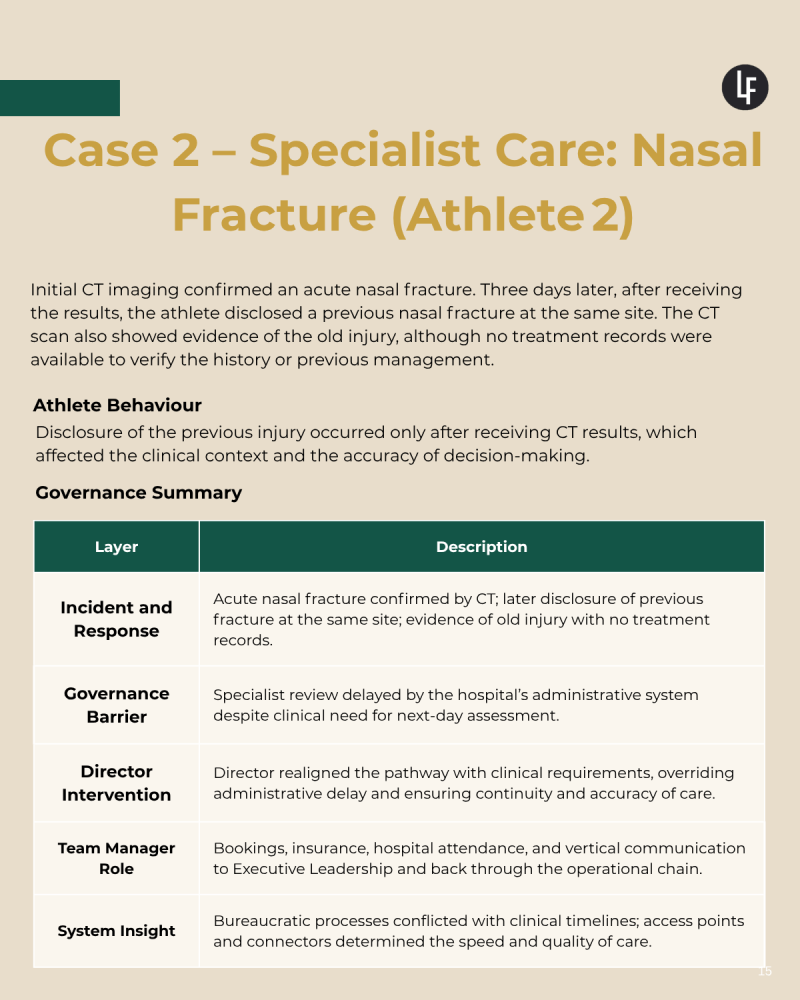
During training, Athlete 2 sustained a nasal fracture following accidental contact. CT imaging at the hospital confirmed the injury, and medication was provided to reduce swelling ahead of specialist review. Three days later, the athlete disclosed a previous nasal fracture at the same site. The CT scan showed evidence of the old injury, but no treatment records were available to verify the history or previous management. The Performance Director supported the clinical reasoning, clarified the injury mechanism and aligned the next steps with the consultant’s recommendations.
Governance Barrier
The hospital’s administrative system scheduled the specialist appointment several days later, despite the consultant indicating that next‑day review was clinically appropriate. This delay reflected a structural gap between clinical need and administrative process, with bureaucracy overriding medical urgency.
Director Intervention
The Performance Director intervened to realign the pathway with clinical requirements. This included direct communication with hospital staff, clarification of the consultant’s recommendation and coordinated action to ensure the appointment was brought forward. Director presence ensured continuity, accuracy and protection of the athlete’s clinical timeline.
Team Manager Role
The Team Manager acted as the operational access point and connector, with other team managers also supporting throughout the process. His responsibilities included:
• booking appointments
• managing insurance
• attending the hospital
• communicating updates vertically to Executive Leadership and back down through the operational chain
• aligning operational decisions with the Director’s clinical direction
This role ensured that administrative processes, insurance approvals and hospital coordination moved at the required pace.
Governance Insight
This case demonstrates:
• operational dependence on the team manager as the primary connector
• the Director as the clinical authority within the governance structure
• hospital bureaucracy conflicting with clinical need
• the importance of Director presence at medical appointments
• real time decision support and relational diplomacy as essential components of safe care delivery
Why this matters: Administrative systems can distort clinical timelines unless Directors actively realign pathways. Case 3 shows how these same structural behaviours appear again, but with different consequences for safety, speed and decision making.
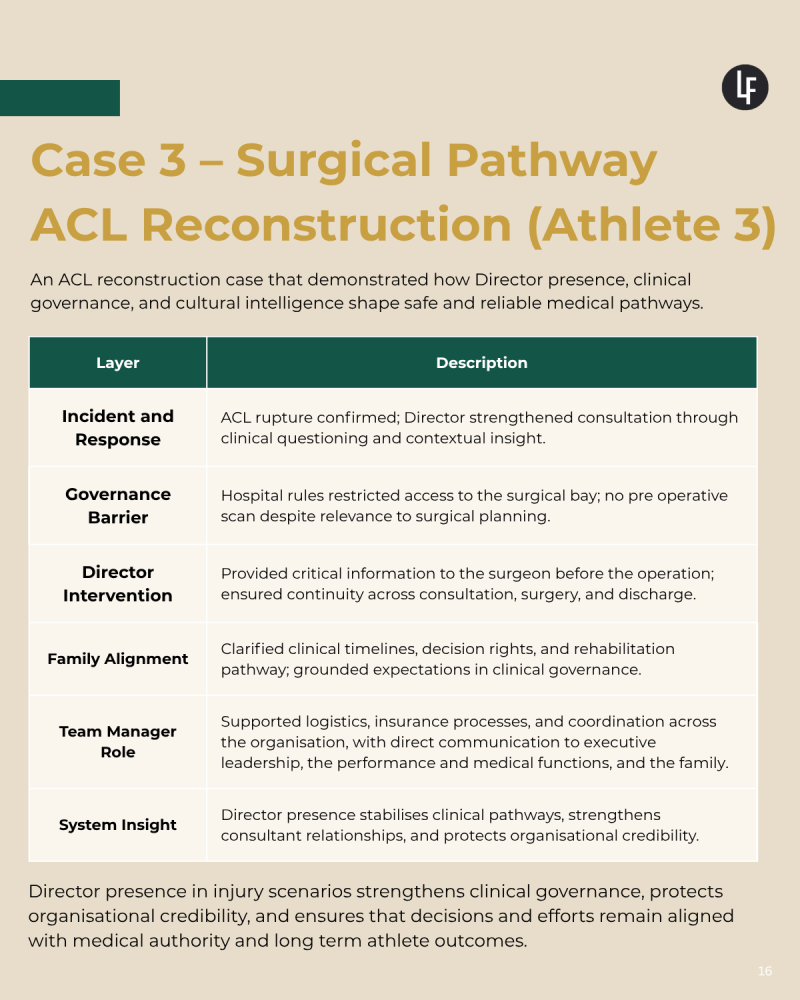
During the consultation, the Performance Director’s presence materially strengthened the clinical process. The consultant noted the Director’s professionalism, clinical knowledge and standards, commenting to his assistant that the Director’s note taking, questioning and medical language demonstrated competence and experience. As MRI scans were reviewed, the Director asked targeted clinical questions and provided context that shaped the consultant’s understanding of the athlete’s condition and injury mechanism. The physiotherapist was also present. In Jordan, members of the medical team attending consultations is a new standard; historically, only team managers, who are non clinical, were present. This shift improved knowledge transfer, capability building and clinical alignment.
The consultant expressed confidence in the Director’s expertise and invited the Director to observe the surgical procedure. On the day of surgery, hospital administrative rules prevented entry into the surgical bay, but the Director met the surgeon pre operatively and provided critical information that influenced intra operative expectations. Significant pre operative work had been completed by the Director, including monitoring healing of knee structures, which had implications for what the surgeon would find and the extent of reconstruction required. The procedure proceeded as a full ACL reconstruction.
The Director remained present post operatively and at discharge, providing continuity for the club, Executive Leadership, team managers and the athlete’s family. This presence reinforced governance, ensured accuracy of communication and protected the athlete’s clinical pathway.
Parental Influence Meeting – ACL Injury (Separate to Consultation)
A separate meeting was held with senior club leadership, the Performance Director and the athlete’s parents after the family sought clarity on timelines and contacted leadership directly. Their concerns focused on the speed of the process and the expected date of surgery, which is a common pressure point in significant injuries where timing influences clinical outcomes.
The meeting centred on providing reassurance, clarity and structure. The Director outlined the full rehabilitation pathway, the surgeon’s clinical timelines and the return to competition protocol. It was explained that the timing of surgery is determined by the consultant surgeon based on clinical criteria, not by the club or the family. The Director also clarified that allowing knee structures to heal before surgery leads to better operative conditions and improved post operative outcomes.
This protected the family’s wellbeing, stabilised expectations and safeguarded the organisation’s reputation. By balancing technical competence with cultural intelligence, the Director turned a potentially high‑risk clinical moment into an opportunity to strengthen trust across the system.
6. Building a Medical Network from Zero - Jordan
When I arrived in Jordan, the organisation’s medical landscape was still emerging and there were no established pathways, networks or integrated referral structures. Clinical access relied on individual relationships, team managers and the national teams (Association) rather than a coordinated internal system. I began by understanding the environment, identifying what was already in place and clarifying where structured pathways would add value for the organisation.
Medical System Pathways Development
A network of five hospitals was established to provide consistent access to imaging, orthopaedics, emergency care and specialist consultations. A highly experienced team manager and the physiotherapist contributed recommendations, ensuring that local knowledge informed the development of these pathways. This created a stable foundation for predictable clinical decision making. The club already worked with an external physiotherapy provider with a high quality facility and equipment, offering an environment with links to Al Hilal. This provider became an extension of our internal capability and ensured that rehabilitation delivery met the expectations of a professional performance environment.
Relationship Building
A strong collaborative relationship developed between the organisation, the external physiotherapy provider and the internal staff. Regular updates, videos and clinical progress were shared through coordinated communication, often facilitated by the team manager. This created an integrated approach to care and ensured that athletes received consistent, high quality support even when specialist equipment or full time physiotherapy coverage was not available internally. The Performance Director attended most medical appointments, with attendance also rotating between medical and performance team members to support capability building and alignment.
Knowledge Transfer and Capability Building
For cases requiring expertise not available locally or nationally, I expanded to my existing international medical network. A complex shoulder case required specialist input, so I engaged Jo Gibson, a world class external expert, to guide the clinical pathway. I coordinated the Jordanian physiotherapy care with the external provider to ensure alignment, continuity and a unified rehabilitation plan.
In line with Vision 2030’s focus on developing sustainable internal capability, I shared rehabilitation guides, Jo Gibson’s specialist rehabilitation principles and structured rehabilitation videos to support the development of internal practice. This ensured that local team members had access to high quality clinical reasoning frameworks and evidence based rehabilitation approaches, strengthening the organisation’s long term capability and reducing the requirement for external expertise.
This network strengthened clinical governance, improved access and demonstrated that the organisation now had structured pathways supporting athletes, families and leadership. It also signalled that the club had a Director capable of building systems, establishing standards and creating the infrastructure required for long term stability.
7. UKSI vs Saudi–MENA: The Structural Misalignment
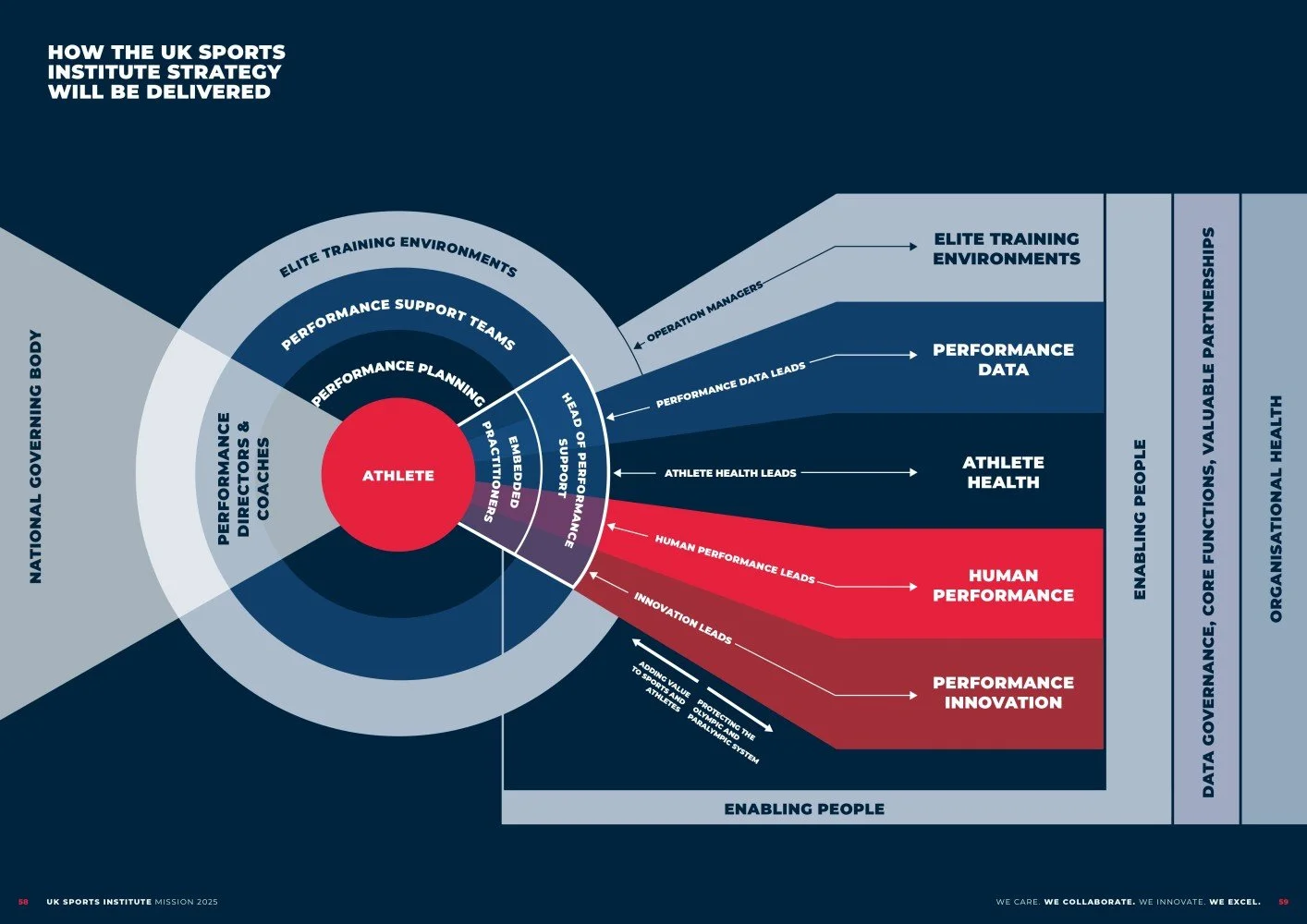
Structural Insight: When Leader Capability Becomes the System Ceiling
In many Saudi and MENA environments, leaders are assumed to be data literate, technologically capable and able to drive organisation wide adoption of AMS, EMR and performance systems. In practice, capability varies. When a leader is not fully confident in using these systems, the organisation may inherit that ceiling.
This creates a predictable structural block:
• systems are only partially implemented
• data is not democratised across departments and sits across multiple platforms
• communication remains manual or fragmented, and compliance is low
• team members and athletes receive only the level of understanding the leader possesses
• organisational capability reflects individual capability, not system need
This is not a cultural issue. It is a governance and capability alignment issue.
Interpretation for Leaders
This section demonstrates that UKSI models are structurally misaligned with the governance logic of Saudi and MENA systems. Effective system design requires alignment with:
• vertical authority
• relational pathways
• executive influence
• institutional priorities
• cultural legitimacy
• capability based ceilings
The goal is not to impose systems into an environment, but to calibrate the architecture of those systems so they function as natural, self sustaining extensions of the existing governance reality.
8. Transformation Requirements
Saudi and MENA systems do not require Western models to be imported; they require Western models to be built to align with the governance logic of the region. Transformation succeeds when systems are delivered through vertical authority, relational pathways, executive influence and capability based ceilings. This section outlines the structural requirements for building performance and medical systems that are stable, predictable and aligned with national priorities.
Executive‑Level Mandate and Ownership
System delivery in the region is driven by executive authority, not departmental autonomy. Transformation requires:
• explicit executive mandate for AMS, EMR and performance systems
• clear ownership at CEO or Executive Leadership level
• alignment with institutional priorities and national objectives
• visible endorsement that legitimises system use across teams
Without executive delivery accountability, systems remain symbolic, partial or siloed.
Relationship Pathways as Delivery Mechanisms
Western systems assume horizontal collaboration; Saudi and MENA systems move through trusted intermediaries. Transformation requires:
• identifying the relationship access points who carry influence
• integrating these access points into communication and approval loops
• structuring delivery pathways that reflect relationship based authority
• ensuring information moves through the people who actually move decisions
Systems stall when they ignore the relationship pathways that govern decision flow.
Capability Alignment and Ceiling Management
Organisational capability reflects the capability of key leaders. Transformation requires:
• assessing the capability ceiling of leaders responsible for system delivery
• providing targeted support, exposure and upskilling where needed
• ensuring systems do not exceed the capability of those expected to lead them
• delivering implementation plans that match the organisation’s actual, not assumed, capability
A system can operate above the capability level of the leader responsible for it, but it will not operate as it should.
Institutional‑Centred System Delivery
Performance and medical systems must align with institutional priorities, not athlete‑first assumptions. Transformation requires:
• mapping institutional approval lines
• aligning system workflows with executive and federation processes
• ensuring data, reporting, and decision‑making structures reflect institutional authority
• delivering systems that support national representation, not just performance outcomes
Systems succeed when they reinforce institutional legitimacy.
Succession Planning and Knowledge Retention
High turnover and evolving mandates create instability. Transformation requires:
• building structured succession pathways for key roles
• capturing institutional knowledge before individuals move
• ensuring continuity across Olympic cycles and competitions
• reducing dependency on single individuals or informal knowledge holders
Without succession planning, systems reset every time a leader moves.
Data Democratisation and System Integration
Data cannot remain concentrated within a small number of individuals at executive level. Transformation requires:
• executive approved data governance frameworks
• controlled but meaningful democratisation of data across teams
• integration of AMS and EMR systems across clubs, federations and national teams
• reducing fragmentation caused by multiple platforms and inconsistent compliance
Data must move from being an executive asset to an organisational capability.
Compliance Through Legitimacy, Not Policy
Compliance in the region is relational, not procedural. Transformation requires:
• securing relational legitimacy before enforcing system use
• aligning compliance expectations with cultural norms
• using trusted intermediaries to reinforce adoption
• ensuring systems are understood as supportive tools, not enforcement mechanisms
Compliance follows legitimacy, not policy.
Strategic Interpretation for Leaders
Transformation is not achieved by importing Western systems. It is achieved by building and delivering systems that align with:
• vertical authority
• relationship pathways
• executive influence
• institutional priorities
• capability ceilings
• cultural legitimacy
• succession realities
• data governance structures
The objective is not to impose systems into an environment, but to deliver systems that operate as natural, self sustaining extensions of the existing governance reality.
9. Implementation Pathways
Implementation in Saudi and MENA environments succeeds when delivery pathways reflect the governance logic of the region: vertical authority, relationship pathways, institutional priorities and capability based ceilings. This section outlines the practical, governance aligned pathways that enable stable, predictable and sustainable system delivery.
Executive Led Delivery Sequencing
System delivery must begin at the level where authority is held. Implementation requires:
• sequencing delivery through executive approval lines
• establishing clear mandates before operational rollout
• positioning system delivery as an institutional priority
• aligning timelines with team, national and federation level cycles
Delivery stalls when implementation begins at departmental level without executive anchoring.
Relationship Delivery Channels
Systems move through people, not departments. Implementation requires:
• identifying the relationship access points and connectors who carry influence
• embedding these individuals into delivery pathways
• ensuring communication flows through trusted intermediaries
• aligning rollout with relationship legitimacy
Delivery accelerates when relationship pathways are recognised as the primary mechanism of movement.
Capability Aligned Delivery
Implementation must reflect the capability of the leaders responsible for delivery. This requires:
• assessing capability levels before rollout
• sequencing delivery according to actual, not assumed, capability
• providing targeted exposure and support to leaders with delivery responsibility
• ensuring system complexity aligns with leadership capacity
Delivery becomes stable when system demands match the capability available to lead them.
Institutional Integration Before Team Adoption
Systems must integrate at institutional level before they can function at team level. Implementation requires:
• aligning system workflows with federation and executive processes
• ensuring reporting structures reflect institutional authority
• integrating AMS and EMR systems across clubs, federations and national teams
• establishing institutional legitimacy before operational adoption
Delivery stalls when teams adopt systems that institutions have not yet endorsed or integrated.
Stabilisation Through Succession and Continuity
High turnover disrupts delivery. Implementation requires:
• embedding succession planning into system delivery
• capturing institutional knowledge at each transition point
• ensuring continuity across Olympic and seasonal cycles
• reducing dependency on single individuals
Delivery stabilises when knowledge and capability remain within the institution, not within individuals.
Data Governance as a Delivery Enabler
Data must move from being an executive asset to an organisational capability. Implementation requires:
• executive approved data governance frameworks
• controlled but meaningful data access across teams
• integration of data systems to reduce fragmentation
• establishing clear data ownership, flow and accountability
Delivery becomes efficient when data supports decision making across the organisation.
Compliance Through Legitimacy
Compliance is achieved through legitimacy, not enforcement. Implementation requires:
• securing relationship legitimacy before enforcing system use
• aligning compliance expectations with cultural norms
• using trusted intermediaries to reinforce adoption
• ensuring systems are understood as supportive tools, not enforcement mechanisms
Delivery becomes sustainable when compliance is relationship anchored.
Delivery Interpretation for Leaders
Implementation succeeds when delivery pathways align with:
• vertical authority
• relationship access points
• institutional priorities
• capability ceilings
• succession realities
• data governance structures
• cultural legitimacy
The objective is not to impose systems into an environment, but to deliver systems that operate as natural, self sustaining extensions of the existing governance reality.
10. Delivery Frameworks for Emerging Systems (Medical and Performance)
Emerging systems do not stabilise through theory. They stabilise through applied frameworks that reflect how authority, information and decisions actually move. This section translates lived experience across Saudi Arabia and Jordan into practical, governance aligned models that leaders can use immediately. Each framework is grounded in real approval chains, real communication loops and real medical and performance behaviour inside evolving systems. These are not Western models adapted for the region. They are Saudi first and MENA real.
Vertical Approval Map in Saudi Arabia and Jordan
In both Saudi Arabia and Jordan, decisions move vertically rather than laterally. Authority sits with leadership rather than departments. This is the most important structural difference between mature Western systems and emerging MENA systems.
In Saudi Arabia, approvals move through formal governance layers that include federation leadership, SOPC departments and senior oversight. In Jordan, approvals move through relationship hierarchies that include the physio, the team manager, the coach, club leadership and investors.
Understanding this verticality is essential. It determines speed, legitimacy and system stability.
Federation and Olympic Delivery Loop in Saudi Arabia
Saudi Olympic delivery follows a centralised loop. The Olympic Committee identifies the need and confirms funding. The federation validates requirements and approves budgets. The federation pays first and the SOPC reimburses. Delivery is then coordinated across coaches, athletes, federation advisors and SOPC departments.
This loop explains why alignment rather than autonomy drives system stability in Saudi sport. It also explains why decentralised Western models do not transfer directly.
Club Performance Governance Model in Jordan
Jordanian clubs operate through relationship based governance rather than structural governance. Etihad illustrates this clearly.
Board members and investors can hold veto power. Technical Directors also serve as Head Coaches, concentrating authority in individuals rather than departments. The Performance Director influences and also makes decisions on the ground within the limits of the governance structure. The Team Manager acts as the operational and cultural bridge between departments.
This model shows why stabilisation depends on relationship building, clarity of communication and structured reporting rather than structural reform.
Athlete Availability Decision Pathway
In emerging systems, athlete availability is institution centred rather than athlete centred.
In Saudi Arabia, national team priorities can override club needs and availability decisions follow formal governance channels.
In Jordan, readiness decisions are shaped by relationship legitimacy, the level of trust, credibility and influence an individual holds with the key decision makers. This affects how their input is received throughout the lead up to matches, including the day before and the day after. Coaches may request athletes to train despite injury risk. Team managers can mediate. Physios navigate expectations. The Performance Director advocates for athlete safety and readiness, but final decisions can be shaped by the club’s relationship dynamics and the realities of the governance structure.
Real cases involving groin injuries, Achilles tendinopathy and stress fractures show why Western assumptions do not transfer directly. The decision maker is different and the approval pathway is vertical rather than clinical. Western high‑performance systems are designed to be athlete centred, but even they can shift toward institutional priorities under pressure; the difference is that the organising principle in Saudi and Jordan is structurally institution centred from the outset.
Data Maturity Ladder in Saudi Arabia and Jordan
Emerging systems can progress through four stages: manual communication through WhatsApp and verbal updates; fragmented systems such as CoachBetter and Google Docs; semi integrated workflows across teams; fully aligned, governance approved data flow.
Progress is measured by alignment rather than technology. A system becomes high performance only when its data becomes governance coherent and fully democratised across the organisation.
Cultural Intelligence Operating Principles
Operating safely and effectively inside Saudi and Jordanian systems requires cultural intelligence.
It requires respect for authority, securing relationship legitimacy, providing rationale rather than instruction, translating everything, anticipating delays and avoiding Western assumptions about autonomy, data and decision making.
Cultural intelligence is the operating system of emerging performance environments.
Stabilised Progression Model
Emerging systems stabilise in four phases: foundations built on relationships, legitimacy and basic reporting; integration of workflows, pathways and communication loops; complexity added through data governance and multi team alignment; optimisation through performance modelling, predictive systems and institutional maturity.
Systems must stabilise before they scale. This is the core principle and reality of Saudi first and MENA system design.
11. The Strategic Shift in the Next Phase
Saudi sport is entering a new phase. The first decade of Vision 2030 relied on state‑driven investment to build capability, create infrastructure and generate national momentum. The next decade will require a different approach. It will require a shift from state wealth to system wealth, where federations, clubs and performance environments build stability, capability and competitive advantage through their own pathways and structures rather than through continuous external support.
This shift is already visible across the sector. Funding is tightening. Expectations on governance are rising. Accountability for performance is increasing. Federations are now being asked to show not only participation and activation, but long‑term sustainability, medal efficiency defined as the number of medals delivered relative to the scale of the system, and the ability to turn investment into real capability. The next phase of Vision 2030 will reward systems that operate with clarity, alignment and financial discipline.
The goal of the next phase is to make performance an institutional asset, ensuring that the legacy of Vision 2030 is defined not only by the infrastructure built but by the sustainable and coherent systems that operate within it.
11.1 What Comes Next – From State Wealth to System Wealth: The Future Funding of Saudi Sport
Next week’s edition introduces a European performance pathway model not yet surfaced in the region. It examines how smaller European nations achieved high medal efficiency at the Paris Olympics without national institutes, and why this matters for Saudi federations preparing for the next phase.
This analysis provides a governance‑level framework for Saudi leaders as they navigate the next phase of national sports sustainability.
Medals: Podium Performance and Medal‑Focused Pathways
This insight is directly relevant for leaders navigating post‑2030 sustainability, federation autonomy, medal efficiency defined as the number of medals delivered relative to system scale, capability building under constrained budgets, the shift from state wealth to system wealth and the realignment of national funding decisions.