GPS-Guided 8-Stage Hamstring Rehabilitation Framework
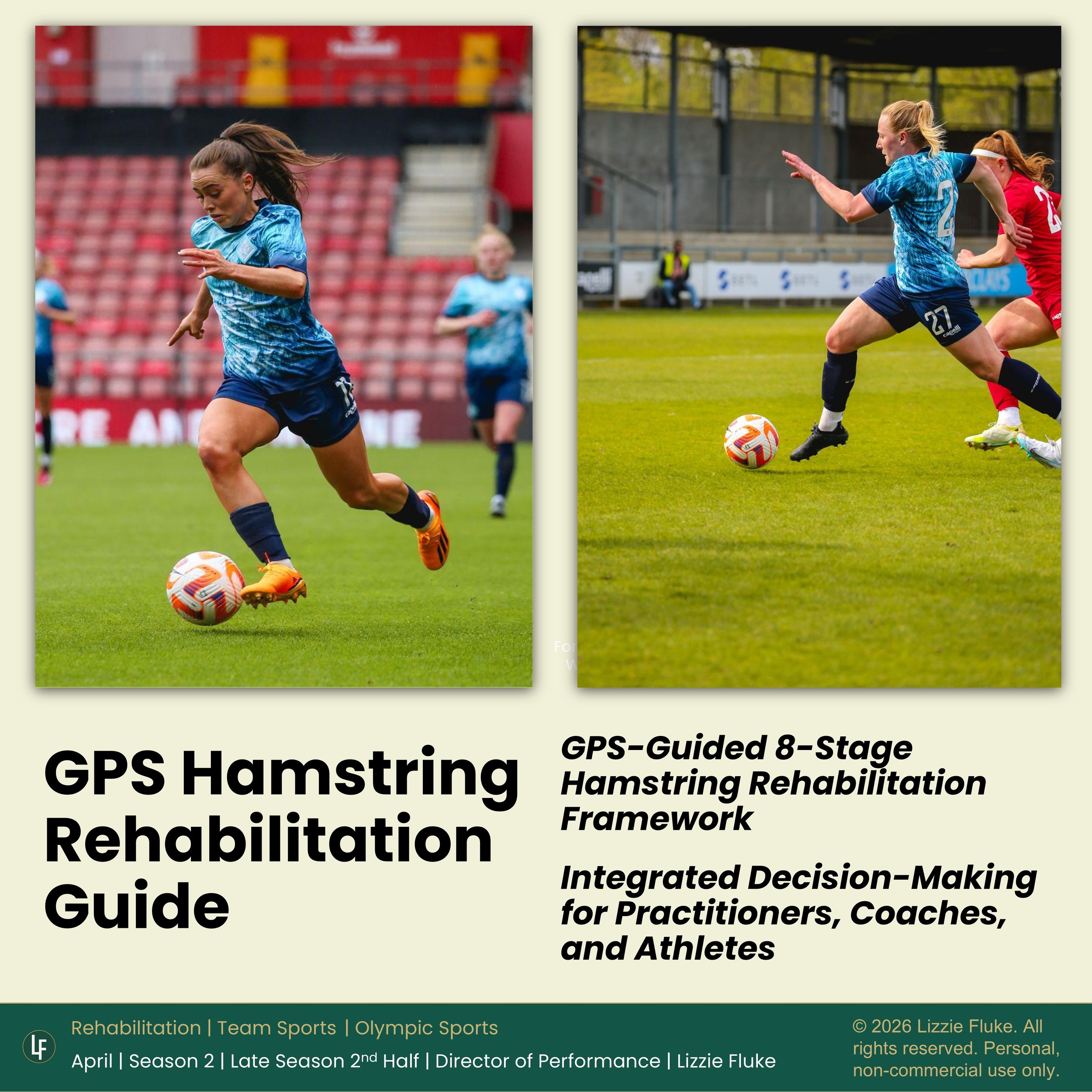
GPS-Guided 8-Stage Hamstring Rehabilitation Framework
This guide accompanies the GPS-Guided 8-Stage Hamstring Rehabilitation Framework. It provides detailed GPS definitions, formulas, practical interpretation guidance, and rehabilitation applications to support individualised return-to-training and return-to-competition decisions.
Important: This resource is for educational purposes only. It does not replace individualised assessment, diagnosis, treatment, or return-to-play decisions by a qualified sports medicine or rehabilitation professional. GPS data should always be interpreted alongside clinical examination, athlete history, symptoms, strength and function, sport demands, and multidisciplinary judgement.
What this guide covers
- Key GPS metrics and definitions, using Catapult Vector Pro terminology as an example
- How GPS metrics can support hamstring rehabilitation and return-to-competition decisions
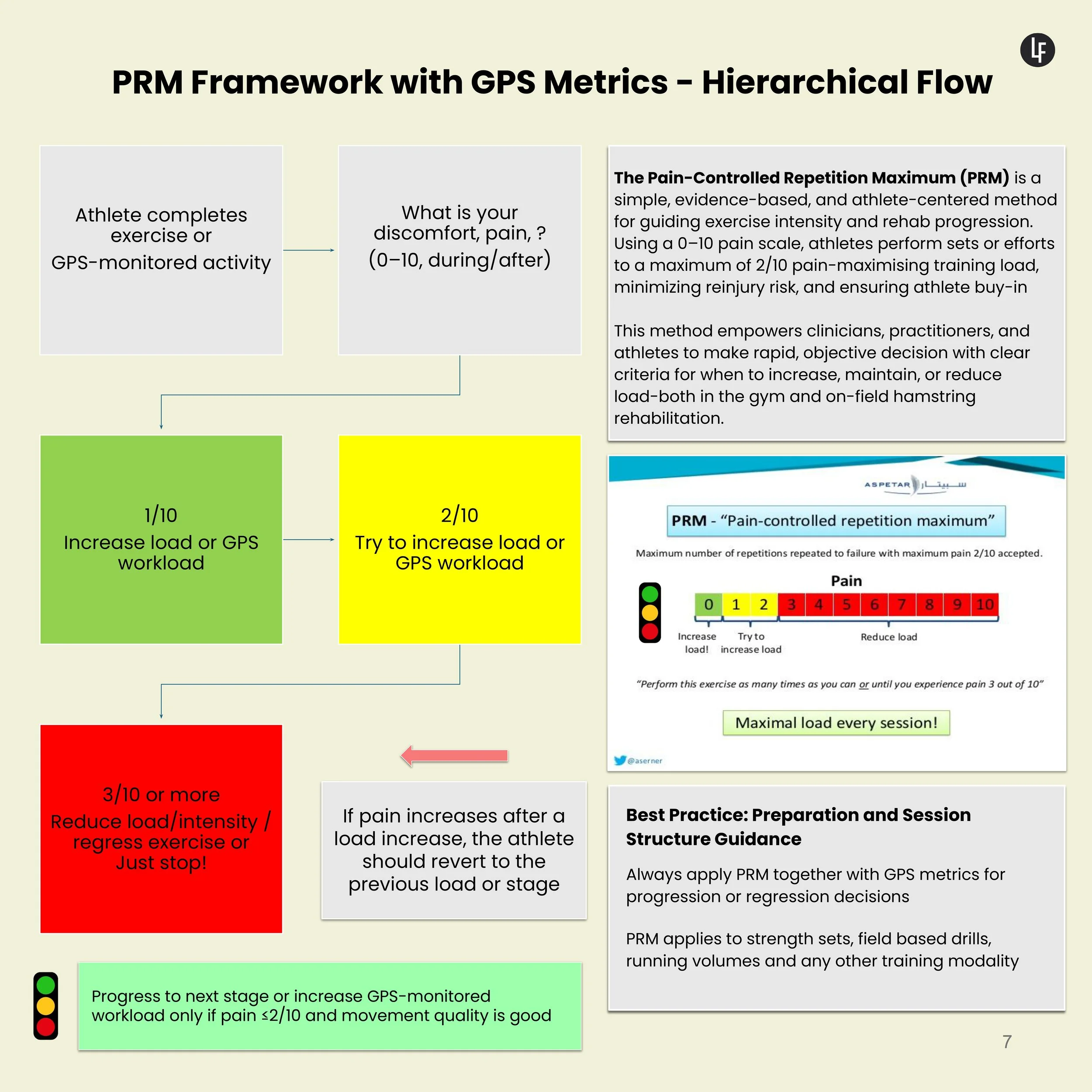
- Pain-guided progression using the Pain-Controlled Repetition Maximum (PRM) approach
- Practical guidance on session structure, running progression, and gym–pitch scheduling
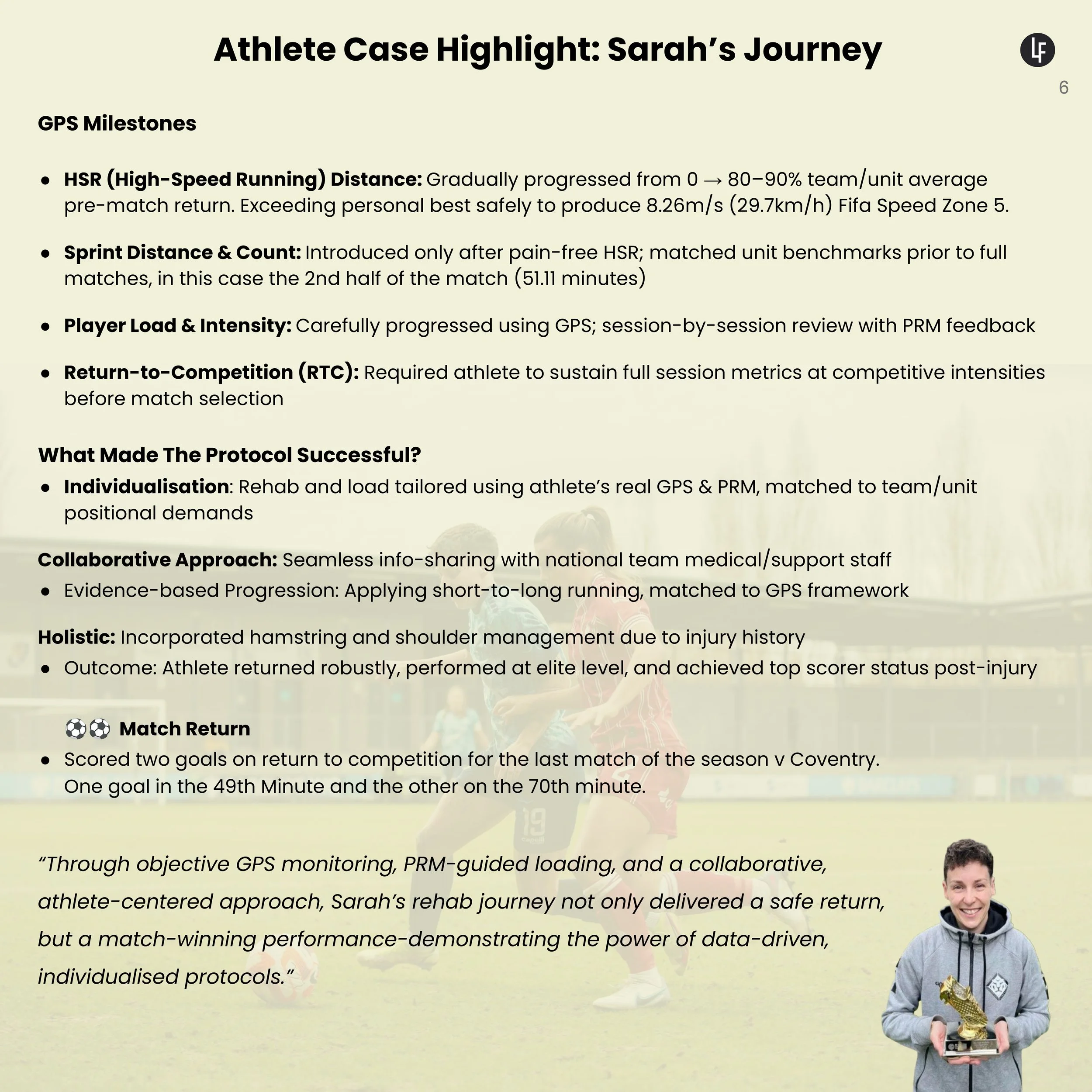
- An anonymised case example illustrating staged rehabilitation and return to competition
GPS glossary and rehabilitation use
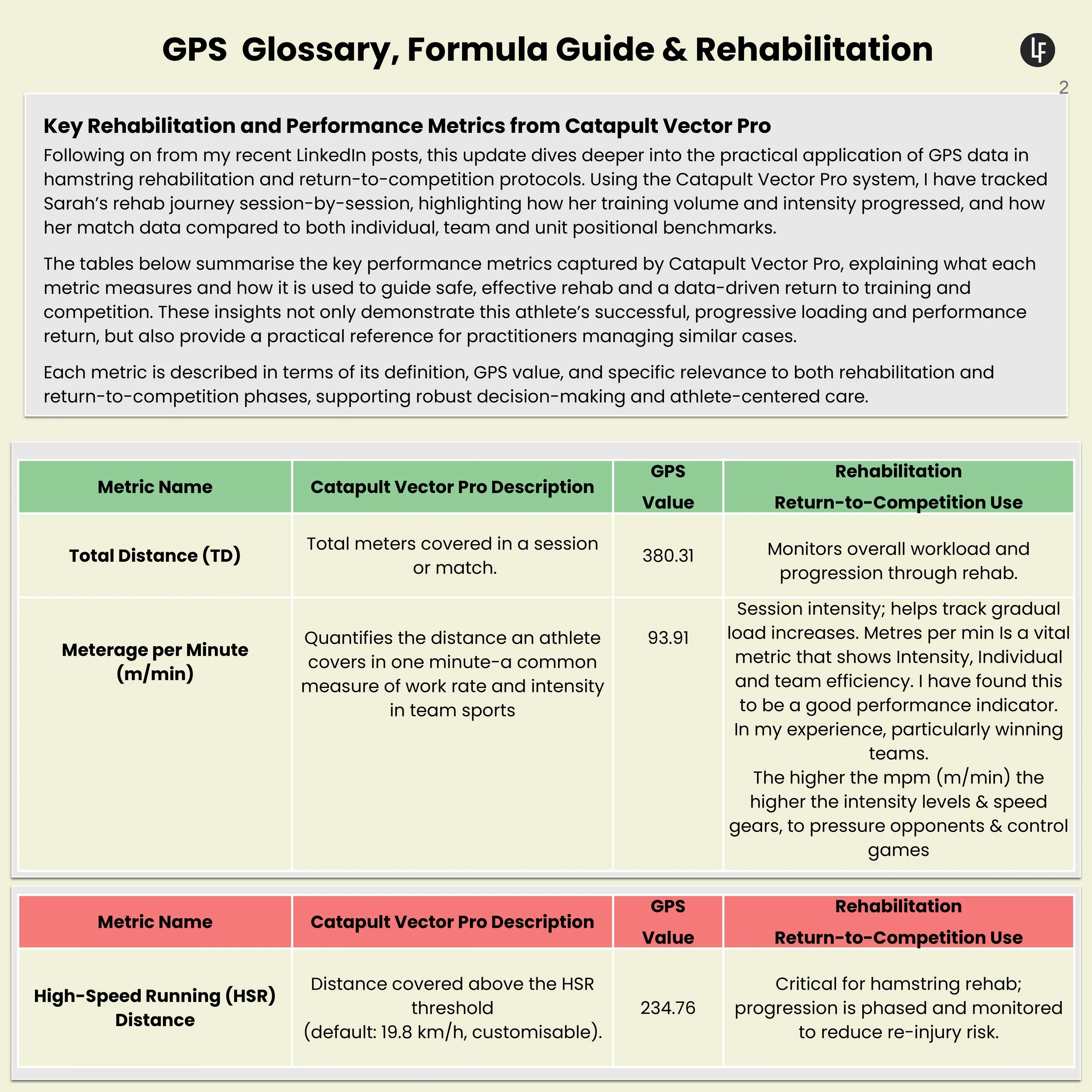
GPS metrics can help practitioners monitor external load, session intensity, high-speed exposure, and explosive actions during rehabilitation. The definitions below use Catapult Vector Pro terminology as an example; threshold values and metric names may differ between GPS providers.
| Metric | What it measures | Rehabilitation and return-to-competition use |
|---|---|---|
| Total Distance | Total metres covered during a session or match. | Monitors overall workload and gradual progression through rehabilitation. |
| Metres per Minute | Distance covered per minute of session time. | Provides a useful indicator of session intensity and work rate. |
| High-Speed Running Distance | Distance covered above the high-speed running threshold, for example 19.8 km/h. | A key late-rehabilitation metric for progressive exposure to faster running. |
| High-Speed Running per Minute | High-speed running distance divided by session duration. | Helps assess the density and intensity of high-speed running exposure. |
| Sprint Distance | Distance covered above the sprint threshold, for example 25 km/h. | Introduced only after pain-free high-speed running and submaximal sprint tolerance. |
| Sprint Count per Minute | Number of sprint efforts divided by session duration. | Monitors sprint frequency and helps prepare athletes for match intensity. |
| Accelerations above 3 m/s² | Number of explosive acceleration efforts above the selected threshold. | Helps monitor exposure to high-force acceleration demands. |
| Decelerations below -3 m/s² | Number of rapid braking efforts below the selected threshold. | Helps monitor braking load and change-of-direction demands. |
| Maximum Speed | Highest speed recorded during a session or match. | Useful for late-stage benchmarking against the athlete’s own historical data and team or positional norms. |
| Player Load | A proprietary metric derived from accelerometer data across multiple planes. | Provides an additional indicator of overall physical load; interpret alongside distance, intensity, and athlete response. |
| Player Load per Minute | Player Load divided by active session time. | Helps compare intensity across sessions of different durations. |
| Match Time Played | Total time actively spent on the pitch during a match. | Provides context for workload data and supports staged match reintegration. |
| Percentage of Minutes Played | Minutes played divided by total match duration, multiplied by 100. | Can support a graduated return to match involvement. |
| Volume to Minutes Played | A projected workload estimate based on the athlete’s recorded intensity. | Can help compare partial-match output with expected full-match demands. |
Combining PRM and GPS data
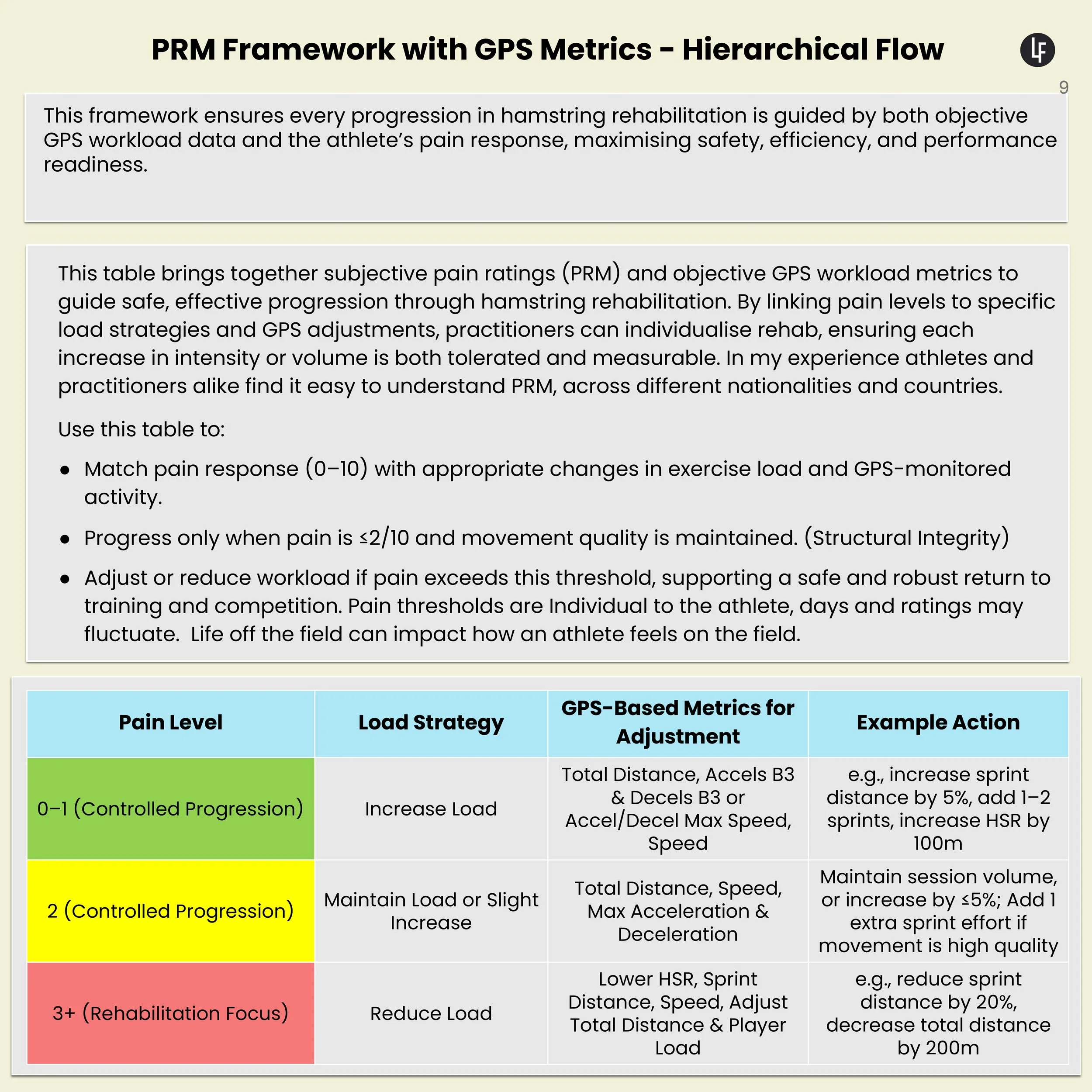
The Pain-Controlled Repetition Maximum (PRM) approach uses a simple 0–10 pain scale to guide loading during rehabilitation. It is intended to be used alongside GPS data, movement quality, strength and function, and the practitioner’s clinical reasoning.
Pain responses are individual and can fluctuate between days. Sleep, stress, training history, recovery, and life outside sport can all influence how an athlete feels during a session. PRM should therefore guide—not replace—professional judgement.
| Pain response | Suggested load strategy | Example GPS-based adjustment |
|---|---|---|
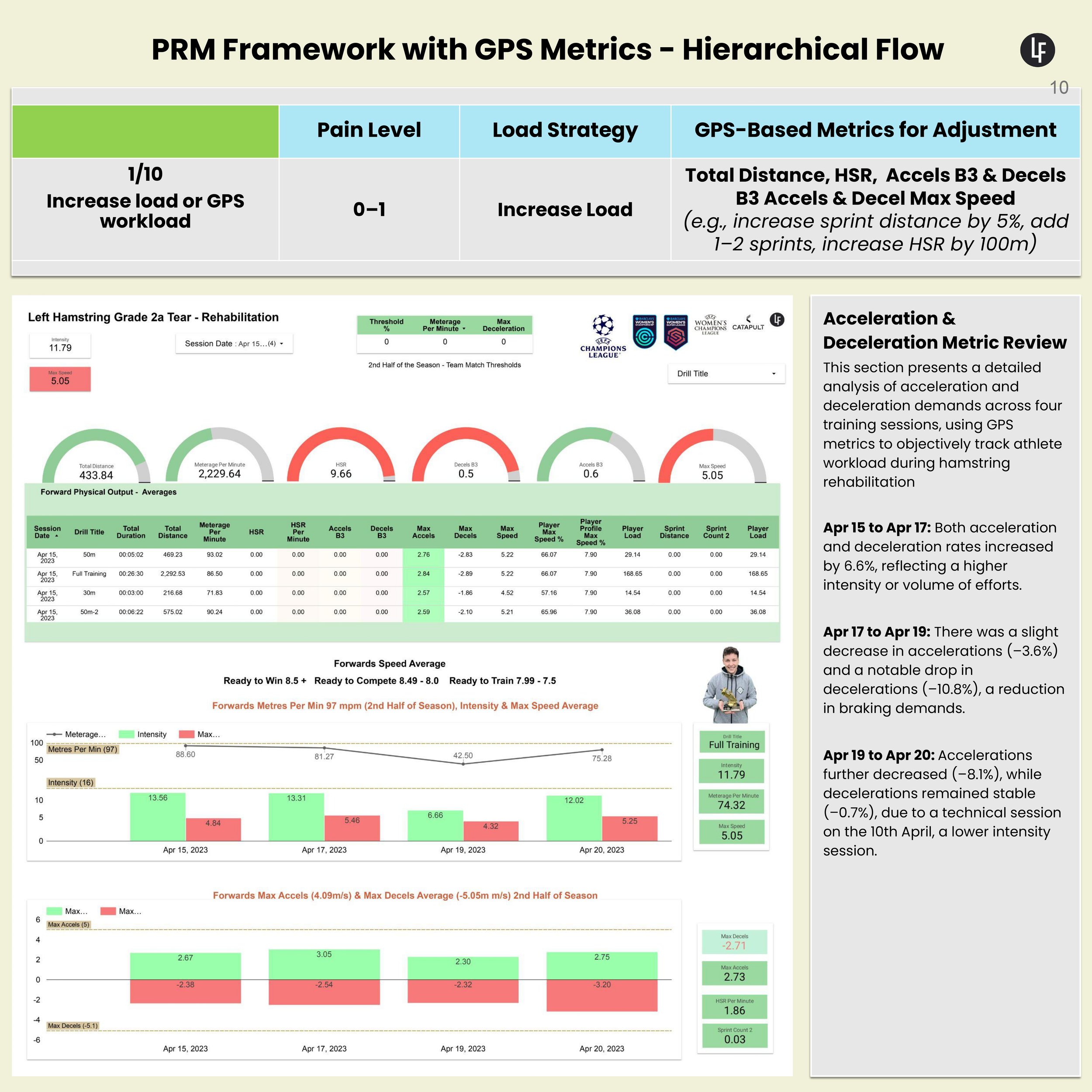
| 0–1/10 | Consider increasing load if movement quality, strength, and function are appropriate. | Increase high-speed running or sprint distance gradually; for example, add a small number of controlled efforts or increase distance by approximately 10%. |
| 2/10 | Maintain load or make only a small increase, with close monitoring. | Maintain session volume or increase by no more than approximately 5%; add one additional controlled effort only if movement quality remains good. |
| 3/10 or above | Reduce load, modify the session, or regress to the previous stage. Stop and reassess if symptoms are worsening or movement quality is compromised. | Reduce sprint distance, high-speed running, total distance, or explosive-action exposure. |
Running and sprint progression
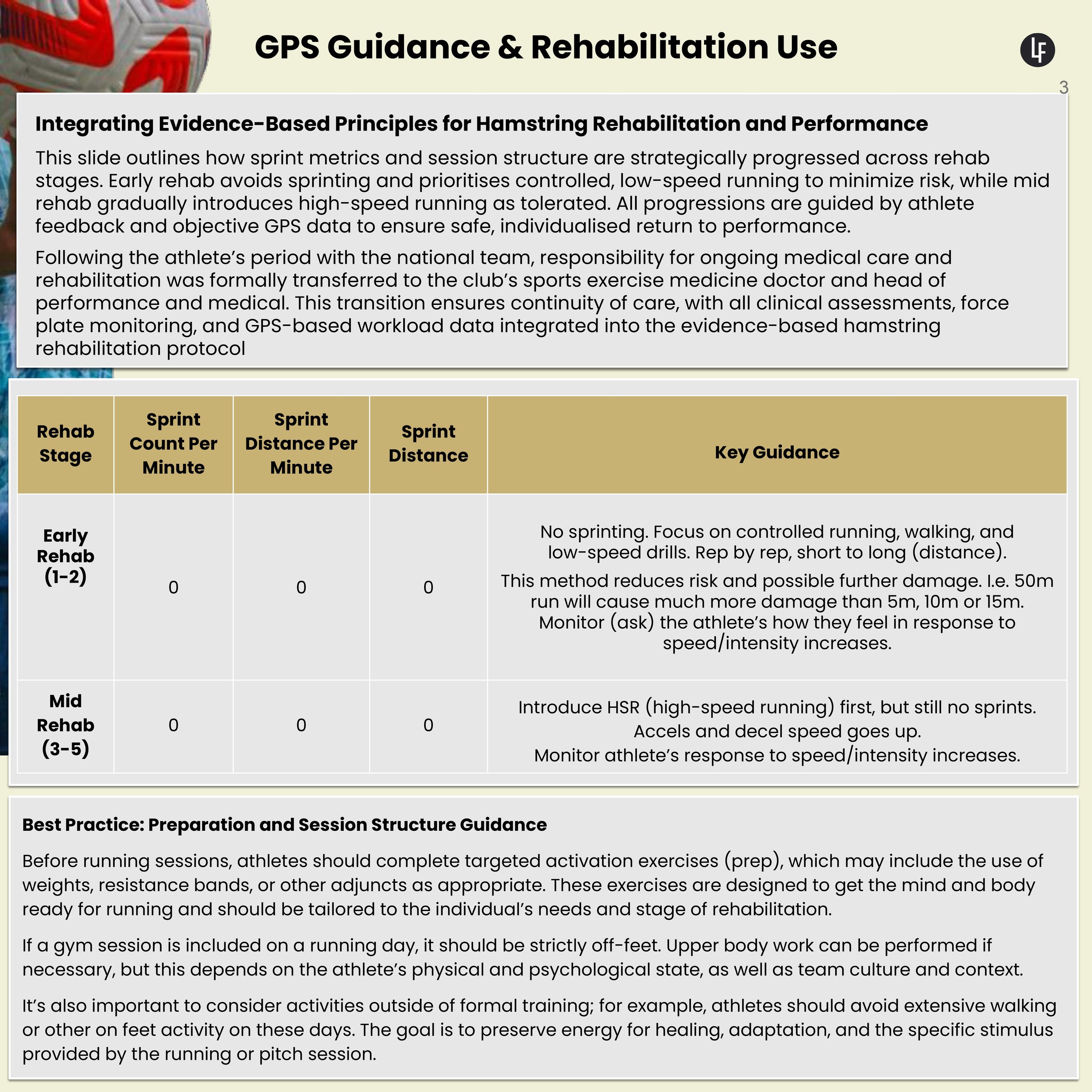
High-speed running and sprinting should be reintroduced progressively. A short-to-long approach can be useful: begin with controlled, lower-speed running over shorter distances before gradually increasing distance, intensity, and sprint exposure.
| Rehabilitation phase | Sprint exposure | Practical guidance |
|---|---|---|
| Early stages | No sprinting. | Focus on controlled walking, running, and low-speed drills. Use short distances before longer distances and monitor the athlete’s response to each progression. |
| Mid stages | No sprinting. | Introduce progressive high-speed running where tolerated. Gradually increase acceleration and deceleration demands while monitoring symptoms and movement quality. |
| Late stages | Introduce controlled sprinting. | Begin with a small number of short, controlled sprints at submaximal intensity. Increase number, distance, and intensity gradually, using individual, positional, and team benchmarks where available. |
| Return to competition | Match-like sprint exposure. | The athlete should tolerate repeated sprint efforts, high-speed running, accelerations, decelerations, and full training demands before unrestricted return is considered. |
Session structure and recovery
Before running-based sessions, targeted preparation may include activation work using bodyweight, resistance bands, weights, or other appropriate adjuncts. Preparation should be individualised to the athlete’s needs, symptoms, and rehabilitation stage.
Where possible, separate demanding gym and pitch sessions by at least 24 hours during the early running stages. This can make it easier to identify which training stimulus may have contributed to an adverse response. If no adverse response occurs, gym and pitch sessions can sometimes be combined, depending on the athlete’s schedule, recovery, and training priorities.
It is also useful to consider total daily load. Extensive walking, additional on-feet activity, or other physically demanding tasks on running days may affect recovery and the athlete’s response to the intended rehabilitation stimulus.
Case Study Example
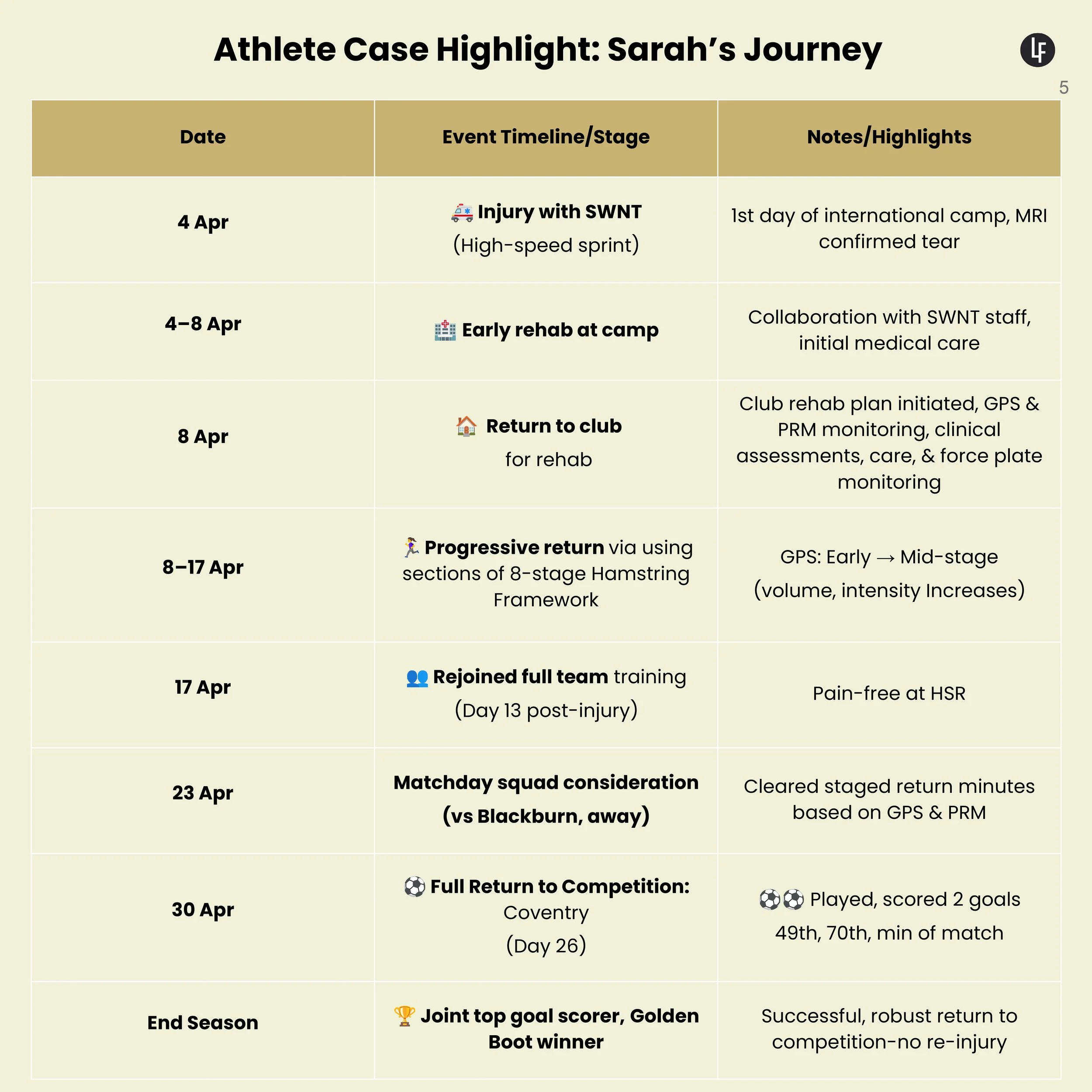
The following example illustrates how the framework and GPS data were applied in practice. It should be interpreted as an individual case, not a template or guaranteed pathway for every athlete.
| Phase | Rehabilitation focus |
|---|---|
| Injury and early management | A hamstring injury sustained during high-speed sprinting was assessed and managed collaboratively by national-team and club staff. Early rehabilitation focused on symptom management, initial loading, and preparation for structured rehabilitation. |
| Early to mid rehabilitation | The athlete progressed through the eight-stage framework using GPS monitoring and PRM feedback. Total distance, player load, accelerations, decelerations, and high-speed running were progressed gradually. |
| Late rehabilitation | High-speed running and sprint exposure were introduced only once the athlete was pain-free at lower intensities. Progression was benchmarked against the athlete’s individual data and relevant unit or team demands. |
| Return to team training | The athlete rejoined full team training once able to tolerate relevant session intensity and high-speed running demands without pain or adverse response. |
| Staged match return | Match involvement was increased progressively. GPS data, athlete feedback, and multidisciplinary discussion informed the return-to-competition plan. |
| Full return | The athlete returned to unrestricted competition after demonstrating tolerance for full training and match demands. No reinjury was reported during the period described. |
Using GPS data in practice
- Early rehabilitation: monitor total distance, session duration, and low-intensity load while reintroducing movement.
- Mid rehabilitation: monitor metres per minute, player load per minute, accelerations, and decelerations as intensity and dynamic loading increase.
- Late rehabilitation: monitor high-speed running, sprint distance, sprint count, and maximum speed as the athlete prepares for competition.
- Return to competition: compare current outputs with the athlete’s own pre-injury data and relevant positional, unit, or team benchmarks.
- Every stage: interpret GPS data alongside pain response, movement quality, strength and function, fatigue, sleep, stress, and the demands of the next training session or match.
Important reminders
- GPS thresholds are not universal; they should be individualised to the athlete, device, position, sport, and rehabilitation stage.
- Avoid sudden spikes in high-speed running, sprint distance, acceleration, or deceleration load.
- Use GPS as one source of information alongside clinical assessment and athlete-reported outcomes.
- Progression should depend on more than numbers: movement quality, confidence, strength, function, and readiness all matter.
- Return-to-competition decisions should be made collaboratively by the athlete and the multidisciplinary team.
Last updated: November 2026
Version: 1.0

Scroll through the full GPS Guidance and Rehabilitation Guide below, or download the PDF to keep, print, and share it with your performance team.
Download the full guide
Download the complete GPS Guidance and Rehabilitation Guide as a PDF.
Download the GPS Guide
© 2026 Lizzie Fluke. All rights reserved.
Commercial, organisational, training, and consultancy use require a separate written licence. For permissions and professional enquiries, contact Lizzie Fluke.