Edition 4: Emerging Performance Environments & Compressed Rehabilitation Systems in Saudi and Jordan
Originally published as Edition 4 of the Saudi–MENA Sport Environments LinkedIn Newsletter.
Edition 4 – Emerging Performance Environments
& Compressed Rehabilitation Systems in Saudi and Jordan
Part 1 - System Context & Case
Introduction
This article explores how rehabilitation pathways are shaped by medical timelines, operational demands, communication, environmental constraints, and middle-layer governance inside emerging performance environments. The athlete case becomes a lens through which wider Saudi-MENA system dynamics can be understood.
Rather than treating rehabilitation as a purely clinical process, this case shows how athlete progression is shaped by the pathways, pressures, and coordination demands of the wider environment around the athlete.
Compressed Rehabilitation Systems in Emerging Environments
A compressed rehabilitation system is one in which injury recovery must operate within accelerated operational timelines, overlapping demands, and evolving decision structures rather than within a fully protected medical timeline.
In emerging Saudi-MENA performance environments, rehabilitation often unfolds where competition and selection pressures remain active, travel and training demands move faster than biological recovery, medical, coaching, and operational layers are still developing their integration processes, communication and adaptation become more influential than fixed procedures, and decision ownership is distributed across multiple people and layers at once. As a result, rehabilitation becomes a negotiated process operating under real-time environmental pressure rather than a clinical pathway.
Importantly, compressed rehabilitation systems are not defined only by limited resources.
Compression can exist in both resource-constrained and highly resourced environments. The defining feature is the interaction between accelerated operational demands and the athlete’s biological recovery timeline.
Why This Case Matters Structurally Rather Than Clinically
Clinically, this case involves an injury, a rehabilitation response, and a staged return to training and competition. Structurally, however, it reveals something more significant: how medical timelines, competition demands, travel pressure, communication systems, and overlapping decision-makers interact while the wider performance environment is still evolving in real time.
The case matters because it exposes how systems function under pressure in practice. It shows that rehabilitation progression was shaped by external operational constraints, not only tissue healing; readiness was assessed across multiple people and organisational layers rather than through a single decision owner; communication and coordination became active parts of the rehabilitation pathway; operational urgency influenced progression timing and compressed recovery timelines; and the environment itself directly affected the athlete’s injury journey.
Two systems were operating simultaneously: the medical system prioritised symptom response, progressive loading, and muscle and tendon readiness, while the operational system prioritised athlete availability, scheduling continuity, travel readiness, and competition demands. The interaction between these systems is the central issue explored throughout this article.
This case therefore illustrates that rehabilitation inside emerging environments is not isolated clinical care. It is an organisationally governed process shaped by operational realities, evolving structures, overlapping authority lines, and continuous adaptation under pressure.
Within emerging performance systems, rehabilitation pathways are often being constructed while they are simultaneously being delivered. Communication, coach and medical education, rehabilitation sequencing, decision ownership, and approval processes may still be evolving in real time. The injury itself is therefore not the primary story. The more important issue is how an emerging performance environment manages recovery, coordination, communication, and decision-making under simultaneous pressure.
Characteristics of Emerging Performance Environments
Understanding the wider environment is essential before examining the athlete pathway itself. It is important to understand the type of system within which the rehabilitation process was unfolding.
Emerging performance environments are not defined by a lack of ambition, expertise, or investment. They are characterised by simultaneous development across multiple domains. Infrastructure, workforce capability, governance processes, athlete and competition pathways, sports medicine provision, and performance systems are often evolving at the same time.
As a result, performance delivery and system construction occur concurrently rather than sequentially. Organisations are expected to support athlete development, competition performance, and medical care while simultaneously building the structures required to sustain them.
This creates environments where communication often compensates for incomplete processes, where decision ownership continues to evolve, where hybrid provider models become common, and where operational adaptation often precedes formal governance. In these settings, systems are rarely static; they are being built while they are being used.
Understanding this distinction is essential because it changes how athlete pathways are interpreted. Challenges that might appear to be isolated operational issues are often reflections of a wider system that is still maturing. The question is therefore not whether pressure exists, but how the environment responds to pressure while capability, governance, and infrastructure continue to develop.
Case Profile: Male Pro Athlete
The athlete sustained a right Achilles tendinopathy with an associated right ankle contusion following a contact tackle while representing his national team during international duty against Russia on 23 November 2025. The mechanism was significant because it combined two distinct issues within the same event: a direct impact injury to the distal Achilles–ankle region, creating a contusion between the ankle joint and Achilles tendon, alongside loading demands consistent with Achilles tendon irritation and reactive tendinopathy.
The injury was identified immediately within the performance environment and formally entered into the club injury tracking system on 27 November 2025. Initial communication from the team physiotherapist described the presentation clearly:
“Regarding the athlete, he is suffering from Achilles tendon inflammation, in addition to a contusion in the area between the ankle joint and the Achilles tendon.”
This established both the primary tendon pathology and the associated local structural injury. The Achilles tendon showed signs of irritability under load, while the contusion added tissue sensitivity around the distal tendon–ankle junction.
“Regarding the athlete, he is suffering from Achilles tendon inflammation, in addition to a contusion in the area between the ankle joint and the Achilles tendon.”
This established both the primary tendon pathology and the associated local structural injury. The Achilles tendon showed signs of irritability under load, while the contusion added tissue sensitivity around the distal tendon–ankle junction.
Symptoms were monitored continuously throughout the rehabilitation process. Operating across both medical and performance domains, I ensured that tendon loading was modified appropriately and that painful, irritable ranges were avoided throughout progression.
“We have to stay away from the painful, irritable range.”
The injury affected the athlete’s ability to tolerate football-specific movement and loading demands, requiring a structured progression before unrestricted training could resume.
Medical Management & Hybrid Provider Support
The initial medical response combined internal physiotherapy oversight with external specialist support through Expert Physio, the club’s external medical partner. Rehabilitation focused on symptom management, progressive loading, and maintaining athlete readiness while treatment and training exposures were coordinated across multiple environments.
This aspect of the case is significant not because of the specific treatment modalities used, but because it shows how rehabilitation was delivered through a hybrid provider model. Internal medical staff, external clinicians, coaches, technical leadership, and the athlete himself all contributed information to the decision-making process.
Clinical progression was guided by symptom response and loading tolerance, with repeated emphasis on avoiding painful and irritable tendon loading while gradually restoring training exposure. The rehabilitation pathway therefore became a coordinated process rather than a single-provider intervention.
Importantly, the athlete’s care pathway extended beyond clinical treatment. Information had to move continuously between providers, coaches, and the operational team so that rehabilitation decisions remained aligned with training requirements, scheduling realities, and performance objectives. That coordination would become one of the defining characteristics of the wider case.
The rehabilitation process unfolded inside a highly compressed operational timeline.
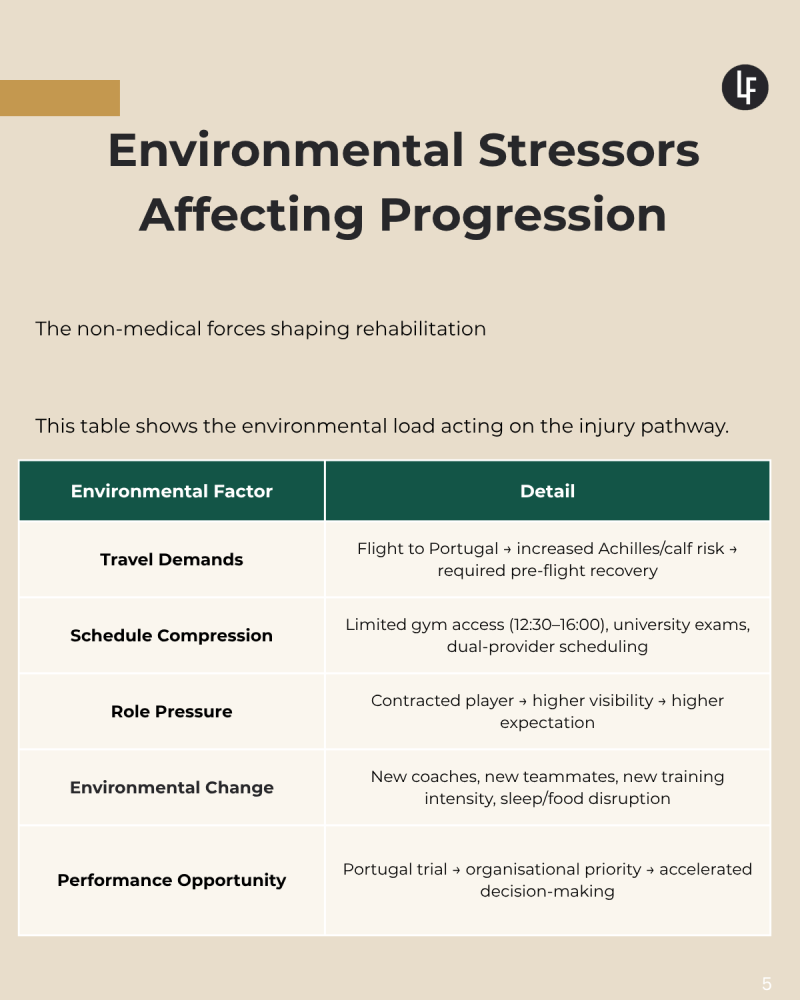
The athlete was not recovering in isolation. At the same time, he was preparing for a Portugal trial opportunity, balancing university examination commitments, operating within restricted facility-access windows, and progressing inside a wider environment managing multiple injured athletes simultaneously.
Environmental factors further complicated the pathway.
The playing surface used during the period was described internally as “very poor” and “very hard on the legs,” creating additional mechanical loading considerations for the Achilles–calf complex. Gym access was restricted to limited daily windows, while athlete availability was frequently shaped by academic schedules and operational demands.
As rehabilitation progressed, communication intensified across the environment. Internal physiotherapy team, coaches, technical leadership, Expert Physio, and the athlete himself exchanged regular updates regarding symptoms, treatment response, training exposure, scheduling constraints, and readiness status. Decisions were made continuously rather than episodically.
By 2 December 2025, symptom response and functional testing indicated that the athlete was tolerating progressive loading without aggravation, allowing a staged return to training and preserving availability for the forthcoming Portugal trial opportunity.
“The athlete will attend testing with the coach to determine whether he can complete the training session without any issues.”
Later that day, the first pain-free functional update was reported:
“His response was that there was no pain or anything bothering him.”
This marked a significant progression point within the pathway. The athlete subsequently returned to full training and remained available for the Portugal trial opportunity.
Viewed clinically, the case demonstrates a successful rehabilitation outcome involving symptom resolution, progressive loading, and return to performance activity. Viewed structurally, however, the case reveals something more important: recovery occurred inside an environment characterised by compressed timelines, overlapping decision-makers, hybrid provider involvement, environmental constraints, and competing operational priorities. The injury therefore becomes more than a clinical event. It becomes a lens through which the interaction between rehabilitation, governance, communication, and system design can be examined.
Before examining the athlete pathway itself, it is necessary to understand the type of system within which the rehabilitation process was unfolding. The case should not be viewed simply as an injury narrative, but as an illustration of how recovery, performance delivery, and system development interact within an emerging performance environment.
System Adaptation
What Kind of System Was This Athlete Operating Inside?
Across Saudi Arabia and wider MENA, many performance environments are currently operating within this phase of simultaneous development. Investment in participation, athlete pathways, sports medicine services, academies, federations, and performance infrastructure has accelerated significantly. As a result, organisations are often required to deliver performance outcomes while simultaneously developing the governance, workforce, and integration mechanisms required to sustain those outcomes over the longer term. Understanding how systems behave during this phase of development is therefore becoming increasingly important for the region.
This athlete was operating inside an emerging performance environment characterised by simultaneous system development across governance, workforce capability, performance delivery, and medical support.
Within this environment, rehabilitation did not occur inside a fully protected medical pathway. Instead, recovery was shaped by overlapping operational demands, evolving decision structures, real-time communication, and multiple stakeholders contributing to the athlete pathway.
More specifically, the athlete was operating within a compressed rehabilitation system. Rehabilitation progression occurred alongside competition demands, travel timelines, training requirements, academic commitments, and availability considerations, creating a constant interaction between medical pacing and operational readiness.
The case also demonstrates how emerging performance environments frequently use hybrid delivery models, integrating internal team members, external providers, and operational stakeholders to support athlete progression. Rather than functioning through a single linear pathway, rehabilitation became a coordinated (integrated) process requiring continuous adaptation, information sharing, and decision-making across multiple layers of the environment.
As a result, recovery was not governed solely by biological healing timelines. It was influenced by the wider system surrounding the athlete, where rehabilitation, coaching, travel, scheduling, and performance decisions were unfolding simultaneously in real time.
Environmental Stressors Affecting Progression
External Medical Provider Integration
A defining feature of this rehabilitation pathway was the integration of an external medical provider into the athlete’s care. Expert Physio, the club’s medical partner, delivered specialist assessment, targeted manual therapy, shockwave treatment, electrotherapy, and extended clinical availability during periods when access to club facilities was limited.
This created a dual‑provider model in which private clinical treatment and club‑based rehabilitation had to be coordinated almost daily.
The external provider did not replace the internal medical structure; it operated alongside it, forming a hybrid rehabilitation environment that required continuous coordination between the team physiotherapist, Expert Physio, coaches, technical leadership, and the performance team.
Successful integration required more than exchanging medical notes. Medical information had to be translated across two environments, interventions had to be sequenced alongside gym loading and field exposure, and external modalities had to be incorporated without disrupting the athlete’s progression timeline.
A key factor was the working relationship between the Performance Director and senior clinicians at Expert Physio. One senior physiotherapist, with more than twenty years of experience in Jordanian national teams, became a trusted point of contact. His knowledge of the athletes, understanding of the local sporting environment, and ability to communicate rapidly across organisational boundaries ensured continuity of care.
The inclusion of massage highlighted an important cultural and clinical consideration. In this environment, massage is not typically applied to an irritated Achilles tendon. A previous case involving a female professional athlete had shown that direct tendon massage increased irritation and required a full reset of the rehabilitation plan. This experience reinforced the need for caution and confirmed that controlled loading, not soft‑tissue compression, would form the foundation of early rehabilitation.
Instructions were issued to the team physiotherapist that strength work must precede further device‑based treatment, reinforcing the principle that tissue loading would remain central to the process.
The pathway also revealed differences in clinical philosophy across providers.
Some interventions emphasised symptom reduction through passive modalities, while the rehabilitation strategy prioritised controlled tendon loading and exposure management. These differences were not problematic; they are normal in hybrid systems. But they required translation, flexibility and alignment. This is where the middle layer becomes more than a coordinator. It becomes the integrator of differing professional perspectives, ensuring the athlete experiences a coherent pathway even when the system itself is distributed across multiple organisations and treatment cultures.
This relationship enabled a level of responsiveness that would have been difficult to achieve inside a compressed timeline.
Clinical reports, videos, voice notes, treatment updates, and athlete feedback were exchanged in real time, allowing decisions to evolve quickly as the athlete progressed. Athletes were frequently accommodated within tight timeframes, reducing delays between assessment, treatment, monitoring, and progression.
In mature performance systems, provider integration is often formalised. In emerging Saudi MENA environments, it is frequently dependent on communication, relationship management, and middle‑layer decision‑making.
As investment increases across academies, federations, sports medicine services, and athlete pathways, athletes are moving through more environments. Integration is therefore becoming less of a medical issue and more of a system‑design challenge. The question is no longer whether expertise exists, but how expertise is connected.
As the athlete moved between environments, information needed to move with him.
External treatment had to be understood within the context of training demands, while internal observations needed to inform subsequent clinical interventions. Manual therapy, shockwave treatment, electrotherapy, gym loading, and field progression all required careful sequencing so that each element supported the next stage of rehabilitation.
This type of coordination is rarely automatic. Internal and external providers operate within different environments, with different schedules, priorities, and visibility of the athlete’s daily experience. Communication is distributed across WhatsApp messages, phone calls, voice notes, and informal conversations. Without active coordination, hybrid systems can drift toward duplicated treatment, conflicting advice, inconsistent readiness definitions, and disrupted progression.
The significance of provider integration therefore extends beyond clinical care. It becomes a structural function within the wider performance environment.
In emerging systems, where services are distributed across multiple organisations and locations, integration is the mechanism that transforms independent providers into a coherent rehabilitation pathway.
This case shows that hybrid medical systems can deliver high‑quality outcomes.
But those outcomes depend less on the number of providers and more on the quality of coordination between them. The middle layer plays a critical role in this process, connecting people, sequencing interventions, translating information, and maintaining continuity as the athlete moves through different parts of the system. Without that integration function, the pathway becomes disconnected. With it, the system can operate as a single, coordinated environment despite being delivered across multiple settings.
Coordination is the middle layer’s core operational function.
It keeps the rehabilitation pathway moving when multiple providers, schedules, and timelines are acting on the athlete simultaneously. It involves aligning the work of the internal physiotherapist, Expert Physio, coaches, and the Technical Director while ensuring that each stakeholder understands what has occurred, what is planned next, and what the athlete can do on any given day.
Coordination extends beyond information sharing. It requires sequencing treatment interventions, gym loading, field exposure, recovery strategies, and training participation so that each component supports rather than conflicts with the others. It also requires translating medical information into operational decisions that coaches and technical team can act upon, while preventing duplication, contradiction, or gaps between internal and external providers.
In this context, coordination is not administrative. It is a system‑stabilising function that maintains continuity when the environment is not integrated.
This is particularly important in hybrid systems where private providers operate alongside club structures. Information is distributed across multiple environments, decisions are made by different individuals at different times, communication occurs through informal channels, and scheduling is constrained by facility access, academic commitments, travel requirements, and provider availability.
Without effective coordination, hybrid systems can drift toward fragmented care, inconsistent messaging, reactive decision‑making, increased injury risk, and operational confusion. The athlete may receive high‑quality support from multiple individuals, but without integration those contributions do not automatically form a coherent pathway.
This is why coordination becomes one of the defining behaviours of the middle layer within emerging Saudi MENA performance environments.
It transforms a fragmented provider landscape into a continuous and workable athlete pathway, maintaining progression despite competing demands, compressed timelines, and evolving organisational structures.
Saudi Arabia - The Early Signals Were Already There
Looking back, the 2016 correspondence surrounding an Olympic athlete’s injury reads less like a medical case but the early signal of a performance system still constructing itself. At the time, the discussion appeared routine: heel pain, suspected stress fracture, DEXA results, vitamin D deficiency, training modification, medical referrals, and the coordination of appointments across providers. The clinical details are not the most significant aspect. What matters is the environment surrounding the athlete.
That Was Then. This Is Still Now.
Long before Saudi sport possessed the scale of infrastructure, workforce capability, specialist services, and governance structures now emerging across the Kingdom, many of the system behaviours visible today were already present. The case reveals an environment attempting to deliver performance outcomes while simultaneously building the structures required to support them.
The challenge was never just the injury. The challenge was coordinating expertise across a system that was still taking shape.
Several characteristics were already visible.
Expertise was distributed across coaches, medical practitioners, hospitals, insurers, federation team, and the athlete. Medical provision operated through a hybrid ecosystem of federation support, private healthcare, external diagnostics, and specialist consultation. Operational realities such as travel, relocation, facility access, training camps, and scheduling constraints continually influenced decision‑making. Communication acted as the connective mechanism linking functions and organisations that otherwise operated separately. The performance function became one of integration, translation, and coordination rather than isolated technical delivery.
None of these features emerged from deliberate design. They emerged because the environment required them.
During this period, Saudi sport was entering an early phase of transformation. Women’s sport was developing new pathways, federations were developing, and performance services were being assembled across multiple domains at once. Capability development, governance evolution, infrastructure growth, and athlete support systems were advancing together rather than sequentially.
In that context, communication was not just an operational tool. Communication was infrastructure. What makes this particularly relevant is that the same underlying system behaviour appears almost a decade later in a completely different environment.
The sport, the country, and the stakeholders all shifted, but the underlying pattern stayed the same.
In both cases, a developing performance environment required multiple providers to contribute information, expertise remained distributed across organisational boundaries, operational timelines exerted pressure on medical processes, and continuity depended on individuals capable of integrating fragmented inputs into a coherent athlete pathway.
In both cases, a developing performance environment required multiple providers to contribute information, expertise remained distributed across organisational boundaries, operational timelines exerted pressure on medical processes, and continuity depended on individuals capable of integrating fragmented inputs into a coherent athlete pathway.
The Jordan football case is therefore not an isolated example. It is a contemporary expression of a pattern that has appeared repeatedly across Saudi and wider MENA performance environments during periods of system growth.
This is why the concept of the middle layer becomes increasingly important.
As Saudi Arabia continues expanding participation programmes, academies, federations, sports medicine services, talent pathways, and performance structures, athletes will move through increasingly complex ecosystems. Their development journeys will span schools, clubs, private providers, national programmes, specialist clinics, universities, and international environments.
The strategic challenge is no longer creating expertise. It is creating the systems that allow expertise to function coherently across multiple environments that allow expertise to function coherently across multiple environments.
The strategic challenge is no longer creating expertise. It is creating the systems that allow expertise to function coherently across multiple environments that allow expertise to function coherently across multiple environments.
One 2016 case reveals an early version of this reality. The Jordan case reveals a more mature version.
The next phase of Saudi sport development will depend on whether coordination remains dependent on individual communication and informal integration, or becomes embedded within governance structures, operational and system design.
Viewed through this lens, the most important lesson is not medical. It is systemic.
The early signals were already there. The same systemic behaviours visible in 2016 are still present now.
These are not isolated historical events; they are recurring patterns within the system. The idea that “that was then and this is now” does not hold, because the underlying dynamics have not changed. They are simply expressing themselves again in the current environment.
Part 3 - Implications for Saudi‑MENA System Design
Rehabilitation in this case was not driven by a single decision owner. It depended on coordination across training, supervision, information flow, and readiness interpretation, with multiple people contributing constraints and judgments into one shared environment. This is what emerging performance systems look like: decisions are assembled, not made in isolation.
The return to competition was therefore not a linear rehabilitation pathway. It was the outcome of a multi‑layered system responding to pressure in real time, where rehabilitation functioned as an organisational process shaped by communication, coordination, environmental constraints, and operational urgency.
This case shows how medical timelines, operational demands, environmental pressures, and communication structures interact inside emerging Saudi‑MENA performance environments. The implications for system design are clear.
Timeline Governance
Timeline governance defines how medical and operational timelines are aligned when pressure rises. In this case, the gap between injury, rehabilitation, return to training, and international travel created constant structural pressure. Medical pacing followed symptom response, tendon and muscle loading, and progression criteria. Operational pacing followed training schedules, testing demands, and travel commitments.
Strong timeline governance clarifies when progression can accelerate and when medical pacing must remain protected. It creates shared readiness definitions and reduces the risk of administrative urgency overruling rehabilitation logic. Without it, systems become reactive and operational deadlines begin to drive medical decisions.
Decision Ownership
Decision ownership defines who has authority at each stage of the pathway. Here, medical progression sat mainly with physiotherapy, training exposure sat with performance coaching, operational scheduling sat with technical leadership, and external treatment input came from the private provider.
This distribution is common in emerging environments, but without clear boundaries it creates fragmentation. Strong ownership structures clarify medical clearance, training exposure, progression pacing, and operational readiness while reducing unnecessary negotiation across the system.
Communication
Communication describes how information actually moved through the environment, not how it was formally designed to move. In this case, information flowed through WhatsApp, voice notes, direct coach feedback, informal updates, Google Drive documents, coach app, and real‑time exchanges between providers. This created fast, flexible communication systems that allowed decisions to be made quickly, training exposure to be adjusted immediately, and the rehabilitation pathway to keep moving despite environmental pressure.
Communication is infrastructure. As systems mature, structured communication pathways become essential. Clear reporting processes, consistent readiness language, and defined channels reduce ambiguity when several stakeholders contribute to one athlete pathway.
Hybrid Provider Integration
The case highlights the importance of integrating internal and external providers. Expert Physio collaborated with the club medical structure, adding specialist assessment, manual therapy, shockwave treatment, electrotherapy, and additional clinical capacity. This created a dual‑provider model that required constant alignment.
Hybrid systems can be valuable, especially when internal capacity is still developing. But they only work when progression criteria are shared, communication is aligned, schedules are coordinated, and treatment goals are consistent. Without that, the athlete experiences disconnection rather than one coherent pathway.
Environmental Load Management
Recognises that non‑medical factors are real performance loads. In this case, travel demands, academic commitments, limited facility access, scheduling pressure, team dynamics, and the opportunity timeline all shaped recovery and decision‑making.
Effective environmental load management means identifying these pressures early and building them into planning. If they are ignored, compression builds and recovery margins shrink. If they are managed proactively, the system becomes more resilient and progression becomes more sustainable.
Operational Planning Structures
Define how training, recovery, scheduling, and progression are organised. Here, planning was shaped by external deadlines, facility windows, academic schedules, and provider availability, all of which influenced exposure, treatment timing, and progression opportunities.
As performance environments mature, operational planning should support medical processes rather than compete with them. That means aligning training with rehabilitation, protecting facility access for progression, and creating buffers that keep medical timelines intact during pressure periods.
Middle Layer Analysis
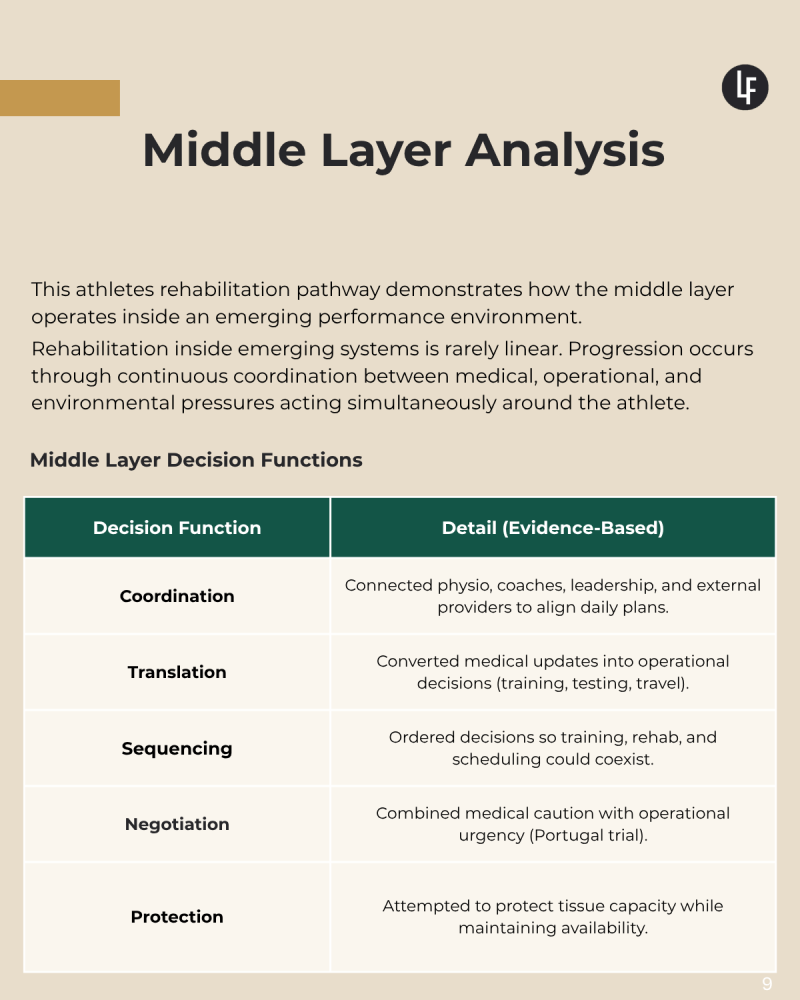
The middle layer became the space that carried the operational tension between medical timelines and performance demands. It was not a single person or a formal role; it was the functional zone where coordination, translation, sequencing, negotiation, and protection occurred simultaneously. As internal physiotherapy, external providers, coaches, and technical leadership all contributed information at different speeds and through different channels, the middle layer integrated these inputs and shaped them into a daily plan.
This layer translated clinical updates into operational decisions, ensuring that symptom irritability, loading tolerance, and tendon response were respected while still meeting the system’s requirement to keep the athlete available for testing, training, and potential selection. It sequenced treatment, gym loading, and field exposure so that each element supported the next rather than competing with it. It negotiated between medical caution and operational urgency, balancing biological recovery with compressed timelines driven by facility access, academic schedules, and the Portugal trial opportunity.
Most importantly, the middle layer protected progression. It ensured the athlete continued to move forward even when the environment was disconnected, when information arrived informally, and when operational pressure risked accelerating decisions beyond what the tendon could tolerate. In emerging Saudi MENA systems, this stabilising function is not optional. It is the mechanism that prevents division and maintains continuity when the system itself is still developing.
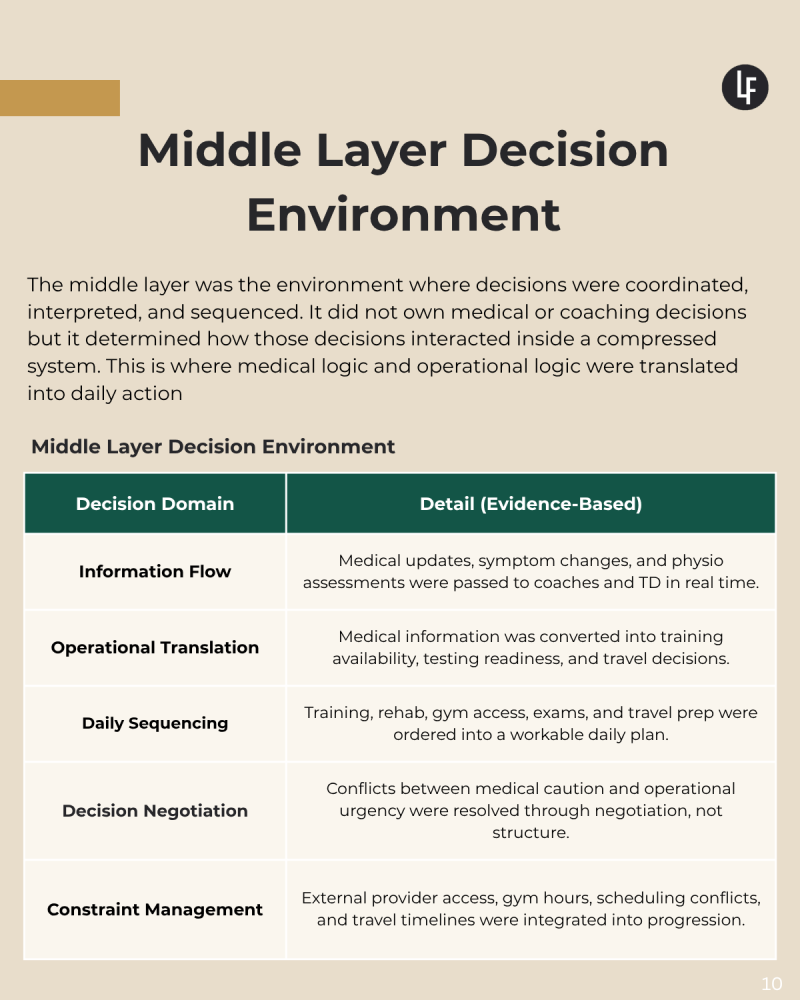
Middle Layer Decision Environment
Middle Layer Decision Environment
The decision environment is the space where medical logic, operational demands, environmental constraints, and provider inputs interacted in real time. It is not defined by people or titles, but by the structure through which decisions moved. In this case, information flowed continuously through WhatsApp messages, voice notes, direct coach feedback, and rapid updates from internal and external providers. These channels formed a distributed communication network that allowed decisions to be made quickly, but also required active interpretation to prevent the pathway from becoming disjointed.
Within this environment, prioritisation became a structural behaviour. Facility access windows, university examinations, provider availability, and travel timelines all exerted pressure on the pathway. The middle layer interpreted these constraints and sequenced decisions so that treatment, loading, and training exposure aligned. This was not a linear process. Decisions were made, adjusted, and remade in real time as new information emerged.
Operational translation was central to this structure. Clinical observations from the external provider needed to be converted into training decisions that coaches could act upon. Similarly, feedback from training needed to be translated back into clinical adjustments. Without this translation function, the athlete would have experienced the system as disconnected. With it, the environment operated as a single pathway despite being delivered across multiple providers, schedules, and organisational layers.
This decision environment demonstrates a core truth about emerging performance systems: governance is not only formal. It is enacted through the structure that connects information, constraints, and decisions. In this case, the middle layer decision environment was the mechanism that allowed the system to function under pressure, maintaining integration even when the environment itself was unstable.
Middle Layer Governance
The middle layer, the space between medical assessment and operational demand, is where continuity is maintained. It is not a department or a job title; it is the structural function that holds the system together when the environment is unintegrated, fast moving, or under pressure. In this case, the middle layer translated clinical information into operational decisions, aligned internal and external providers, managed scheduling constraints, and ensured that the athlete’s progression remained coherent despite competing demands.
In emerging Saudi MENA environments, this governance function becomes even more significant. Systems are often still developing their infrastructure, formal processes, and organisational clarity. As a result, the middle layer compensates for structural gaps by diffusing pressure, reducing disconnection, and stabilising the pathway when multiple providers, timelines, and decision makers are acting simultaneously. It is the mechanism that prevents the environment from drifting into reactive decision making or inconsistent messaging.
Middle layer governance is therefore not just about coordination. It is about creating the conditions in which medical logic and operational logic can coexist without compromising athlete health or system integrity. It ensures that decisions made in one part of the environment are understood, sequenced, and acted upon in another. It protects progression while maintaining availability, and it holds the system together when formal structures are still evolving.
Building and strengthening middle layer governance is essential for building resilient performance systems across Saudi Arabia and the wider MENA region. As investment increases and athletes move through more complex pathways, the ability to integrate information, manage constraints, and maintain continuity becomes a core capability. Governance in this context is not abstract; it is the practical structures that enables a disconnected environment to operate as a single, integrated coherent system.
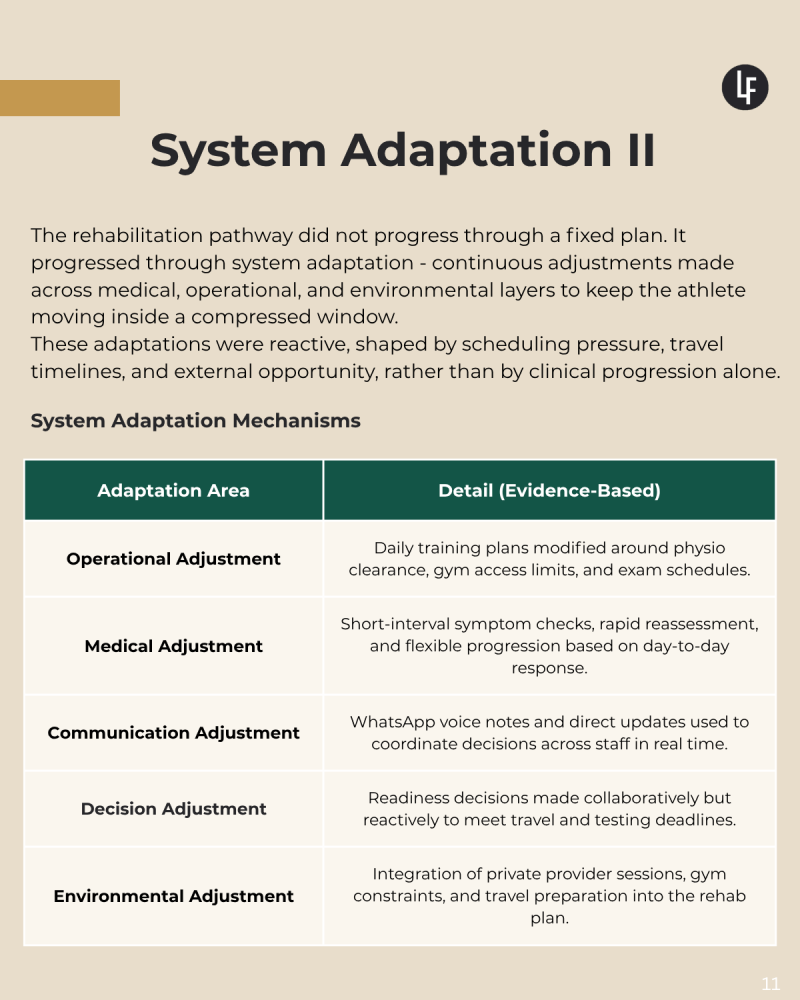
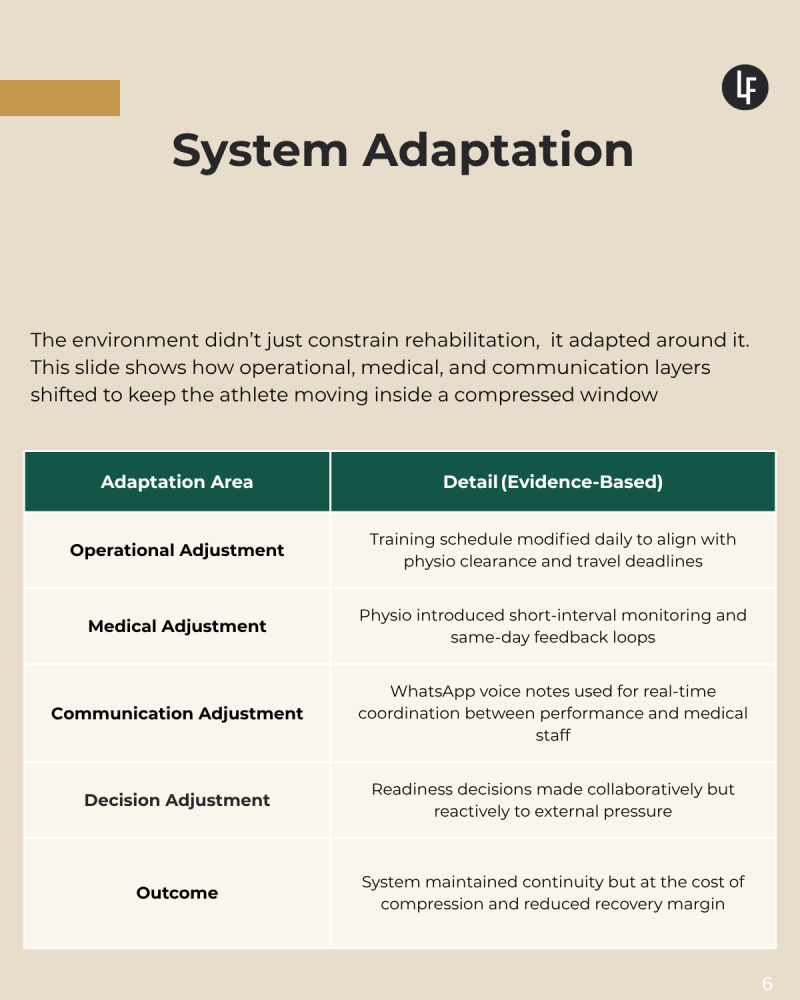
System Adaptation II
System Adaptation II
The rehabilitation pathway did not progress through a fixed plan. It evolved through system adaptation, continuous adjustments across medical, operational, and environmental layers to keep the athlete moving inside a compressed window. These adaptations were reactive, shaped by scheduling pressure, travel timelines, and external opportunity rather than by clinical progression alone.
Operational adjustments modified daily training plans around physiotherapy clearance, gym access limits, and university exam schedules. Medical adjustments involved short‑interval symptom checks, rapid reassessment, and flexible progression based on day‑to‑day response. Communication adjustments relied on WhatsApp voice notes and direct updates to coordinate decisions in real time. Decision adjustments were made collaboratively but reactively to meet travel and testing deadlines. Environmental adjustments integrated private provider sessions, gym constraints, and travel preparation into the rehabilitation plan.
Together, these mechanisms show how emerging systems adapt under pressure. They reveal that progression in such environments is not linear; it is negotiated daily through coordination, translation, and responsiveness.
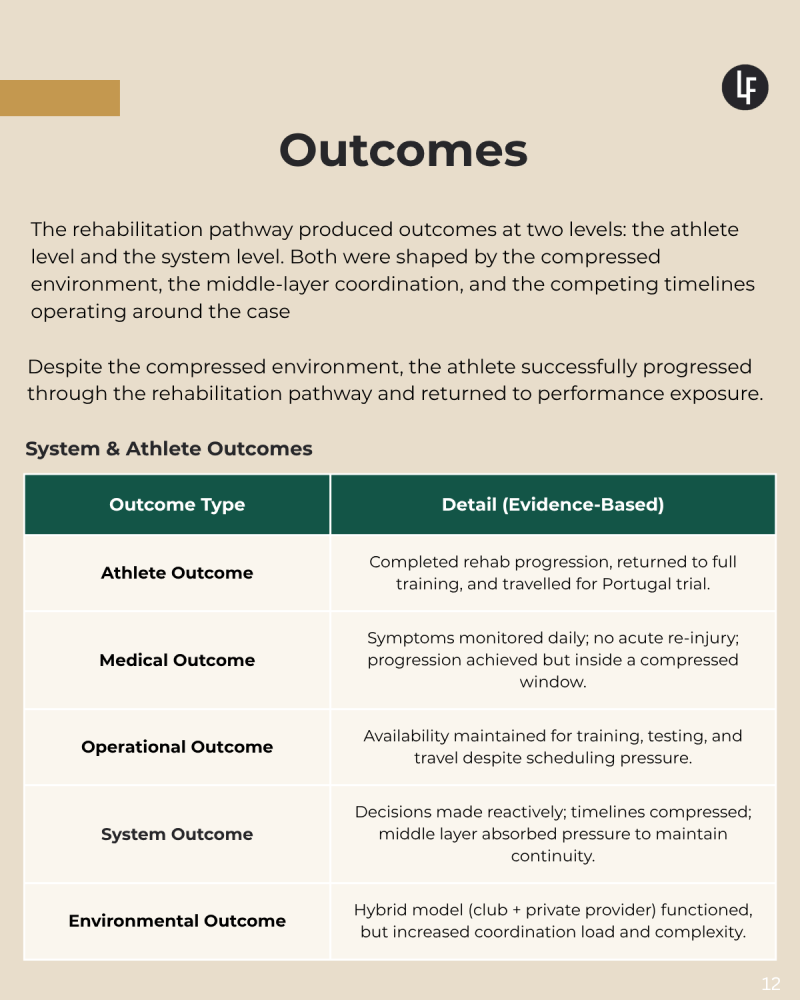
Outcomes
Outcomes
The rehabilitation pathway produced outcomes at two levels: the athlete level and the system level. Both were shaped by the compressed environment, the middle‑layer coordination, and the competing timelines operating around the case. Despite the pressure, the athlete progressed through the pathway and returned to performance exposure.
At the athlete level, rehabilitation was completed, full training resumed, and travel for the Portugal trial was achieved. Medically, symptoms were monitored daily, no acute re‑injury occurred, and progression was achieved within a compressed window. Operationally, availability was maintained for training, testing, and travel despite scheduling pressure. Systemically, decisions were made reactively, timelines compressed, and the middle layer diffused pressure to maintain continuity. Environmentally, the hybrid model of club and private provider functioned, though at the cost of increased coordination load and complexity.
These outcomes show that success in emerging systems depends less on structural full maturity and more on the system’s ability to coordinate, adapt, and maintain continuity under pressure.
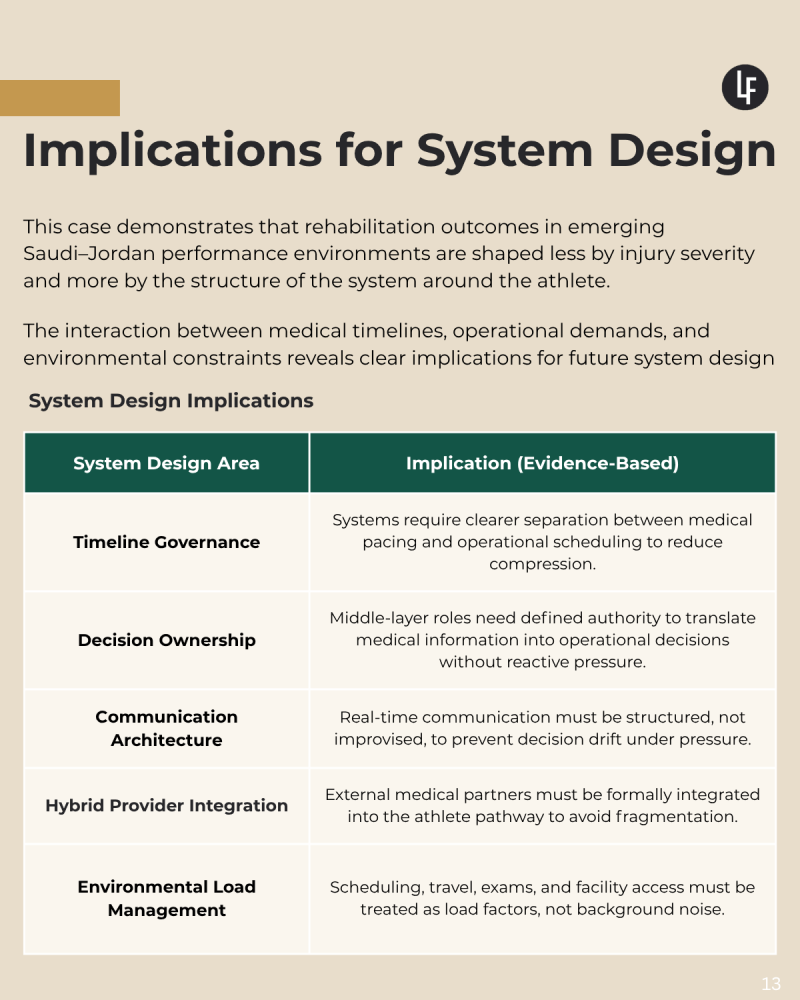
Implications for System Design
This case demonstrates that rehabilitation outcomes in emerging Saudi‑Jordan performance environments are shaped less by injury severity and more by the structure of the system surrounding the athlete. The interaction between medical timelines, operational demands, and environmental constraints reveals clear implications for future system design.
Systems require clearer separation between medical pacing and operational scheduling to reduce compression. Middle‑layer roles need defined authority to translate medical information into operational decisions without reactive pressure.
External medical partners must be formally integrated into the athlete pathway to avoid disconnection.
Scheduling, travel, exams, and facility access must be treated as load factors, not secondary noise.
Together, these implications point toward a governance‑driven model of system design, one that recognises that performance environments succeed not by eliminating complexity, but by learning to organise it.
Closing
Sustainable performance environments are defined by how well they organise complexity when pressure increases. In emerging Saudi MENA systems, success depends less on eliminating constraints and more on building structures that can coordinate information, decisions, and maintain continuity even when timelines compress.
This case showed that progression was protected not by optimal conditions, but by the system’s ability to translate information, stabilise decision flow, and hold medical and operational timelines together.
Sustainable environments require communication that functions as infrastructure, provider pathways that operate as one system, and middle‑layer capability that manages pressure without losing combinations of integration.
The environments that will endure are those that learn to organise complexity, not avoid it.
This is the foundation of culturally intelligent, governance‑aligned performance system design.